| Charlse VP maketi MBA ile maketi numera |
TL; AMA: Manual LinkedIn prospecting costs sales reps 2–3 hours per day — time that directly competes with discovery calls, demos, and closing. LinkedIn outreach automation handles connection requests, follow-up sequences, profile views, and contact exports systematically, freeing reps to focus on conversations that convert. According to McKinsey & Company, sales reps spend less than 30% of their time actually selling; automation is one of the most direct levers available to reclaim that time.
-
Why Manual LinkedIn Outreach Doesn’t Scale (And What It’s Costing Your Team)
Manual LinkedIn prospecting is a revenue problem disguised as a workflow problem. When each rep spends 2–3 hours daily sending connection requests, following up on cold messages, and manually viewing profiles, that’s 10–15 hours per rep per week — hours that could go toward discovery calls, demos, and deals.
For a team of five reps, you’re losing 50–75 hours of selling time every single week.
The Hidden Time Tax on Your Sales Team
The time cost is only part of the problem. What doesn’t show up in any CRM report is the cognitive load: reps context-switching between LinkedIn, their inbox, and a spreadsheet of who they’ve already contacted. That friction compounds. Reps lose track of follow-ups, let warm prospects go cold, and repeat outreach to the same people — sometimes in the same week.
Ae faimai foi McKinsey & Kamupani, sales reps spend less than 30% of their time actually selling. Manual prospecting is one of the biggest reasons why. The rest is admin, search, and repetitive manual tasks that automation can absorb entirely.
Inconsistency Kills Conversion: Why Rep-by-Rep Variation Matters
Here’s a scenario every sales manager recognizes: your best rep has a 40% connection acceptance rate. Your newest rep sits at 12%. The difference isn’t just talent — it’s message quality, timing, and follow-up discipline. Without a standardized system, every rep is running a different experiment with no shared data.
That inconsistency isn’t just a performance management headache. It means your team is generating wildly different results from the same LinkedIn audience — and you have no clear picture of why. You can’t coach what you can’t see, and you can’t scale what you can’t replicate.
-
What Does LinkedIn Outreach Automation Actually Mean?
LinkedIn outreach automation is the use of software to execute repeatable prospecting actions — connection requests, message sequences, profile views, and contact exports — on a scheduled, rule-based cadence. It does not mean blasting identical messages to thousands of strangers and hoping something sticks.
The distinction matters, because the wrong mental model leads teams to either avoid automation entirely (out of fear) or use it recklessly (and get accounts restricted). For a deeper comparison of how automation tools differ in practice, see this Taiala meafaigaluega otometi a le LinkedIn mo 'au fa'atau.
Automatable Actions vs. What Still Needs a Human Touch
Some LinkedIn actions are perfectly suited for automation. Others need genuine human judgment.
| Action | Automatable? | Notes |
|—|—|—|
| Connection requests with short notes | ✅ Yes | Use segment-specific templates with personalized variables |
| Initial follow-up message | ✅ Yes | Triggered after acceptance, timed 24–48 hours later |
| Profile views | ✅ Yes | Signals interest; often prompts the prospect to view back |
| Contact/lead export | ✅ Yes | Pull from searches, groups, event attendees |
| Responding to replies | ❌ No | Conversations require human judgment |
| Strategic commenting on posts | ⚠️ Partially | AI can draft; human should review before posting |
| Relationship-stage outreach | ❌ No | Warm follow-up after a meeting needs authenticity |
The goal is to automate the volume work so your reps can focus exclusively on the human work — responding to replies, running discovery calls, and closing.
AI-Powered Personalization: Scaling Outreach Without Losing Relevance
The biggest fear teams have about automation is sounding robotic. That fear is valid — but it’s a tool selection problem, not an automation problem.
Modern automation platforms use generative AI to craft connection notes and follow-up messages that reflect the prospect’s industry, role, and recent activity. This isn’t mail-merge with a first name. It’s contextual messaging that reads like it came from someone who actually looked at the profile. The output feels human because the AI is drawing from real prospect signals — not just filling in blanks.
When this works well, acceptance rates go up. Prospects respond to relevance, not volume.
-
How Do You Run LinkedIn Campaigns Across a Whole Sales Team Without Chaos?
Coordinating LinkedIn outreach across multiple reps is the hardest operational problem sales managers face. Without a central system, you get duplicated outreach (two reps messaging the same prospect in the same week), inconsistent messaging, and no shared visibility into who’s doing what.
The answer isn’t asking reps to update a shared spreadsheet. It’s giving the whole team a single platform where every account, campaign, and contact lives together. If you’re still evaluating your options, this LinkedIn lead generation software buyer’s guide covers what to look for before committing to a platform.
Centralizing Multi-Rep Outreach Under One Dashboard
When every rep’s LinkedIn account is connected to one platform, you get full visibility as a manager. You can see which campaigns are running, which prospects are in which stage, and which reps are hitting their daily outreach targets — without asking anyone for an update.
This also enables consistency. Rather than each rep writing their own connection notes from scratch, your team runs from centrally managed campaign templates. You set the messaging once. The platform handles execution across every account. Your brand voice stays consistent whether the message comes from your most senior AE or the rep who started last month.
Avoiding Overlap and Protecting Sender Reputation at Scale
Prospect overlap is a real risk at scale. When two reps independently target the same person, it signals disorganization — and it damages trust with the very people you’re trying to impress.
A platform with profile visitor filtering and interaction tracking solves this structurally. The system knows which prospects have already been contacted across any account on the team, and blocks duplicate outreach automatically. No spreadsheet reconciliation. No awkward “sorry, my colleague just reached out too” follow-ups.
Sender reputation protection matters here too. Sending volume should be distributed intelligently across accounts — not concentrated on one rep’s profile until LinkedIn flags it. Smart campaign management does this automatically, which is why choosing the right platform matters more than most teams realize.
-
Building an Automated LinkedIn Outreach Sequence That Actually Converts
A high-converting automated LinkedIn sequence has four distinct touches, each with a specific job to do.
Touch 1 — Connection request with a short personalized note. Keep it under 300 characters. Reference something specific: their role, a shared group, or a relevant challenge in their industry. Don’t pitch. The goal is acceptance, not a sale. Touch 2 — Value-first follow-up message (24–48 hours after acceptance). Open with something useful — a relevant stat, a short insight, or a specific question about their situation. This is not the moment for a product demo request. One or two sentences of value. One soft question to open dialogue. Touch 3 — Engagement touchpoint (Day 5–7). Like or comment on a recent post the prospect made. This is the touch most teams skip — and it’s often the one that converts. A thoughtful comment on someone’s post is visible to their entire network and signals genuine interest. For guidance on writing comments that feel human rather than automated, see these Fa'amatalaga a le AI LinkedIn e manumalo ai i fefa'ataua'iga. Touch 4 — Soft CTA message (Day 10–14). This is where you make a low-friction ask: a 15-minute call, a relevant resource, or a specific question tied to their role. Not “Can I show you our product?” but “Would it be worth a quick chat about how you’re currently handling [specific problem]?”Timing matters as much as content. Space touches 2–4 days apart minimum. Sequences that fire every 24 hours read as automated even when the copy is good. Prospects notice cadence.
Build separate sequences for different audience segments — by industry, seniority level, or deal stage. A sequence targeting VP-level buyers in SaaS should sound different from one targeting operations managers in manufacturing. The more specific the sequence, the higher the conversion rate.
Set these sequences up once and let the platform run them consistently across every rep. That’s where automation shifts from a time-saver to a revenue multiplier.
-
How Do You Measure Whether Your LinkedIn Automation Is Working?
Four metrics tell you whether your LinkedIn automation is working — and each one points to a different lever you can pull.
| Metric | What It Tells You | Healthy Benchmark |
|—|—|—|
| Connection acceptance rate | Message relevance + targeting quality | 30–50% |
| Reply rate (post-connection) | Follow-up message quality | 10–25% |
| Conversation-to-meeting rate | Qualification and CTA effectiveness | 15–30% of replies |
| Lead export volume | Reach and prospecting coverage | Track weekly per rep |
If your acceptance rate is low, the targeting or the connection note needs work. If acceptance is high but reply rate is low, the follow-up sequence isn’t delivering enough value. If replies are coming in but meetings aren’t, the CTA is off — either too aggressive or too vague.
These numbers exist to coach reps, not just report on them. When you can see that one rep has a 45% acceptance rate and another has 18%, you have a coaching conversation backed by data — not a gut feeling.
Tracking gets harder when reps are running outreach across LinkedIn and other channels simultaneously. The teams with the clearest picture are the ones consolidating contact data across sources — LinkedIn searches, group members, event attendees — into one place. When you can see every touchpoint in a single view, pipeline attribution stops being guesswork.
Export the contact data regularly. Build a rhythm: weekly exports, weekly pipeline reviews, monthly sequence optimization. The teams that treat this as a system — rather than a one-time setup — are the ones that compound results over time.
-
Staying Safe: LinkedIn Automation Limits, Risks, and How to Stay Compliant
LinkedIn actively monitors for automation behavior, and accounts that violate its terms of service face restrictions ranging from temporary action blocks to permanent bans. This risk is real — and it’s the reason poorly built or unguarded automation tools are genuinely dangerous to use.
Account restrictions don’t just interrupt one rep’s outreach. They can take a key account offline for weeks, wipe a carefully built prospect list, and damage the LinkedIn credibility your rep has spent months building.
Understanding LinkedIn’s Limits and Why They Exist
LinkedIn sets daily limits on connection requests to protect the user experience and prevent spam. The specific thresholds vary and have tightened in recent years — but the principle is consistent: accounts that send too many invites too fast, or that receive high rates of “I don’t know this person” responses, get flagged.
The practical implication: automation volume must be distributed intelligently. A single account sending 100+ connection requests per day is a risk. The same volume spread across 10 accounts, each operating within LinkedIn’s individual thresholds, is manageable — and can produce 1,000+ invites daily at the team level while keeping each individual account safe.
What Safety Features to Look for in Any Automation Tool
Before adopting any LinkedIn automation platform, evaluate it against these non-negotiables:
- Daily send limits per account — Does the platform cap daily activity at safe levels automatically, or does it let you set volumes that violate LinkedIn’s thresholds?
- Human-like sending patterns — Does it randomize timing between actions, or fire them in robotic bursts that LinkedIn’s detection systems will flag?
- Account health monitoring — Does the platform alert you when an account is showing signs of restriction risk?
- Compliance with LinkedIn’s terms — Does the vendor publish clear guidance on how their tool stays within platform rules?
The right answer to each question is not “we leave that up to you.” A tool that gives you unlimited, unguarded sending volume isn’t a feature — it’s a liability. Safety constraints aren’t limitations on what automation can do. They’re what makes automation sustainable.
-
Fesili e Masani ona Fesiligia
Q: How many LinkedIn connection requests can I send per day without getting restricted?LinkedIn does not publish an official daily limit, but most practitioners recommend staying under 20–30 connection requests per day per individual account — especially for newer or less-established profiles. Accounts that send too many invites too quickly, or that receive a high rate of “I don’t know this person” responses, are flagged by LinkedIn’s detection systems. Teams needing higher volume should distribute activity across multiple accounts, each operating within safe individual thresholds.
Q: What is LinkedIn outreach automation?LinkedIn outreach automation is the use of software to execute repeatable prospecting actions — connection requests, follow-up message sequences, profile views, and contact exports — on a scheduled, rule-based cadence. It removes the manual effort of daily prospecting so sales reps can focus on high-value conversations. Done correctly, automation improves consistency and scales output without reducing the quality of individual touchpoints.
Q: Is LinkedIn automation against LinkedIn’s terms of service?LinkedIn’s terms prohibit scraping and certain aggressive third-party behaviors, but automation that operates within LinkedIn’s daily action limits and mimics natural human activity patterns is widely used by sales teams. The risk comes from tools that ignore rate limits or use burst-sending patterns that trigger LinkedIn’s detection systems. Choosing a platform with built-in daily limit enforcement and human-like activity timing significantly reduces account risk.
Q: What should a LinkedIn outreach sequence include to get replies?A high-converting LinkedIn outreach sequence typically includes four touches: a personalized connection request under 300 characters, a value-first follow-up message sent 24–48 hours after acceptance, an engagement touchpoint such as a thoughtful comment on the prospect’s post, and a soft CTA message requesting a low-friction next step. Spacing touches 2–4 days apart — rather than firing every 24 hours — prevents the sequence from reading as automated even when the copy is strong. Tailoring each sequence by audience segment consistently improves reply and meeting rates.
Q: What metrics should I track to measure LinkedIn automation performance?The four core metrics are connection acceptance rate (benchmark: 30–50%), reply rate post-connection (benchmark: 10–25%), conversation-to-meeting rate (benchmark: 15–30% of replies), and lead export volume tracked weekly per rep. A low acceptance rate signals a targeting or messaging problem; high acceptance with low replies points to a weak follow-up sequence; strong replies without meetings usually means the CTA is either too aggressive or too vague. Reviewing these weekly gives both pipeline visibility and data-backed coaching material for individual reps.
Q: How do you prevent two reps from messaging the same LinkedIn prospect?The most reliable solution is centralizing all rep outreach under a single platform that tracks which prospects have already been contacted across every account on the team. Platforms with profile visitor filtering and interaction tracking can block duplicate outreach automatically — no spreadsheet reconciliation required. Without a centralized system, prospect overlap is nearly inevitable at scale and signals disorganization to the very people you’re trying to convert.
Q: What is the difference between LinkedIn automation and LinkedIn spam?LinkedIn automation executes targeted, rule-based outreach to relevant prospects with personalized messaging and controlled sending volume. Spam is indiscriminate high-volume blasting of identical messages with no regard for relevance, timing, or recipient fit. The distinction matters operationally: automation done correctly improves acceptance rates because it delivers relevant messages at appropriate intervals, while spam-style approaches trigger LinkedIn restrictions and damage sender reputation permanently.
-
Ready to turn LinkedIn into a predictable pipeline engine for your whole team? Connector lets you link unlimited LinkedIn accounts, run intelligent campaigns with tailored messages and interaction tracking, and automate invites, profile views, and contact exports — all with built-in safety features that keep every account compliant. Try it FREE and see how easy it is to automate, coordinate, and scale outreach across every rep — without the risk.
Tusia ma Aso e TasiBlogADo — anotusi e maua
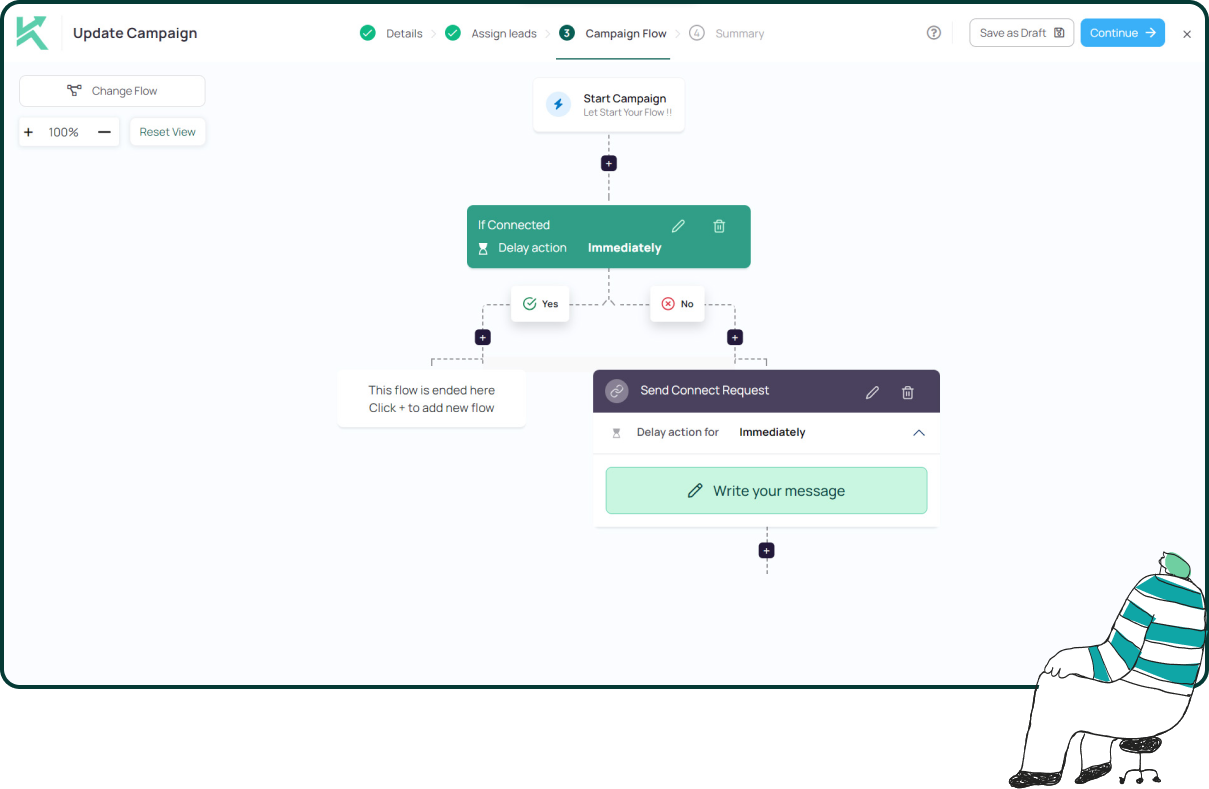
11x lau feso'ota'iga LinkedIn ma
Otometi ma Gen AI
Fa'aaoga le malosi ole LinkedIn Automation ma Gen AI e fa'ateleina lou aapa atu e pei lava o le taimi muamua. Auai le faitau afe o taʻitaʻi i vaiaso taʻitasi ma faʻamatalaga e faʻauluina AI ma faʻasalalauga faʻapitoa-uma uma mai le tasi taʻitaʻi-gen powerhouse platform.