| Charlesse Mutevedzeri weMutungamiriri weKushambadzira MBA mukushambadzira kwedhijitari |
TL; DR: Multiple LinkedIn accounts management is the practice of running outreach across two or more accounts from a single coordinated system — and it’s what separates scalable B2B pipeline from daily operational chaos. According to Statista, LinkedIn consistently ranks among the top channels for B2B lead generation globally, making structured multi-account management a genuine competitive advantage. The core challenge isn’t volume — it’s keeping every account within LinkedIn’s per-account activity limits while maintaining consistent messaging and centralized contact data across the team.
-
Multiple LinkedIn accounts management is the practice of running, coordinating, and monitoring LinkedIn outreach activity across two or more accounts from a centralized system. For teams of three or more — whether that’s an SDR team, a B2B agency, or a recruitment firm — doing this well is the difference between a scalable pipeline and a daily fire drill.
Most teams start by managing accounts manually. Someone keeps a spreadsheet. Another person pastes messages into Slack. It works until it doesn’t — and then it really doesn’t.
-
Why Managing Multiple LinkedIn Accounts Breaks Down at Scale
Fragmented multi-account outreach doesn’t just create inefficiency. It actively costs you pipeline. When coordination breaks down, leads fall through gaps, messaging drifts off-brand, and accounts get flagged — sometimes permanently.
If you’re building your first structured approach to team outreach, the LinkedIn outreach automation practical team guide covers the foundational system design decisions worth making before you scale headcount.
The Copy-Paste Coordination Trap
Consider a five-person SDR team where each rep manages their own LinkedIn account independently. Campaign briefs live in a shared Google Doc. Message templates circulate on Slack. Each rep interprets them slightly differently.
By week three, one rep is sending formal outreach while another is overly casual. One is targeting decision-makers; another is connecting with junior hires. The messaging isn’t wrong — it’s just inconsistent. And inconsistency at scale dilutes your brand and confuses prospects who interact with more than one team member.
Coordination via Slack threads and shared docs isn’t a system. It’s a workaround that collapses under its own weight as your team grows.
Account Bans and Daily Limit Violations
LinkedIn enforces strict per-account limits on connection requests, messages, and profile views. These limits aren’t publicly published as fixed numbers, but they’re real — and they vary based on account age, activity history, and account type. Exceed them and you get a warning. Exceed them repeatedly and your account gets restricted.
The problem on teams: no one is tracking cumulative usage across accounts. One rep pushes 150 invites on Monday. Another runs a campaign that fires off messages to 200 contacts mid-week. No one knows the other is doing it. Both accounts hit limits. Both get flagged.
Maererano ne McKinsey & Kambani, poor coordination across sales teams directly reduces commercial productivity — and LinkedIn account restrictions are one of the clearest examples of that in outbound sales operations.
No Consolidated View of Team-Wide Activity
When you’re managing outreach across six, eight, or twelve accounts, you need to know who reached out to whom — and what happened next. Without a unified dashboard, you’re asking reps to self-report, cross-referencing spreadsheets, or guessing.
This blind spot creates duplicate outreach (two reps contacting the same prospect on the same day), missed follow-ups, and zero accountability. Managers can’t identify what’s working because the data lives in ten different places.
-
How Do You Safely Run LinkedIn Outreach Across Multiple Accounts?
Safe multi-account LinkedIn management means running outreach at scale while keeping every individual account within LinkedIn’s activity thresholds. It’s a solved problem — but only with the right infrastructure.
Understanding LinkedIn’s Limits and How They Apply Per Account
LinkedIn’s limits are per account, not per team. That distinction matters enormously. A team of ten reps isn’t sharing one limit pool — each rep has their own threshold. Collectively, a coordinated team can send a significant volume of outreach daily. But each account must stay within its individual safe range.
LinkedIn Premium and Sales Navigator accounts tend to have higher tolerance for activity than free accounts. Newer accounts are more likely to be flagged for the same activity level that an established account handles without issue. Age, consistency of use, and profile completeness all factor in.
The mistake most teams make: they don’t track per-account usage at all. They only notice the limit when LinkedIn sends a warning.
Built-In Safety Features to Protect Accounts at Scale
Browser-based tools — extensions that run directly inside your browser — leave accounts exposed because LinkedIn can detect unusual automated behavior tied to a single session. Cloud-based platforms with built-in safety controls are categorically safer.
What safe multi-account management looks like in practice:
- Each account has defined daily limits that the platform enforces automatically
- Activity is spread across natural time windows, not fired in bulk
- Per-account usage is tracked in real time, not estimated after the fact
- Campaigns pause automatically when an account approaches its threshold
This isn’t about gaming LinkedIn. It’s about operating within the rules consistently — at a volume that a human could plausibly reach manually.
-
What to Look for in a Multi-Account LinkedIn Management Tool
The right tool for multiple LinkedIn accounts management does three things well: it centralizes contact data, gives you campaign control at the account level, and helps your team produce consistent messaging without sounding robotic. For a deeper breakdown of how to evaluate options in this category, the Gwaro rekutenga software yeLinkedIn yekugadzira lead covers the feature criteria worth prioritizing.
Unified Inbox and Contact Management
Every contact your team engages — across every account — should live in one place. That means when two reps work the same industry vertical for different clients, duplicates are caught before they become awkward double-touches.
Look for one-click contact export from multiple LinkedIn sources: Sales Navigator lists, LinkedIn search results, group members, event attendees. Pulling contacts manually from each source, per account, per rep, is a major time sink that compounds across a team. Consolidated contact management eliminates that entirely.
Campaign Controls Per Account or Team Member
Campaign settings should be configurable at the account level — not just globally. One client account might need conservative outreach pacing. Another might support aggressive volume. A good tool lets you set these parameters independently.
Profile visitor filtering is a non-obvious feature worth prioritizing. Targeting users who have already viewed a profile converts at a meaningfully higher rate than cold outreach to a filtered list. It’s intent-based targeting inside LinkedIn’s own ecosystem — and most teams never use it because they don’t have the tooling to act on it.
Interaction tracking matters too. You need to know when a contact viewed a message, clicked a profile, or engaged with content — not just whether a message was sent.
AI-Assisted Messaging for Consistency at Scale
This is where most teams underinvest. Consistency in messaging across a five-person team is hard enough. Across ten accounts serving multiple clients, it’s nearly impossible without systematic support.
AI-generated LinkedIn posts and automated comments that match your tone and target audience solve two problems at once: they keep accounts active and visible (which LinkedIn rewards algorithmically), and they reduce the burden on reps to produce content from scratch. The distinction between AI LinkedIn comments that win deals versus those that land in spam folders comes down to personalization depth and contextual relevance — worth understanding before building this into your outreach system.
The differentiator isn’t just bulk messaging — it’s personalized messaging at volume. Templates with dynamic fields are table stakes. AI-crafted messages that adapt to prospect profiles and context are what separate high-converting outreach from spam.
-
How Can Agencies and Sales Teams Send More Invites Without Getting Flagged?
Volume and safety aren’t opposites — they become compatible when you distribute outreach correctly across accounts.
Here’s the math: if each account safely handles 80–100 connection requests per day, a team of ten accounts can collectively send 800–1,000+ invites daily without any single account exceeding its threshold. That’s the structural advantage of coordinated multi-account outreach. It’s not about pushing limits — it’s about aggregating safe capacity.
But volume without targeting is noise. The accounts that generate real pipeline use intelligent campaign features to filter and prioritize who gets reached out to.
Source-based targeting is the most underused lever in LinkedIn outreach. Pulling contacts from a specific LinkedIn event your ICP attended is categorically different from pulling from a keyword search. Event attendees have already signaled intent by showing up. Group members have self-selected into a relevant community. Profile visitors have looked at your page. Each source produces a warmer contact than a cold search result.Consider a B2B agency managing outreach for four SaaS clients simultaneously. Each client has its own LinkedIn account in the system. Each account targets a different ICP — one goes after VP-level buyers in fintech, another targets HR leaders in mid-market companies. Campaigns are configured per account, message sequences are tailored per ICP, and the agency sends 1,000+ invites daily in aggregate while each client account stays well within safe activity levels.
That’s quality volume — not spam.
For a practical breakdown of how to set up this kind of coordinated infrastructure for sales teams specifically, the Gwaro rekushandisa otomatiki reLinkedIn rezvikwata zvekutengesa walks through the configuration decisions that determine whether high-volume outreach stays safe or triggers restrictions.
Maererano nedatha kubva Statista, LinkedIn is consistently ranked among the top channels for B2B lead generation globally. The teams capturing that opportunity aren’t sending more messages — they’re sending better-targeted messages, more efficiently.
-
Building a Repeatable Multi-Account Outreach System
A well-run multi-account setup isn’t defined by how many accounts you’re running. It’s defined by how clearly ownership, process, and reporting are structured across all of them.
Assigning Accounts, Roles, and Campaign Ownership
Start with clear account ownership. Every LinkedIn account in your system should have one named person responsible for it — whether that’s an internal rep or a designated point of contact for a client.
From there, structure campaigns around ICP segments, not just accounts. If two accounts are targeting the same buyer type in different geographies, they should run the same campaign logic with localized messaging — not two independently invented approaches.
Role clarity matters operationally:
- Account owner — monitors daily activity, approves message sequences, reviews flagged contacts
- Campaign maneja — sets targeting parameters, manages lead sources, adjusts pacing
- Team lead or agency owner — reviews aggregate performance, exports consolidated lead reports, makes budget or scaling decisions
Without this structure, you’re back to the coordination trap — just with more accounts involved.
Tracking Performance and Exporting Leads Across Channels
A repeatable system produces clean data. That means knowing, at a glance, which accounts generated the most accepted connections this week, which message sequence has the highest reply rate, and which lead sources are converting.
The operational goal is a single export that pulls contact data from all active accounts — Sales Navigator, LinkedIn search, group outreach, event-based campaigns — into a unified lead list. One click, not ten manual exports stitched together in a spreadsheet.
Maererano US Bureau of Labor Statistics, sales roles that involve systematic prospecting and pipeline management are among the fastest-growing occupations in professional services — and the teams filling that demand successfully are the ones who’ve removed manual bottlenecks from their process.
What a healthy week looks like in a well-run multi-account setup: campaigns run automatically Monday through Friday within defined activity windows, new contacts flow into a shared CRM or export file daily, team leads review a single dashboard rather than chasing individual reps for updates, and the only active decisions being made are strategic — not operational.
That’s the 10X lead generation outcome — not because you’re sending ten times more messages, but because you’ve removed ten times the friction from the process.
-
Is Managing Multiple LinkedIn Accounts Worth It for Your Team Size?
Multi-account LinkedIn management delivers real ROI for specific team structures — and it’s the wrong investment for others. Here’s an honest framework.
| Team Type | Multiple Account Management Worth It? | Why |
|—|—|—|
| Agency managing 3+ client accounts | Yes, strongly | Client isolation, separate campaigns, consolidated reporting are all essential |
| SDR team of 5–20 reps | Yes | Consistent messaging, limit enforcement, and pipeline visibility at scale |
| Recruitment firm (multiple consultants) | Yes | High daily volume requirements, distinct candidate pools per consultant |
| B2B SaaS growth team | Yes, if running coordinated outbound | Campaign consistency and data consolidation justify the setup |
| Solo founder doing their own outreach | Probably not yet | One account, manageable manually — complexity isn’t warranted |
| Two-person team with light outreach | Borderline | Depends on volume targets; may be overkill until team grows |
The honest answer: if you’re managing three or more active LinkedIn accounts and coordinating outreach manually, the operational cost of kwete having a system is already higher than the cost of setting one up. Every week you spend in copy-paste coordination mode is pipeline you’re not capturing.
If you’re a solo operator doing targeted outreach to 20–30 prospects a week, a multi-account platform is overhead you don’t need yet.
The clearest signal you’ve crossed the threshold: you’ve had an account flagged or restricted, you’ve caught two reps reaching out to the same prospect, or you genuinely can’t tell a client what your team’s outreach numbers looked like last month.
When those things happen, the system — not the effort — is the problem.
-
Mibvunzo Inonyanya Kubvunzwa
Q: How do you manage multiple LinkedIn accounts without getting flagged?The safest approach is to use a cloud-based platform that enforces per-account daily activity limits automatically, rather than browser extensions that LinkedIn can detect as unusual automated behavior. Each account should operate within its own individual threshold — not share a pooled limit — and activity should be spread across natural time windows rather than fired in bulk. Keeping each account’s profile complete, consistent, and aged further reduces the risk of restrictions.
Q: Can a team legitimately run multiple LinkedIn accounts for outreach?Yes — LinkedIn does not prohibit managing multiple accounts for legitimate business purposes such as agency client management, SDR teams, or recruitment operations. The restriction is on per-account activity volume, not on the number of accounts a business operates. Teams stay compliant by ensuring each account individually remains within LinkedIn’s activity thresholds, regardless of how many accounts the team runs in total.
Q: What are LinkedIn’s daily connection request limits for outreach teams?LinkedIn does not publish fixed daily invite limits, but limits vary by account type, age, profile completeness, and activity history. LinkedIn Premium and Sales Navigator accounts generally tolerate higher activity than free accounts, and newer accounts are flagged more easily than established ones. Most practitioners treat 80–100 connection requests per day as a conservative per-account safe range, though this is not an officially confirmed figure.
Q: What’s the difference between browser-based and cloud-based LinkedIn automation tools?Browser-based tools run inside your browser session, which means LinkedIn can detect unusual activity patterns tied to that session — increasing the risk of account restriction or flagging. Cloud-based platforms operate independently of your browser, distribute activity more naturally, and can enforce per-account safety limits programmatically. For teams managing multiple accounts at volume, cloud-based platforms are the safer and more scalable category.
Q: How do agencies manage LinkedIn outreach for multiple clients without overlap?Agencies typically assign a dedicated LinkedIn account to each client, configure campaigns independently per account with separate targeting parameters and message sequences, and use a centralized dashboard to monitor all accounts from one place. Contact deduplication across accounts prevents two client accounts from reaching the same prospect simultaneously. Consolidated reporting then gives the agency a unified view of performance across all client accounts without manually aggregating data.
Q: What is source-based targeting in LinkedIn outreach and why does it matter?Source-based targeting means pulling your prospect list from a specific LinkedIn context — such as event attendees, group members, or people who viewed a profile — rather than from a broad keyword search. Contacts sourced this way have already demonstrated intent by attending an event, joining a relevant community, or visiting a page, making them warmer than cold search results. Teams that use source-based targeting typically see higher connection acceptance rates and reply rates than those running undifferentiated cold outreach.
Q: How do you prevent two team members from contacting the same LinkedIn prospect?The only reliable fix is centralizing all contact data across accounts into a single system that flags duplicates before a message is sent. Without a shared contact database, there’s no mechanism to catch overlap — two reps targeting the same vertical will inevitably reach the same prospect. Duplicate detection works at the data layer, not the rep level, which is why spreadsheet-based coordination fails as teams grow.
-
Try Konnector for FREE and manage all your LinkedIn accounts from one dashboard — link unlimited accounts, enforce per-account safety limits automatically, and run AI-assisted campaigns that keep your outreach consistent and your pipeline moving.Yakanyorwa na OneBlogADay — zviri mukati zvinowanikwa
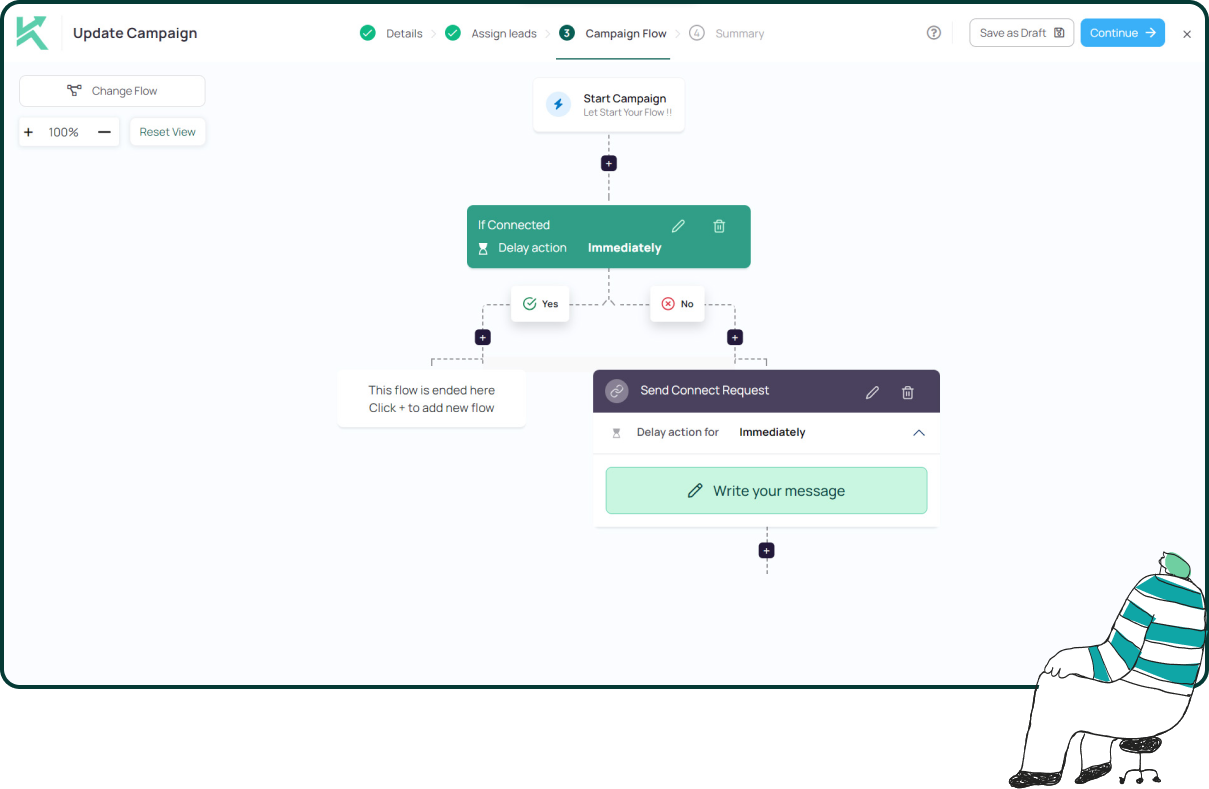
11x Yako LinkedIn Kusvika Na
Automation uye Gen AI
Batanidza simba reLinkedIn otomatiki uye Gen AI kukwidziridza kusvika kwako sezvisina kumbobvira zvaitika. Batanidza zviuru zvevanotungamira vhiki nevhiki neAI-inotungamirwa makomendi uye yakanangwa mishandirapamwe-ese kubva kune imwe lead-gen powerhouse chikuva.