Why LinkedIn Works So Well for B2B Lead Generation (When You Do It Right)
LinkedIn has evolved into the primary decision-making platform for B2B buyers. Long before a demo is booked or a sales conversation begins, professionals use LinkedIn to research vendors, compare solutions, validate credibility, and decide who they can trust. This shift in buying behaviour is exactly why LinkedIn works so well for B2B lead generation when used correctly. Some reasons to leverage LinkedIn for building your B2B pipeline include:
- Decision-makers actively research vendors, solutions, and peers on LinkedIn.
- Buying committees form opinions early—often before they ever visit your website.
- Trust is built in public through content, comments, and credibility signals.
- Direct access to the right people beats waiting for inbound.

Key point: LinkedIn rewards relevance. Your results depend less on volume and more on clarity, targeting, and conversation quality.
1) Turn Your Profile into a Lead-Generating Landing Page
A high-converting LinkedIn profile states who you help and what outcome you drive. It also signals credibility with proof: results, outcomes, clients, and clear positioning. Your profile can also make the next step obvious: connect, DM, or book a call.

Profile updates that lift reply rates
- Headline: Use a “help + outcome + audience” format, not just your title.
- About section: Lead with problems you solve, then how you solve them.
- Featured section: Add a lead magnet, case study, or “start here” resource.
- Experience: Replace responsibilities with outcomes and impact.
Simple rule: If your profile reads like a resume, it won’t convert like a landing page.
2) Define a Sharp ICP Before You Send a Single Message
One of the biggest reasons B2B LinkedIn lead generation fails is unclear targeting. When your ideal customer profile is too broad, even the best messaging sounds generic. A sharp ICP ensures every connection request, message, and follow-up feels relevant to the person reading it. Before you send a single message, you need absolute clarity on who you are trying to reach and why they should care.
- Industry: What sector do you serve best?
- Company size: Headcount and stage matter for budget and urgency.
- Role: Who owns the problem you solve?
- Triggers: Hiring, new funding, expansion, new leadership, compliance changes.
- Pain points: What problem are they actively trying to fix right now?

Why it matters: A LinkedIn Lead Generation Tool cannot fix weak targeting. It only scales what you feed it—good or bad.
3) Build Smarter Prospecting Lists with LinkedIn Search and Sales Navigator
Just by the way, did you know ‘How to Use LinkedIn Sales Navigator for Free: Without the Chrome Extension’ ?
On the other hand, here are some filters that you can use to consistently improve lead quality and enhance your B2B LinkedIn lead generation:
- Seniority: Director, VP, Head, C-level (based on your deal size).
- Function: Sales, Marketing, RevOps, IT, Procurement, Finance, etc.
- Posted recently: Active users respond more often.
- Changed roles recently: New leaders are often open to new systems.
- Company growth: Growth signals budget and urgency.

What to save (so your pipeline stays full)
- Saved lead lists (by role + segment).
- Saved account lists (Tier 1, Tier 2, Tier 3).
- Alerts for job changes, new posts, and company updates.
Pipeline tip: Lists create consistency. Consistency creates predictability.
Here is how we save your lead lists:

4) Warm Prospects Before You Connect
There are a lot of easy warming social signals that create familiarity on LinkedIn. Here are some you use day to day:
- Follow the prospect and engage with 2–3 posts.
- Leave thoughtful comments that add perspective (not “Great post!”).
- React to posts consistently for a week before requesting a connection.
Why warming works?
- Your name becomes familiar before you appear in their inbox.
- Your connection request feels contextual, not random.
- Your first message starts warmer, with less resistance.
Trust is built faster when you show up in public first.
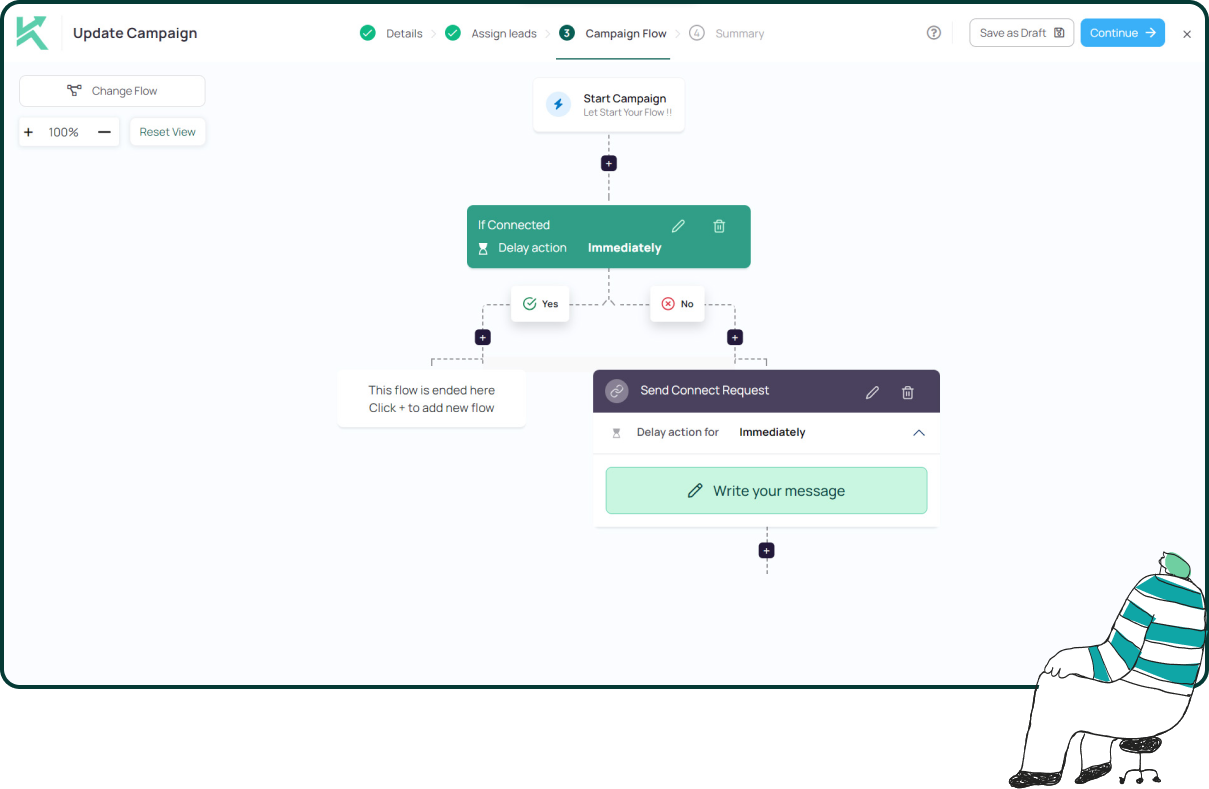
Take a look at how Konnector uses all of this social warming and automates LinkedIn leads with social signals.
5) Send Connection Requests That Feel Human (Not Like a Pitch)
To make sure, that you have a personalised connection request, here is what you can include:
- Context: a post they wrote, a talk they gave, a company update.
- Specificity: one line that proves you looked.
- No selling: connection first, conversation later.

Connection note examples
- Example 1: “Hi {{FirstName}}, your post on {{topic}} was spot on—especially the part about {{specific point}}. Would love to connect.”
- Example 2: “Hi {{FirstName}}, noticed {{company}} is expanding in {{area}}. Curious to follow your work—open to connecting?”
Don’t pitch in the request. Pitching early reduces acceptance and damages trust.
6) Use a Simple Message Sequence That Builds Conversation (Not Pressure)
To keep things simple, here is a proven 4-step LinkedIn sequence (conversation-first) that you can use:
- Message 1: Context + curiosity
- Reference their role, team, or a recent initiative.
- Ask a low-friction question.
- Avoid links and long explanations.
- Message 2: Value
- Share a useful insight or framework.
- Offer a resource only if it’s truly relevant.
- Message 3: Problem framing
- Highlight a common pain point you see in their space.
- Use “curious if this is relevant” language.
- Message 4: Soft invite
- Invite a short chat or ask if they want a quick breakdown.
- Keep it optional and respectful.
Best practice: Every message should feel like it can be ignored without guilt.
Don’t know where to begin? Here are some LinkedIn first messages you can use.
7) Use a LinkedIn Lead Generation Tool Carefully (Automation That Protects Trust)
Here is what a good LinkedIn Lead Generation Tool can help you do:
- Maintain a consistent outreach cadence without manual effort.
- Space actions naturally to avoid spam-like patterns.
- Track replies and stop sequences when someone responds.
- Organize leads by status, stage, and tag.

What “safe automation” looks like
- Low daily limits and realistic pacing.
- Personalized messaging built around context.
- Stop rules on reply, interest, or “not now.”
- Human review loops before scaling what works.
Important: Automation should support conversations—not replace them.
8) Post Content That Supports Outreach (Even 2x a Week Is Enough)
Your content strategy builds trust and helps you convert faster. Here are some types of posts you can try:
- Problem posts: “Most teams struggle with X because…”
- Framework posts: “Here’s a 5-step process to…”
- Lessons learned: “What I’ve noticed after working with…”
- Myth-busting: “Hot take: X isn’t the real issue—Y is.”
- Case insights: “We reduced X by Y using…”
Why content makes LinkedIn lead generation easier
- Prospects check your profile and see proof of expertise.
- Your messages feel aligned with what you publicly believe.
- In some cases, content creates inbound replies without outreach.
Reality: You don’t need to go viral. You need to be clear, consistent, and credible.
Read more—->The Ultimate Guide: Scrape LinkedIn in 2026 with Konnector.AI
9) Measure Replies and Pipeline Influence (Not Vanity Metrics)
Metrics actually matter for B2B LinkedIn lead generation and you should use them wisely. Here are the top ones to use:
- Connection acceptance rate (target relevance check).
- Reply rate (message-market fit check).
- Positive reply rate (quality + relevance check).
- Meetings booked (conversion check).
- Pipeline influenced (business impact check).

What to do with the numbers
- If acceptance is low, refine ICP and connection notes.
- If replies are low, sharpen message clarity and personalization.
- If replies are high but meetings are low, improve CTA and next-step framing.
LinkedIn is a conversation channel. Measure the conversation quality first.
10) Integrate LinkedIn Into a Multi-Channel Lead Engine
LinkedIn works best when it is not isolated. Here are some ways you can use it for a better reach:
- Use LinkedIn to start the relationship.
- Use email to nurture and follow up when appropriate.
- Use content to build credibility and stay top-of-mind.
- Use webinars or guides to move buyers from interest to intent.
- Use CRM tracking so nothing drops.
An example integrated flow
- LinkedIn warming (comments + reactions)
- Connection request (context-based)
- Message sequence (conversation-first)
- Value asset (framework, checklist, guide)
- Meeting invite (short, optional, clear)
When LinkedIn connects to the rest of your funnel, pipeline becomes predictable.
Common Mistakes That Kill LinkedIn Lead Generation
- Pitching too early before trust exists.
- Using generic templates with no context.
- Targeting too broadly to “increase volume.”
- Over-automating before message-market fit is proven.
- Ignoring profile credibility and expecting replies anyway.
- Measuring activity instead of conversion and pipeline impact.
LinkedIn Lead Generation Is Trust + Timing + Consistency
Winning B2B LinkedIn lead generation is not about hacks. It is about showing up consistently, targeting precisely, and starting conversations that feel relevant and human.
- Trust comes from credibility signals: profile, content, and relevance.
- Timing comes from targeting: triggers, activity, and role changes.
- Consistency comes from process—and the right LinkedIn Lead Generation Tool.
Next Step
- If you want to scale faster, start by tightening your ICP and message sequence.
- If you want better replies, warm prospects and improve your profile conversion.
- If you want predictability, integrate LinkedIn into a multi-channel engine.
Pipeline is built one quality conversation at a time. Start with relevance, then scale what works.
To ace B2B LinkedIn lead generation and actually leverage it, connect with us today and let Konnector.AI do all the work for you!
11x Your LinkedIn Outreach With
Automation and Gen AI
Harness the power of LinkedIn Automation and Gen AI to amplify your reach like never before. Engage thousands of leads weekly with AI-driven comments and targeted campaigns—all from one lead-gen powerhouse platform.
Frequently Asked Questions
B2B LinkedIn lead generation is the process of identifying, engaging, and converting business decision-makers on LinkedIn into qualified sales leads through profile optimisation, outreach, content, and relationship-building strategies.
LinkedIn is effective because it hosts verified professional profiles, active decision-makers, and real-time business conversations, making it easier to target the right audience and build trust before a sales discussion.
Most teams see initial replies within 2–4 weeks, while consistent pipeline impact typically builds over 60–90 days when messaging, targeting, and follow-ups are refined.
A LinkedIn Lead Generation Tool is not mandatory, but it helps scale outreach, maintain consistency, track replies, and reduce manual effort once message-market fit is established.
LinkedIn automation is safe when used carefully with low daily limits, human-written messages, natural timing, and clear stop rules. Over-automation or aggressive activity increases risk.
Messages that reference the prospect’s role, content, or company context perform best. Short, curiosity-driven messages without early pitching consistently achieve higher reply rates.
For safe and effective B2B LinkedIn lead generation, most teams stay between 20–40 personalised actions per day, focusing on relevance rather than volume.
Yes, LinkedIn lead generation can work without frequent posting, but having some relevant content on your profile improves trust, acceptance rates, and conversation quality.
Key metrics include connection acceptance rate, reply rate, positive reply rate, meetings booked, and pipeline influenced—not just messages sent.
LinkedIn typically works best as the top or mid-funnel channel, starting conversations that are later nurtured through email, content, webinars, and sales calls.