LinkedIn automation works best when it mirrors real human behaviour. The “Polite Guest” strategy does exactly that. Instead of rushing into a cold connection request, it helps you show up first, create familiarity, and then start the relationship naturally.
What Is the “Polite Guest” Strategy on LinkedIn?
The “Polite Guest” strategy is a simple three-step LinkedIn automation workflow:
- View the prospect’s profile
- Like their recent post or activity
- Send a connection request
This approach is called “Polite Guest” because it behaves the way a thoughtful professional would behave in real life. You do not walk into a room, interrupt someone, and immediately ask for something. You first make your presence known, acknowledge the person’s work, and then begin the interaction.
That is exactly why this strategy performs better than direct cold outreach.
When a prospect sees your name in profile viewers, then notices you liked something they posted, your connection request no longer feels random. It feels familiar. That small difference changes the psychology of outreach.
Why This LinkedIn Automation Strategy Works?

Most LinkedIn users are overwhelmed by generic outreach. They receive connection requests from people who clearly have not read their profile, have not engaged with their content, and are only interested in making a pitch.
The “Polite Guest” strategy fixes that by creating a lightweight trust-building sequence before the invitation is sent.
Here is why it works:
- It creates familiarity: People are more likely to accept a request from someone whose name they already recognize.
- It feels human: Viewing a profile and liking a relevant post is normal LinkedIn behaviour.
- It reduces friction: Instead of going from stranger to request instantly, you create a softer transition.
- It improves timing: If someone has posted recently, they are active, and active users are more likely to respond.
- It supports safer LinkedIn automation: Low-friction actions like profile views and likes help warm up outreach behaviour more naturally.
This is especially useful for founders, consultants, recruiters, agencies, and sales teams who want to scale LinkedIn outreach without sounding robotic.
Read more—-> Daily LinkedIn Outreach Routine for Founders Using Konnector.AI
When to Use the View -> Like -> Connect Sequence
The sequence is not for every prospect in every situation. It works best when the target person has some recent activity on LinkedIn.
| Section | Details |
|---|---|
| Use this workflow when |
|
| It is especially effective for |
|
If the prospect has no content, no visible activity, and no recent engagement, the “Like” step may not be possible. In that case, you can still use a lighter variation such as View -> Connect.
How to Automate the “Polite Guest” Strategy Step by Step

Step 1: Build a Qualified Prospect List
Before automation begins, the list has to be clean. Do not run this workflow on random contacts. The sequence works because it feels relevant, and relevance starts with good targeting.
Your list should ideally include prospects from:
- Sales Navigator searches
- People who engaged with posts in your niche
- Event attendees
- Group participants
- Profile viewers
- Followers of relevant creators or competitors
The more specific the list, the better the outcome. If your targeting is weak, even the best automation workflow will underperform.
Step 2: Trigger a Profile View First
The first action is the simplest one: visit the prospect’s profile.
A profile view is a low-pressure signal. It tells the prospect, “Someone relevant stopped by.” On LinkedIn, that matters. Many users check who viewed their profile, especially if they are active or curious about their audience.
Best practices for the profile view step:
- Space views naturally across the day
- Avoid hitting too many profiles in a short burst
- Run the sequence on active accounts with complete profiles
- Make sure your own profile is optimized before doing outreach
Your profile is part of the message. If a prospect clicks back and lands on a weak headline, vague positioning, or low-trust page, the sequence loses power.
Step 3: Like a Relevant Post or Activity
After the profile view, the next step is engagement. A like is small, but it matters. It reinforces visibility without demanding attention.
This step works because it tells the prospect that your visit was not random. You noticed something they shared and acknowledged it.
What to like:
- A recent post
- A meaningful repost
- A comment on an industry discussion
- A company-related update they shared
What not to do:
- Like multiple posts in a row
- Like old content from months ago
- Use blanket engagement with no relevance
- Engage in a way that feels obviously automated
One relevant like is enough. The point is not volume. The point is recognition.
Step 4: Send the Connection Request
Once the prospect has had a chance to potentially notice the view and the like, you send the connection request.
This is where most people ruin the sequence by overloading it with a pitch. Do not do that.
The request should feel light, contextual, and easy to accept.
Good connection request styles include:
- A simple professional intro
- A line referencing shared industry context
- A note tied to their recent post or topic of interest
- A clean request with no sales push
Example approaches:
- Minimal: Hi Sarah, enjoyed your perspective on retail CX. Thought I’d connect.
- Context-led: Hi Mark, came across your recent post on RevOps alignment and found it insightful. Happy to connect.
- Shared space: Hi Priya, we both work in SaaS growth and I’ve been following conversations in this space closely. Would be great to connect.
The goal is acceptance, not conversion in the note itself.
Let Konnector do the heavy lifting. Sign up for a free trial now.
What Timing Should You Use Between Each Step?
Timing is what makes the sequence feel natural.
You do not want the three actions to happen instantly one after another. That creates a mechanical pattern. A better workflow staggers the actions so the experience feels closer to real behaviour.
A practical structure looks like this:
- Profile View: first action
- Like: after a short delay
- Connect: later the same day or the next day
The exact timing depends on your setup and account health, but the principle is the same: create spacing, not bursts.
How to Automate This Safely
LinkedIn automation is not just about what action you perform. It is also about how you perform it.
The safest workflows are the ones that resemble realistic user behaviour. The “Polite Guest” strategy is strong because each step is common, lightweight, and logical.
To automate it safely:
- Start with small daily volumes
- Use realistic delays between actions
- Target active prospects instead of dead lists
- Keep your profile complete and credible
- Do not combine this with aggressive message blasts
- Monitor acceptance rates and stop poor-performing segments
- Warm up new accounts before scaling activity
A lot of people think automation fails because tools are bad. In reality, automation often fails because the behaviour pattern is bad. Poor targeting, rushed sequences, and unnatural timing create risk.
How Konnector.ai Fits This Workflow
Konnector.ai is built for this exact style of LinkedIn outreach. Instead of pushing users into direct-message-first automation, it supports sequences that create familiarity before the ask.
With the “Polite Guest” approach, Konnector.ai can help you:
- Identify active prospects based on social signals
- Segment people who recently posted or engaged
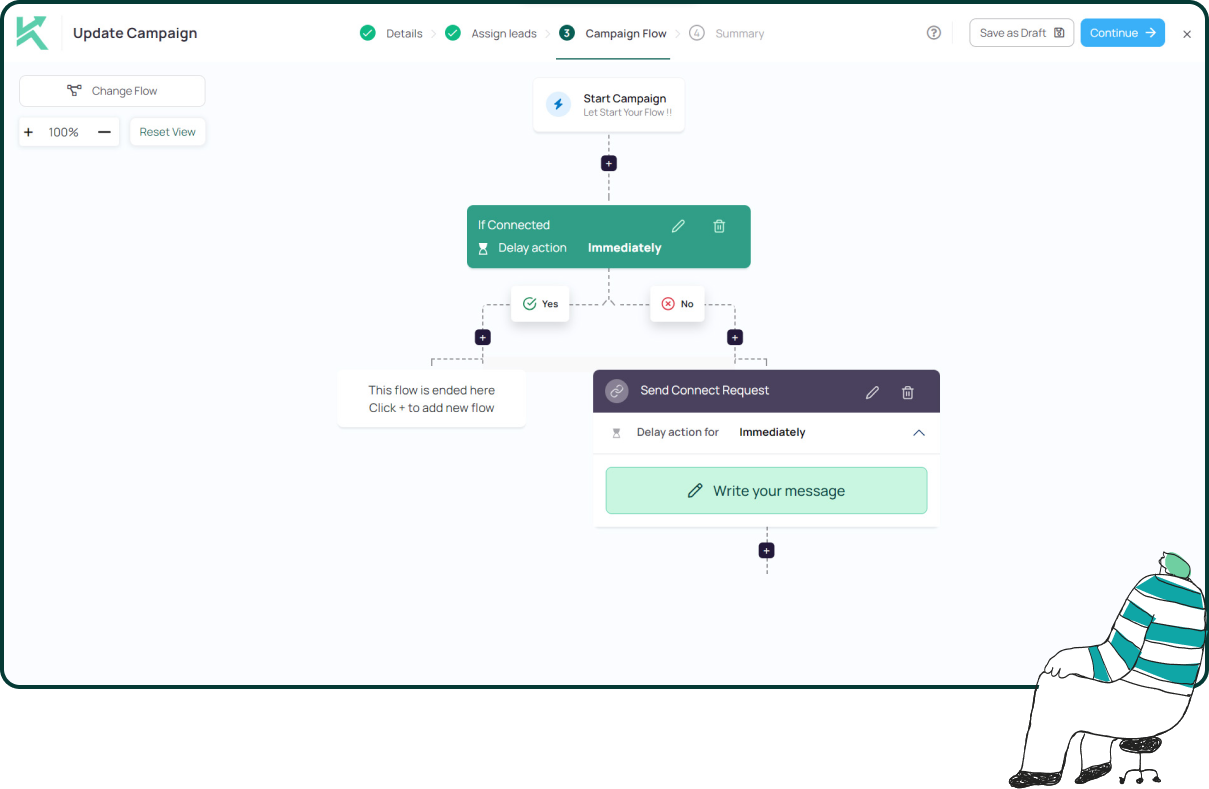
- Run action-based sequences such as View -> Like -> Connect
- Keep timing more natural across actions
- Build smarter follow-up paths after acceptance
This matters because the best LinkedIn automation is not just about sending more requests. It is about sending requests that already have some social context around them.
Read more—> The Evolution of LinkedIn Automation: How AI Agents Are Raising the Bar in 2026
What Happens After the Connection Is Accepted?
The sequence should not end at acceptance. That is where the relationship actually begins.
Once someone accepts, you need a follow-up that feels aligned with the tone you established.
If your first three touches were polite, contextual, and low-pressure, your next step should match that energy.
Good post-acceptance follow-up ideas:
- Thank them and keep it short
- Reference the topic they posted about
- Share a useful insight or resource
- Ask a small, relevant question
Example:
Thanks for connecting, James. I liked your recent point about pipeline quality versus lead volume. Curious if that has changed how your team approaches outbound this quarter.
That feels like a conversation, not a pitch sequence.
Common Mistakes to Avoid

Even good workflows can fail if the execution is sloppy.
Avoid these mistakes:
- Using bad targeting: If the prospect is irrelevant, the sequence will not save it.
- Sending a pitch in the connection note: This kills the soft-touch advantage.
- Over-engaging: One like is enough. Do not try to fake interest.
- Skipping profile optimization: Prospects will often check who viewed them.
- Automating too aggressively: Natural sequences work better than high-volume blasts.
- Ignoring signals after acceptance: The real opportunity is in the follow-up conversation.
Who Should Use This LinkedIn Automation Keyword Strategy?
If your core SEO phrase is LinkedIn Automation, this topic is powerful because it speaks to a real tactical use case. It is not abstract. It is practical, behavioural, and directly tied to better outcomes.
This strategy is a good fit for content targeting people who are searching for:
- LinkedIn automation strategies
- safe LinkedIn automation workflows
- LinkedIn connection request tactics
- LinkedIn outreach automation
- how to automate LinkedIn prospecting
It also helps position Konnector.ai as a smarter alternative to blunt-force automation. Instead of “send more,” the message becomes “show up better.”
The Real Value of the “Polite Guest” Workflow
The biggest strength of this sequence is that it respects how relationships start on LinkedIn.
It does not try to hack trust. It builds enough familiarity to make the first ask feel normal.
That is why the “Polite Guest” strategy works so well for modern LinkedIn automation. It combines scale with restraint. It gives you a repeatable workflow without turning your profile into a spam machine.
In practical terms, it helps you:
- increase connection acceptance rates
- make cold outreach feel warmer
- use automation more safely
- build better first impressions
- create a stronger foundation for replies and meetings
Book a demo today to see all that Konnector.ai can do for you.
Final Thoughts
If your LinkedIn outreach still begins with a cold request to a stranger who has never seen your name before, you are making the job harder than it needs to be.
The “Polite Guest” strategy offers a better path. View first. Engage lightly. Connect after recognition begins. It is simple, scalable, and far more aligned with how professionals actually build trust online.
That is what good LinkedIn automation should do. Not replace human judgment, but support it with structure.
For teams using Konnector.ai, this workflow is a practical way to combine automation with intent. You stay visible before you become direct. You warm the interaction before asking for attention. And that small shift often makes the difference between being ignored and being accepted.
11x Your LinkedIn Outreach With
Automation and Gen AI
Harness the power of LinkedIn Automation and Gen AI to amplify your reach like never before. Engage thousands of leads weekly with AI-driven comments and targeted campaigns—all from one lead-gen powerhouse platform.
Frequently Asked Questions
The Polite Guest strategy is a soft-touch LinkedIn outreach method where you first view a prospect’s profile, then like a relevant post or activity, and only after that send a connection request. It helps your outreach feel more natural and familiar.
It works because it builds recognition before the connection request appears. Instead of seeming random, your name becomes familiar through small, low-friction interactions.
In many cases, yes. It creates a warmer first impression and can improve connection acceptance rates because the prospect has already seen your name before the invite arrives.
Yes, but only if the workflow uses realistic timing, controlled volumes, and relevant targeting. Safe LinkedIn automation should mimic natural professional behaviour rather than aggressive bursts of activity.
This strategy is especially useful for founders, consultants, recruiters, agencies, and B2B sales teams who want to build familiarity before sending connection requests.
It works best with active prospects who have recently posted, commented, or engaged on LinkedIn. If someone has no visible activity, a lighter View -> Connect approach may be more practical.
Like one relevant and recent piece of activity, such as a post, repost, or comment. Avoid liking multiple posts at once or engaging with very old content.
No. The note should stay light, contextual, and easy to accept. The goal is to get the connection accepted, not to force a sales message too early.
You should space the actions naturally. A profile view comes first, the like should happen after a short delay, and the connection request can be sent later the same day or the next day.
After acceptance, send a short and relevant follow-up that matches the low-pressure tone of the sequence. Thank them, reference their content, or ask a small contextual question.