What is a LION on LinkedIn? Complete Guide to LinkedIn Open Networkers in 2026
Looking to grow your LinkedIn outreach list fast?
Let’s talk about LIONs—not the ones in the wild, but the bold professionals on LinkedIn who roar with 30,000+ connections and open the floodgates of opportunity for networking, visibility, and outreach.
These are the LinkedIn Open Networkers, aka LIONs.
They don’t wait for introductions. They don’t limit themselves to common groups. And they certainly don’t let LinkedIn’s connection limitations hold them back.
They’re here to build expansive networks—and if you’re in sales, recruiting, or partnership roles, becoming a LION might just be the secret weapon you didn’t know you needed.
What Does LION Mean on LinkedIn?
LION stands for LinkedIn Open Networker
A LION is someone who intentionally connects with as many people as possible—no warm intro, no mutual connections required. They’re essentially saying, “My inbox is open. Let’s connect.”
Most LIONs proudly display the label in their profile headline or name. You’ll see something like:
“John Smith | CMO | LION | 30K+ Connections”
They also tend to use hashtags like #LIONLinkedIn, #LinkedInLion, or #OpenNetworker, and join large open-networking groups to grow their connections at lightning speed.
Their goal? To maximize visibility, boost reach, and leverage LinkedIn’s algorithm for outbound sales, brand building, or job hunting.
The History of LinkedIn Open Networking
The LION movement emerged in the early 2010s when LinkedIn sales professionals and recruiters realized that connection limits were restricting their outreach potential. Traditional networking required mutual connections or group memberships to send connection requests, creating artificial barriers for legitimate business development.
Early adopters began adding “LION” to their profiles to signal willingness to connect with anyone, regardless of existing relationships. The movement grew rapidly among sales development representatives, recruiters, and entrepreneurs who needed access to large prospect pools without InMail costs.
By 2015, dedicated LION groups on LinkedIn had grown to over 100,000 members. Today, hundreds of thousands of professionals identify as LIONs, using the strategy to bypass LinkedIn’s connection request limitations and build networks exceeding 30,000 first-degree connections.
Read more—> 25 Best LinkedIn Outreach Templates That Actually Get Replies
Why Become a LION on LinkedIn?
Still wondering if it’s worth it? Here’s why people opt to become LIONs—and why it might work for you.
Massive Visibility
With more connections, your content shows up in exponentially more feeds. That means every time you post, engage, or share value, you reach hundreds—sometimes thousands—of people you’d never meet otherwise.
For founders, marketers, and job seekers, that’s a game-changer.
Built-in Outbound Power
Once someone becomes a 1st-degree connection, you don’t need InMail credits to message them.
That means more free outreach without relying on cold emails or paid InMails. You can start conversations right in the LinkedIn inbox—no extra tools required.
Higher Visibility in Search
LIONs tend to show up in more search results—simply because they’re connected to more people.
So when a recruiter, prospect, or partner searches for a role, industry, or location you match, you’re more likely to appear.
That boosts inbound opportunities, too.
More Touchpoints for Engagement
Not everyone replies to messages. But even passive interactions—like profile views, post likes, or page visits—can be the start of a new conversation.
LIONs increase those odds significantly. And when paired with the right engagement strategy, it can lead to real pipeline growth.
The Downside of LION Life: What to Expect
Of course, it’s not all rainbows. With great reach comes… well, spam.
You’ll Get Irrelevant Messages
Expect to receive a flood of pitches, requests, and automated spam. Your inbox will fill up—quickly. Without proper filtering and automation tools, managing thousands of messages becomes impossible.
Lower Engagement Rates
High-volume networks often mean low engagement. People connect quickly but don’t always interact meaningfully. That can make personalized outreach harder.
Your content may reach 10,000 connections but only generate 50 likes and 3 comments. The engagement rate drops significantly compared to smaller, more targeted networks.
Noisy Network, Lower Trust
It’s harder to build deep relationships when your network is full of strangers. Without the right tools, your message can get lost in the noise.
Prospects may view your profile, see 30,000+ connections, and question whether you actually know anyone in your network or if you’re just collecting contacts.
Read more—> LinkedIn Automation: Personal Profile vs Ghost Sales Profile – Which Is Safer?
LION vs Traditional LinkedIn Networking: Which Strategy Wins?
The debate between LION networking and traditional selective networking continues in 2026. Here’s how they compare:
Traditional LinkedIn Networking
- 500-2,000 highly targeted connections
- Higher engagement rates (8-15% on posts)
- Stronger trust and relationship depth
- Easier to manage manually without automation
- Limited reach for content distribution
- Requires more InMail credits for outreach
LION Networking
- 10,000-30,000+ broad connections
- Lower engagement rates (2-5% on posts)
- Wider reach for content and visibility
- Requires automation for effective management
- Free messaging to massive prospect pool
- Higher search visibility across LinkedIn
The winning strategy depends on your goals. B2B sales professionals targeting specific industries benefit from LION networking combined with segmentation tools. Consultants and executives building thought leadership often prefer smaller, more engaged networks.
The hybrid approach works best: build a large LION network for reach, then use tools like Konnector.ai to segment and engage strategically as if you had a smaller, targeted network.
How to Become a LION on LinkedIn: Step-by-Step Guide
Step 1: Update Your Profile for LION Networking
Add “LION” or “Open Networker” to your headline. Example: “B2B Sales Leader | SaaS Growth Specialist | LION 30K+”
Include relevant hashtags in your About section: #LION #OpenNetworker #LinkedInNetworking
Optimize your profile for search with industry-specific keywords so the right people find you when you appear in their search results.
Step 2: Join Open Networking Groups
Search for “LION” or “Open Networker” in LinkedIn Groups. Join 5-10 large groups with 10,000+ members.
Popular LION groups include:
- LinkedIn Open Networkers (LION)
- Global LION Network
- Open Networkers Group
- Professional LION Community
These groups provide immediate access to thousands of professionals actively seeking connections.
Step 3: Send Strategic Connection Requests
Don’t just spam connection requests. Focus on your Ideal Customer Profile (ICP):
- Filter by industry, job title, location, and company size
- Send 50-100 connection requests daily (LinkedIn’s safe limit)
- Personalize requests when possible: “Hi [Name], fellow LION here—let’s connect!”
- Use LinkedIn Sales Navigator for advanced filtering
Step 4: Accept Relevant Connections
Review pending requests daily. Accept connections from:
- Professionals in your target industry
- Decision-makers matching your ICP
- Other LIONs building their networks
- Recruiters and potential partners
Decline obvious spam, fake profiles, or completely irrelevant connections.
Step 5: Engage Your Network Strategically
Post valuable content 3-5 times per week. Share industry insights, case studies, and thought leadership.
Comment on connections’ posts to increase visibility. Use LinkedIn automation tools to systematically engage with target segments.
Track which connections interact with your content to identify warm prospects for outreach.
Enter Konnector.ai: Turning LION Chaos into Outreach Gold
That’s where Konnector.ai comes in.
So you’ve become a LION. Your network is massive. Great! But how do you activate it?
Konnector helps you turn a bloated connection list into a laser-focused outreach machine.
Here’s how:
- ✅ Auto-Segment by title, location, tags, or industry
- ✅ Personalized Campaigns that feel human, not robotic
- ✅ Smart Engagement using likes, follows, and comments
- ✅ Trigger-Based Follow-Ups based on opens, views, or ghosting
- ✅ Lead Tagging to track hot, warm, and cold prospects
You can label leads as LION – Warm, Replied – Hot, or Ghosted to organize your outreach better.
It’s how you move from random connections to relevant conversations.
LION Outreach Strategy with Konnector: The 3-Step System
Here’s a simple 3-step strategy to grow and engage your LION network using Konnector.
Step 1: Extract Your Connections
Use Konnector’s Connections Extractor to pull your entire 1st-degree contact list.
Then, apply filters like:
- Industry: “Marketing”
- Location: “Ireland”
- Title: “Head of Growth”
Now you’ve gone from 30K+ random connections to a qualified outbound list.
Step 2: Automate Campaigns—with Context
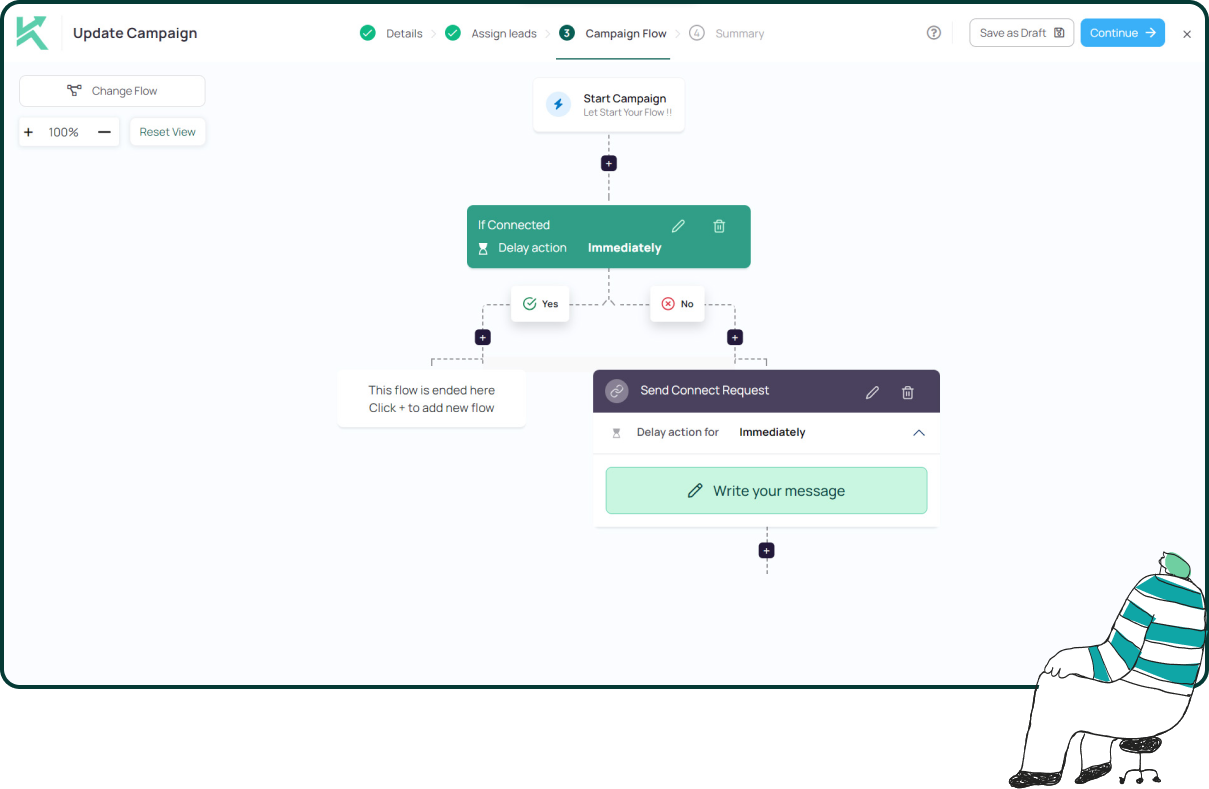
Konnector allows you to build conditional messaging flows. For example:
- If connected = Yes
“Hey [FirstName], we’ve been connected a while—let’s finally chat!” - If they viewed your profile
“Hey [FirstName], noticed you stopped by—was it something I shared?” - If not connected yet
Engage with a post ➝ Send connection request ➝ Warm follow-up message
These tailored paths help you stay relevant—and human.
Step 3: Let Konnector Auto-Follow-Up
Forget spreadsheets and sticky notes.
Konnector automates:
- Smart follow-ups if there’s no reply
- Branches based on opens, views, or clicks
- Optional email outreach in parallel
This means you show up consistently—without spending all day in your inbox.
Real-World Use Case: Meet Anika, the Sales LION
Let’s say you’re like Anika—a sales rep at a B2B SaaS company in Dublin.
Your ideal customer? Marketing Directors at mid-sized tech firms.
Anika becomes a LION and adds 500+ relevant marketers over a month.
Then she:
- Extracts those new connections into Konnector
- Segments them by title and company size
- Sends personalized campaigns with soft CTAs
- Uses Konnector triggers to follow up with people who viewed her profile but didn’t reply
Result?
- ✅ 12 discovery calls booked
- ✅ 3 conversions
- ✅ Zero InMails used
That’s the power of strategic LinkedIn LION networking + automation.
Advanced LION Strategies for 2026
The Social Signals Approach
Rather than messaging all connections immediately, use Konnector’s social signals feature to identify who is actively engaging on LinkedIn:
- Track connections posting about specific topics (e.g., “marketing automation,” “lead generation”)
- Monitor who comments on industry discussions
- Identify prospects attending virtual events or webinars
- Engage with their content before sending outreach messages
This intent-based approach increases response rates from 8% to 25% compared to cold outreach.
The Content Amplification Strategy
LIONs with 30,000+ connections have built-in content distribution power. Leverage it:
- Post thought leadership content 3x weekly
- Use Konnector to identify connections who engaged with your posts
- Send personalized follow-up messages to engaged prospects
- Create content addressing common pain points in your target segment
- Use LinkedIn polls to increase visibility and identify interested prospects
Each post reaching 5,000 impressions generates 50-100 profile views. Convert those views into conversations.
The Multi-Touch Attribution Method
Track how LION connections interact across multiple touchpoints:
- Profile view
- Content engagement
- Direct message response
- Email open/click
- Meeting booked
Konnector’s unified dashboard shows you which connections have engaged multiple times, indicating higher intent and readiness for sales conversations.
Pro Tips for Smart LION Outreach
1. Don’t connect with everyone
Stay focused on your Ideal Customer Profile (ICP). A targeted 20,000 connections beats a random 30,000.
2. Add context in your connection notes
Even LIONs appreciate a quick “saw your post on X, would love to connect!” This increases acceptance rates by 40%.
3. Post valuable content consistently
Educate, entertain, or inspire your network—don’t just pitch. Share case studies, industry insights, and authentic experiences.
4. Use lead tags and triggers inside Konnector
Keep your campaigns clean and performance-driven. Tag connections as “LION-New,” “Engaged,” “Replied,” or “Opportunity” to track progression.
5. Schedule regular network audits
Every quarter, review your connections. Remove obvious spam accounts and inactive profiles. LinkedIn allows you to remove connections to make room for more relevant ones.
6. Combine LION networking with Sales Navigator
Use Sales Navigator’s advanced search to find ideal prospects, then leverage your LION network to request introductions or find mutual connections for warm approaches.
Common LION Mistakes to Avoid
Sending Generic Mass Messages
The fastest way to get flagged for spam is sending identical messages to hundreds of connections daily. Use Konnector’s personalization variables and conditional logic to maintain authenticity.
Ignoring Engagement Opportunities
Many LIONs build large networks but never interact with connections’ content. Comment on posts, share relevant content, and engage before asking for anything.
Neglecting Profile Optimization
Your profile is your landing page. With 30,000+ connections viewing your profile regularly, ensure your headline, summary, and experience clearly communicate your value proposition.
Forgetting to Follow Up
Research shows 80% of sales require 5+ touchpoints. Use Konnector’s automated follow-up sequences to stay top-of-mind without manual tracking.
Not Segmenting Your Network
Treating all 30,000 connections the same is ineffective. Segment by industry, role, engagement level, and buying intent to deliver relevant messaging.
Should You Become a LION? Decision Framework
| ✅ Say YES if | ❌ Say NO if |
|---|---|
| You’re in sales, recruiting, or partnerships | You prefer tight-knit, high-trust networks |
| You want maximum reach and low-cost messaging | You’re not ready to manage a large engagement funnel |
| You have Konnector to help personalize at scale | You don’t plan to actively post or interact |
| Your business model benefits from high-volume outreach | Your business relies on deep, consultative relationships |
| You’re comfortable managing automation tools | You lack time to set up proper segmentation and automation |
| You post content regularly and want amplification |
Best Bet?
Use LION to grow your reach.
Use Konnector to drive relevance and revenue.
LION Networking in Different Industries
LIONs in B2B SaaS Sales
Sales development representatives use LION networking to build prospect databases. With 30,000 connections segmented by industry and role, SDRs can run targeted campaigns without InMail costs, booking 10-20 discovery calls monthly through strategic outreach.
LIONs in Recruiting
Recruiters leverage LION networks to access passive candidates. A recruiter with 30,000 connections can search for specific skills and reach out directly, filling positions 40% faster than relying solely on job postings and InMails.
LIONs in Consulting
Consultants use LION status to amplify thought leadership. Large networks increase content reach, establishing expertise and generating inbound leads. Each post reaching 10,000 impressions creates multiple consulting opportunities.
LIONs in Real Estate
Real estate professionals build LION networks to connect with investors, buyers, and sellers across multiple markets. The visibility helps them stay top-of-mind when connections are ready to transact.
The Future of LION Networking in 2026 and Beyond
LinkedIn continues evolving its algorithm and connection policies. In 2026, successful LIONs combine quantity with quality using AI-powered tools that:
- Identify high-intent prospects through engagement signals
- Personalize outreach at scale using AI-generated messages
- Track multi-touch attribution across LinkedIn and email
- Integrate with CRM systems for seamless sales workflows
- Maintain LinkedIn safety through cloud-based automation
The LION strategy remains effective in 2026 because it solves a fundamental problem: access to decision-makers. As LinkedIn tightens organic reach and increases InMail costs, LION networking provides free, direct access to thousands of potential customers.
Tools like Konnector.ai make LION networking sustainable by adding the intelligence layer that massive networks require—turning raw connection counts into qualified pipeline.
Final Roar: Making LION Networking Work
Becoming a LION on LinkedIn unlocks visibility. But without a strategy, it’s just noise.
With Konnector.ai, you turn that noise into:
- 🎯 Segmented lead lists
- 💬 Personalized conversations
- 🔁 Automated follow-ups
- 📈 Measurable pipeline growth
So while others collect connections, you convert them.
Ready to Outreach Like a LION?
Don’t just grow your network—activate it.
Start using Konnector.ai to turn your LinkedIn LION strategy into a scalable outreach engine.
👉 Try it now and outreach louder (and smarter) on LinkedIn.
11x Your LinkedIn Outreach With
Automation and Gen AI
Harness the power of LinkedIn Automation and Gen AI to amplify your reach like never before. Engage thousands of leads weekly with AI-driven comments and targeted campaigns—all from one lead-gen powerhouse platform.
Frequently Asked Questions
A LION (LinkedIn Open Networker) is a user who accepts connection requests from anyone to grow a large network and increase visibility, reach, and messaging opportunities on LinkedIn.
Yes, becoming a LION helps grow your network quickly, improves profile visibility, and allows free messaging to more people, making it useful for sales, recruiting, and job searching.
LinkedIn allows up to 30,000 first-degree connections. After reaching this limit, you can still accept incoming requests and follow unlimited profiles.
No, LinkedIn does not ban users for being LIONs. However, excessive connection requests or spammy behavior can lead to temporary restrictions.
Yes, LIONs typically get higher reach because their content appears in more feeds due to their large network size.
Adding “LION” to your headline signals openness to connections and can increase acceptance rates, but it should not replace your core professional identity.
It usually takes 12–24 months of consistent networking, depending on your connection request volume and acceptance rate.
LIONs often receive spam messages, experience lower engagement rates, and may struggle to maintain meaningful relationships within a large network.
It depends on your goals. LION strategy offers scale and reach, while traditional networking provides deeper relationships and higher engagement.
You can manage a large network by segmenting connections, engaging with relevant prospects, and using tools like Konnector to automate and personalize outreach.