There is a debate that almost every sales rep, founder, and growth marketer hits at some point in their LinkedIn outreach career: do you send the connection request first, or do you lead with a message?
It sounds like a minor tactical call. It is not. The order in which you initiate contact on LinkedIn determines whether your outreach gets a response, gets ignored, or gets you flagged.
And in 2026, with LinkedIn’s behavioural AI evaluating every interaction sequence, the sequencing question has become a compliance question as well as a conversion one.
This guide breaks down exactly when to use each approach, what the data says, and how to build a LinkedIn messaging strategy that converts cold contacts into real conversations.
Why the Order of Outreach Actually Matters?
LinkedIn is not email. The context in which someone receives your message changes how they interpret it, whether they trust it, and whether they respond.
A connection request and a direct message are two different social signals — and they carry different psychological weight depending on where you are in the relationship.
When you send a connection request, you are asking to enter someone’s professional network. It is a low-commitment, low-pressure action. The person you are reaching out to can assess your profile before deciding whether to accept. If your profile is credible and your note (if any) is relevant, the barrier to accepting is low.
When you send a direct message or InMail before connecting, you are bypassing that social gate entirely. You land in their inbox without permission. That can work — but it requires a far higher level of relevance and personalisation to overcome the friction of the unsolicited approach.
What the Data Says: Connection Request vs. Direct Message First

The question of sequencing has been studied across millions of LinkedIn interactions. The data is not as straightforward as either camp would suggest.
| Approach | Metric | Performance |
|---|---|---|
| Connection request only (no note) | Acceptance rate | 55–68% on average |
| Connection request with personalised note | Acceptance rate | 26–45% depending on quality |
| Connection request with note → DM after acceptance | Reply rate | 9.36% vs. 5.44% without note |
| Direct message (InMail) without connection | Reply rate | 10–25% average; 6.38% for cold InMail campaigns |
| Message + profile visit combination | Reply rate | 11.87% — highest of any two-action sequence |
| Profile view alone (no message) | Reply rate | Near zero — passive touches do not initiate conversations |
The clearest finding: the connection request approach wins on volume and account safety, but the direct message wins on reply rate quality — provided the message is relevant and timed correctly. The best performers combine both.
The Case for Sending a Connection Request First
For most cold LinkedIn outreach, starting with a connection request is the right move. Here is why.
It is lower friction for the recipient
A connection request does not demand anything from the recipient immediately. They can check your profile, weigh your credibility, and accept or decline on their own terms.
This mirrors how real professional networking works — you meet someone at an event before pitching them, not the other way around.
It expands your direct messaging access
Once someone accepts your connection request, they become a first-degree connection. You can message them directly, without InMail credits, without character limits, and without the psychological signal that InMail carries — the unmistakable signal that says “this person paid to reach me.”
It protects your account health
LinkedIn’s compliance system monitors your outreach patterns.
Sending large volumes of unsolicited direct messages or InMails without connection context can increase your spam report rate, which is one of the fastest ways to damage your Trust Score and trigger Volume Tax suppression.
Connection requests, followed by post-acceptance messaging, create a two-step sequence that looks natural in LinkedIn’s activity data.
When to add a note to your connection request?
This is where the data gets counterintuitive. Studies consistently show that blank connection requests achieve higher acceptance rates than requests with generic notes — in some cases up to 89% better. The reason is simple: notes that sound templated, salesy, or vague create resistance. The recipient can tell within two seconds whether you wrote the note for them specifically or swapped their name into a sequence.
However, including a note significantly improves post-acceptance reply rates. Accounts that send a personalised note see a 9.36% reply rate versus 5.44% without one. The note is not there to get you accepted — it is there to prime the conversation so your first message after acceptance lands.
The rule for connection request notes: if you have a specific, genuine reason to connect — a mutual contact, a post they published, a shared group, a role change you noticed — write a short note under 200 characters that references it. If you do not have a specific reason, a blank request outperforms a generic one every time.
The Case for Messaging First (Without Connecting)
There are situations where waiting for a connection request to be accepted is not the right strategy. InMail and direct message approaches without prior connection have their place.
When the prospect’s acceptance rate is predictably low
Senior executives — VPs, C-suite, founders at scale — receive dozens of connection requests daily. Their acceptance rates can drop below 10%. Waiting for an acceptance that will likely never come wastes time and adds ignored requests to your backlog, which damages your Trust Score. For these prospects, a well-crafted InMail that leads with a specific business insight relevant to their role can cut through faster.
When timing is a commercial signal
If you have a time-sensitive reason to reach out — a prospect just announced a funding round, a leadership change, or a company expansion — acting on that signal immediately matters. Waiting 3–5 days for a connection request to be accepted is a missed window. LinkedIn outreach tied to recent activity sees 32% higher reply rates. In these cases, a direct message or InMail that references the trigger event opens the conversation in the moment it is most relevant.
When message requests are available
If you share a LinkedIn group with someone or have attended the same event, LinkedIn allows you to send a message without connecting. This is a useful middle ground — you have some shared context, you are not paying InMail credits, and you avoid the connection request queue entirely. The caveat: message requests are easy to miss, and LinkedIn surfaces them inconsistently across devices and notification settings.
The Sequencing Question: What Actually Converts
The practitioners generating the highest reply rates are not picking one approach over the other. They are sequencing them deliberately.
| Stage | Action | Purpose | Timing |
|---|---|---|---|
| Stage 1 | Engage with a prospect’s recent content (like, comment) | Become a recognisable name before any direct outreach | 2–5 days before connection request |
| Stage 2 | Send connection request (blank or contextual note) | Enter the network; trigger profile view | Day 1 of active sequence |
| Stage 3 | First LinkedIn message after acceptance | Open the conversation with a specific, relevant hook — not a pitch | Within 24–48 hours of acceptance |
| Stage 4 | Follow-up message if no reply | Add a second touchpoint referencing something new | 4–5 business days after Stage 3 |
| Stage 5 (if unanswered) | InMail or email sequence | Multi-channel escalation for high-value prospects | 7–10 days after Stage 3 |
The message-plus-profile-visit combination produces an 11.87% reply rate — the highest recorded for any two-action sequence. What that tells you is that being seen before you message matters. Warm intent signals, even passive ones like a profile view, meaningfully change how a message lands.
What Your First LinkedIn Message Should Actually Say
Whether you send your first LinkedIn message immediately via InMail or after a connection request is accepted, the message itself determines whether the conversation continues. The data is clear on what works.
Length
Messages under 300 characters get 19% more responses than longer, pitch-heavy alternatives. The instinct to over-explain who you are, what your company does, and why you are reaching out works against you. Your LinkedIn profile exists to answer those questions. The message should open the conversation, not close the sale.
The first sentence
Over 40% of recipients decide whether to open a message based on the preview text — which is functionally the first sentence. That sentence needs to address something specific to them: a pain point you have observed in their industry, a post they published, a company milestone, or a signal you picked up from their profile activity. Generic openers like “I came across your profile and thought we could connect” are structurally indistinguishable from thousands of other messages sitting in the same inbox.
Personalisation beyond the name
Swapping a first name into a template is not personalisation — it is a formatting variable. LinkedIn’s algorithm can now detect structural similarity across messages sent from the same account. More practically, recipients can tell instantly whether a message was written for them or assembled from a template. Personalisation that references a specific post, a role change, a shared contact, or a company announcement sees 27% higher reply rates than name-swapped templates.
For practical templates and first message frameworks, see our guide on LinkedIn first message examples and how to write compelling LinkedIn connection messages.
Connection Request vs. Message First: Decision Framework
| Scenario | Recommended Approach | Why |
|---|---|---|
| Cold outreach to a mid-level professional you have never interacted with | Connection request first (blank or contextual note) | Lower friction; builds trust before the ask; protects account health |
| Senior executive with low expected acceptance rate | InMail with specific, relevant hook | Avoids unanswered request backlog; higher immediacy |
| Prospect who engaged with your content (liked, commented) | Direct message or connection request with note referencing their engagement | Warm signal reduces friction; personalisation is natural and credible |
| Prospect who just changed roles or announced company news | InMail or connection request note referencing the trigger event immediately | Relevance window is short; acting on the signal increases reply rate by 32% |
| Shared group or event attendee | Message request without connecting first | Shared context removes the cold outreach barrier; no InMail credits needed |
| Re-engaging a past connection who has gone quiet | Direct message with a new reason to reconnect | You are already connected; no request needed — the relationship just needs a fresh signal |
For re-engagement specifically, see our guide on re-engaging lost customers with Konnector.AI.

How Organic Engagement Changes the Equation
There is a third path that the connection-request-versus-message debate tends to obscure: the warm approach.
Before either option, engaging with a prospect’s content — commenting thoughtfully on a post they published, responding to something they shared in a group — does something that neither connection requests nor cold InMails can replicate. It puts your name in front of them in a context that is not sales-initiated.
When you follow up with a connection request or message, you are not a stranger.
Accounts that engage with prospect content before outreach consistently achieve acceptance rates above 60%. Cold, context-free requests average 20–30% even with solid targeting.
The platform-level implication matters too. LinkedIn monitors engagement ratios as part of its compliance scoring system. An account sending 40 connection requests per day with zero organic activity — no posts, likes, or comments — looks mechanical. Integrating organic engagement alongside your outreach is not just a conversion strategy. It is a compliance strategy. See our breakdown of AI-powered LinkedIn commenting for how to scale this without it consuming your day.
How Konnector.ai Handles the Sequencing Decision for You
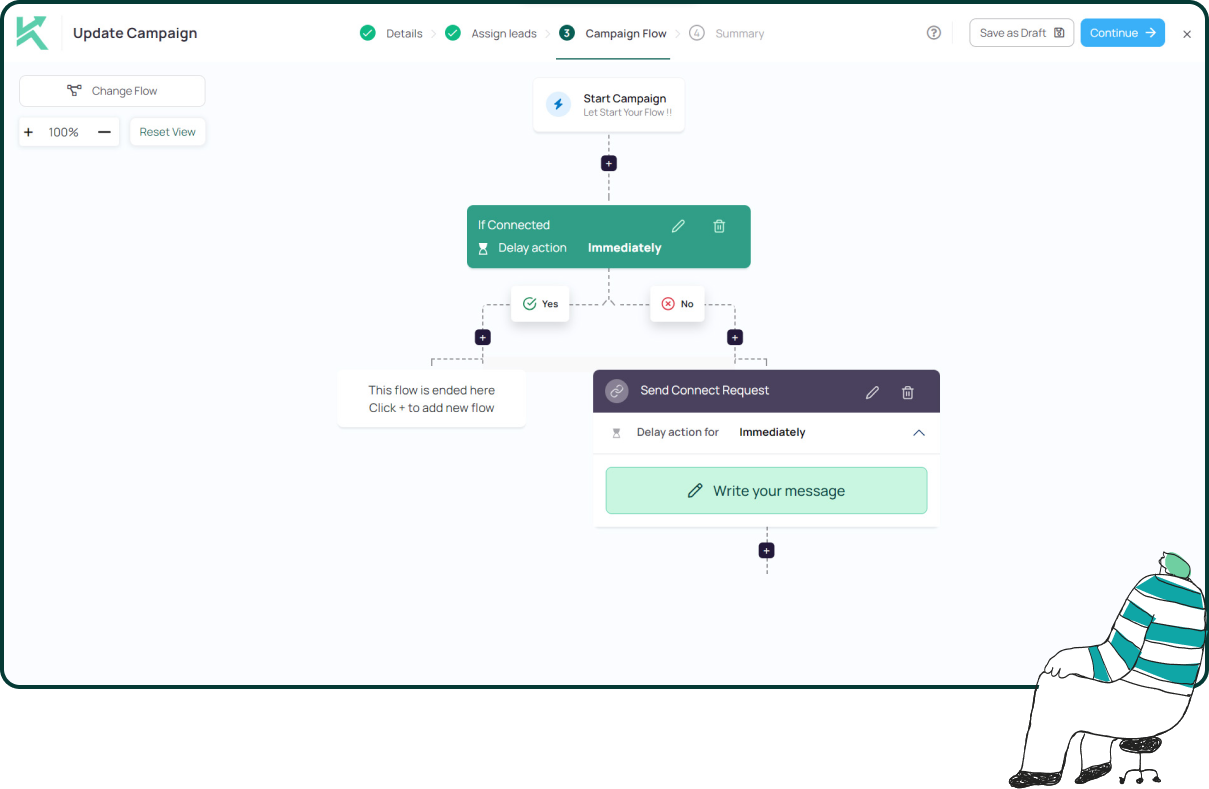
The challenge with multi-stage LinkedIn outreach sequences is that managing them manually — tracking who accepted, who replied, when to follow up, which engagement signals to act on — becomes untenable at scale. Miss a reply and your follow-up lands as spam. Send too fast and your Trust Score drops. Send too slow and the relevance window closes.
Konnector.ai’s Social Signals Intelligence identifies when a prospect has engaged with relevant content, announced a role change, or taken an action that creates a natural opening — then surfaces that trigger as the basis for personalised outreach. The sequencing (connection request, warm message, follow-up) is governed by real-time acceptance rate monitoring, which automatically adjusts volume if your acceptance rate dips below the threshold that protects your account health.
Every message in the sequence requires human approval before it sends. Your brand voice stays yours. The compliance architecture is built in, not bolted on.
📅 Book a Free Demo → See how Konnector.ai manages outreach sequencing for your account type and ICP.
⚡ Sign Up Free → Start building signal-based outreach sequences today.

Further Reading
- LinkedIn First Message Examples and Templates
- Harnessing AI Comments to Boost LinkedIn Engagement
- 7 Templates to Write Compelling LinkedIn Connection Messages
- Re-engaging Lost Customers with Konnector AI
11x Your LinkedIn Outreach With
Automation and Gen AI
Harness the power of LinkedIn Automation and Gen AI to amplify your reach like never before. Engage thousands of leads weekly with AI-driven comments and targeted campaigns—all from one lead-gen powerhouse platform.
Frequently Asked Questions
Send one follow-up message 4–5 business days after your first. If there is still no reply, a second follow-up referencing a new signal or piece of value is reasonable. Beyond two follow-ups, returns drop sharply and the risk of a spam report increases. For high-value prospects who remain unresponsive, escalate to a different channel — InMail or email — rather than continuing to message on LinkedIn.
Yes — tools like Konnector.ai are built specifically for this. Konnector.ai's Social Signals Intelligence identifies trigger events that create natural outreach openings, manages the sequencing from connection request through follow-up, and monitors your acceptance rate in real time to adjust volume before your account health is affected. All public-facing messages require human approval before sending, so your brand voice stays consistent throughout the sequence.
For most cold outreach, a connection request first is the safer and more effective approach. It lets the prospect check your profile before engaging, avoids the unsolicited inbox feel of InMail, and protects your account health. Reserve direct messaging first for senior executives with low acceptance rates or prospects where a time-sensitive trigger event makes immediate contact more relevant.
It depends on the note. Blank connection requests outperform generic notes on acceptance rate — in some tests by as much as 89%. However, including a short, specific, personalised note significantly improves your reply rate after acceptance: 9.36% with a note versus 5.44% without. Only add a note when you have a genuine, specific reason to connect. If you cannot write something relevant to that person specifically, leave it blank.
Keep it under 300 characters. Reference something specific to the recipient — a post they published, a role change, a shared contact, or a relevant trigger event. Do not open with who you are or what your company does. Your profile answers those questions. The first message should open a conversation, not deliver a pitch. Messages that reference recent activity or company news see 27% higher reply rates than name-swapped templates.
Use InMail when the prospect is a senior executive with a predictably low connection acceptance rate, when you have a time-sensitive reason to reach out that cannot wait for acceptance, or when you are running a high-value, low-volume outreach sequence where paying per send is justified by the deal size. InMail delivers directly to the main inbox without requiring acceptance, but it carries a visible "premium outreach" signal that some recipients filter out immediately. How long should I wait after a connection request is accepted before messaging? Send your first message within 24–48 hours of acceptance. Acting quickly keeps you top of mind while your profile is still fresh from when they reviewed it before accepting. Waiting longer reduces context and makes the follow-up feel disconnected from the original request. Does engaging with someone's content before connecting improve results? Yes, substantially. Accounts that like or comment on a prospect's content before sending a connection request consistently achieve acceptance rates above 60%, compared to 20–30% for cold, context-free requests. The engagement makes your name recognisable before the request arrives, which reduces the friction of an unknown sender asking to join their network.