LinkedIn® automation has reached a turning point.
What worked quietly a few years ago now risks account restrictions, reach throttling, or permanent bans if done carelessly. At the same time, manual outreach alone no longer scales for founders, recruiters, sales teams, or job seekers trying to stay visible and relevant.
The question is no longer whether to automate LinkedIn®.
The real question is how to do it safely, sustainably, and in a way that actually builds trust instead of damaging your brand.
This guide breaks down what safe LinkedIn® automation truly means today, why most tools fail this test, and how cloud-based, behaviour-aligned automation has become the gold standard.
Automation does not fail because it exists. It fails when it ignores human behaviour.
Why LinkedIn® is cracking down harder than ever
LinkedIn®’s platform has matured. With over a billion users and millions of daily interactions, trust is the product.
Every algorithm update and restriction introduced in recent years has one goal: protect the user experience. Here is what LinkedIn® is actively targeting.
| LinkedIn®’s priority | What it penalises | Why it matters |
|---|---|---|
| Protect user experience | Spammy, repetitive, or robotic activity patterns | Unnatural spikes and identical engagement sequences get flagged |
| Preserve data integrity | Browser extensions, scraping scripts, local automations | Inconsistent signals are easy to identify against normal behaviour |
| Encourage genuine networking | Bulk operations without context | LinkedIn® wants conversations — not campaigns |

This is why choosing the safest LinkedIn® automation tool is not about features. It is about architecture, pacing, and intent.
The hidden risks of traditional LinkedIn® automation
Many users still associate automation with quick wins. More connections. More messages. More replies. But traditional automation introduces silent risks that compound over time.

Browser-based automation is fragile
Tools that operate through browser extensions or local scripts rely on your device, your IP, and your session state.
- They mirror actions too precisely, creating repetitive behavioural patterns
- They break when browsers update or LinkedIn® changes its structure
- They require constant logins, increasing authentication flags
From LinkedIn®’s perspective, this does not look human. It looks automated.
Speed without context triggers detection
Many automation tools advertise volume as a benefit. But volume without context is exactly what LinkedIn® monitors.
- Sending connection requests back-to-back without natural gaps
- Messaging new connections immediately without prior engagement
- Repeating identical follow-ups regardless of response signals
These behaviours are statistically abnormal. LinkedIn®’s detection systems are built to catch anomalies.
Automation without intent erodes trust
Even if an account avoids restrictions, poor automation damages reputation.
| What prospects feel | What actually happened | The result |
|---|---|---|
| Broadcasted to, not spoken with | Generic message sent to a bulk list | No reply — or worse, a block |
| Transactional, not relevant | Template with no signal context | Low acceptance and reply rates |
| Pressured by follow-ups | Sequence ignores silence and timing cues | Unsubscribes and spam reports |
This is why the best safe LinkedIn® automation is not louder. It is quieter, slower, and smarter.
What safe LinkedIn® automation actually means
Safety in LinkedIn® automation is not a single feature. It is a system. A system designed to blend into normal LinkedIn® behaviour rather than override it.

Behaviour-led automation
Safe automation works best when it closely reflects how real people actually network on LinkedIn®. Instead of sending a burst of requests at once, activity is spread naturally across the day — just as a person would check LinkedIn® between meetings or during short breaks.
A typical behaviour-led LinkedIn® outreach flow looks like this:
- Morning: view a prospect’s profile and follow them — no message sent
- Later that day: like or comment on a relevant post they have shared
- Next day: send a short, context-aware connection request
- After connection: tailor follow-ups based on whether the person accepts, ignores, or replies
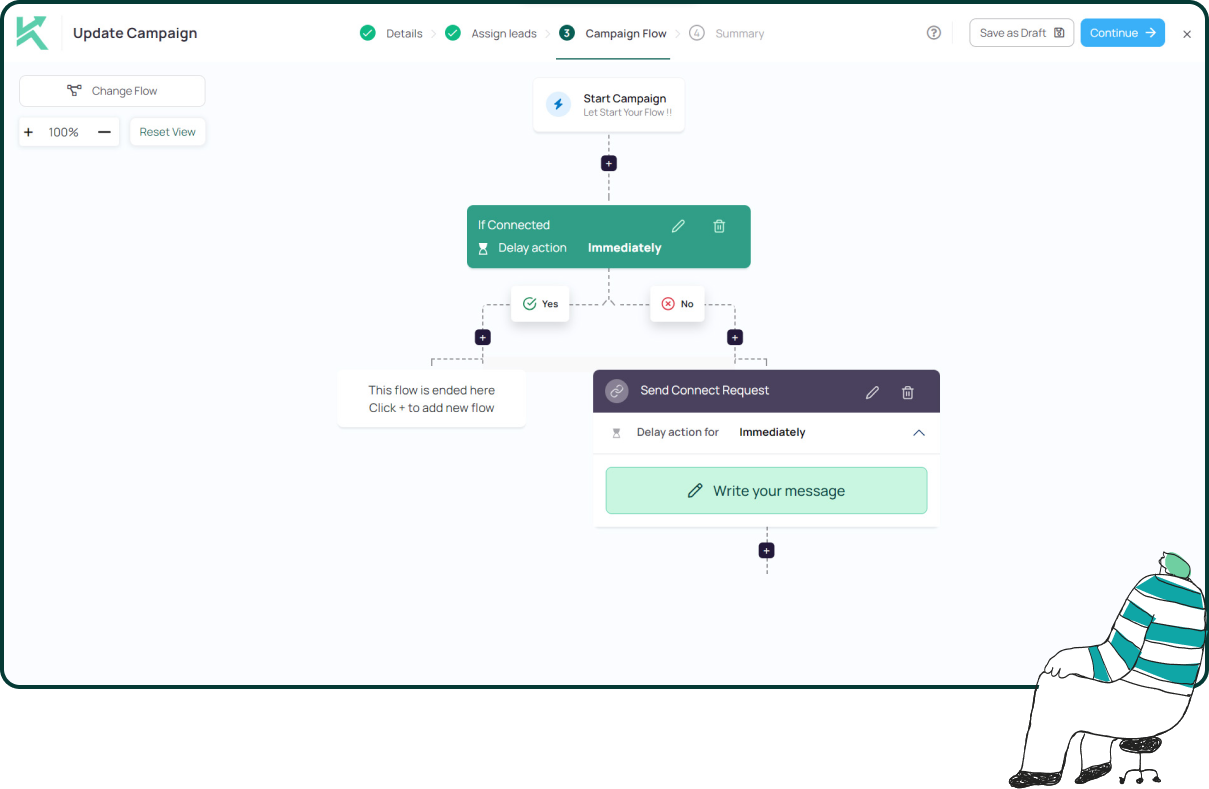
Engagement comes before outreach. Familiarity is built before a message ever lands in the inbox. This is something you can run directly inside Konnector’s campaign builder — choosing your interval, your actions, and your tone at each stage.
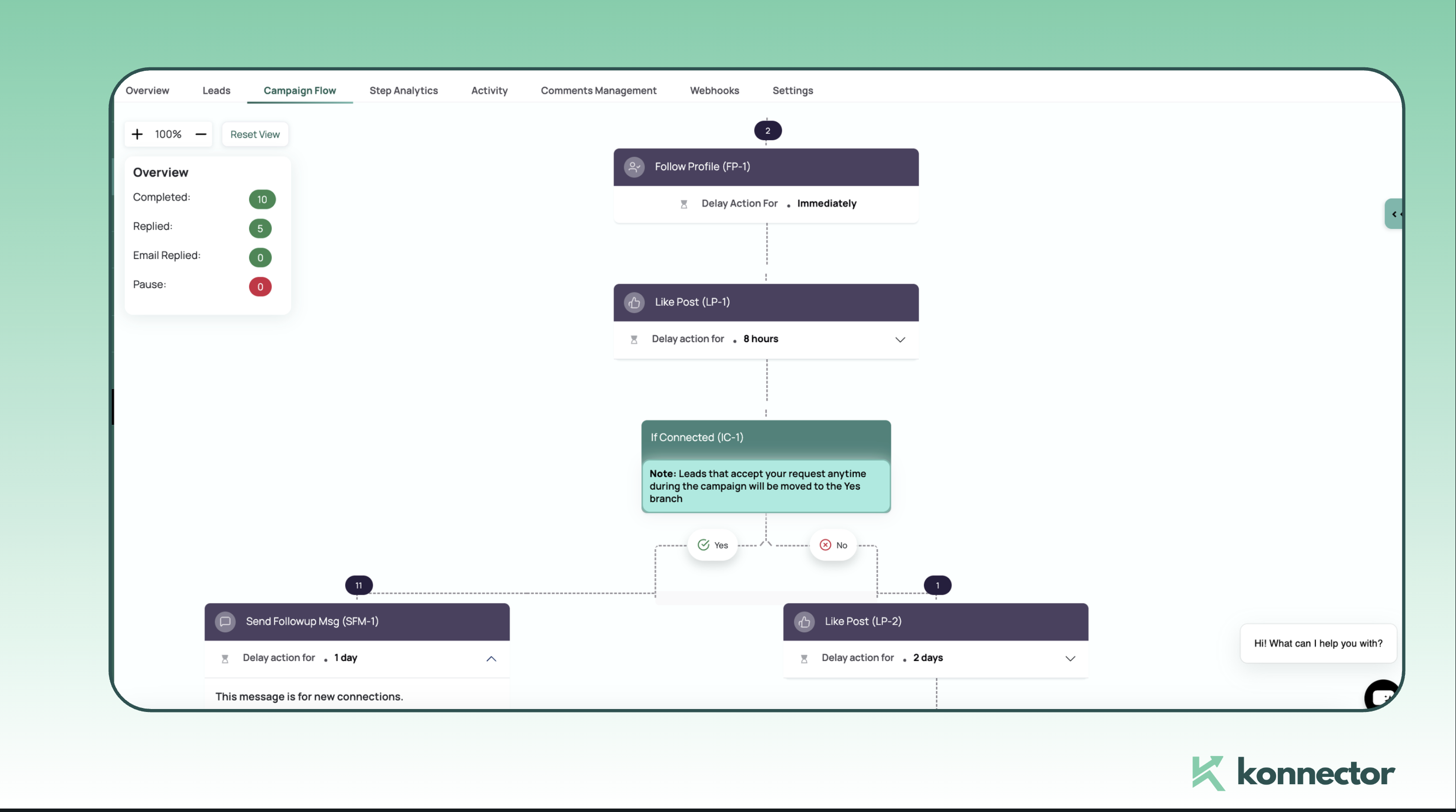
This keeps LinkedIn® lead generation feeling human, reduces friction, and helps conversations develop naturally rather than feeling scripted.
Respect for LinkedIn®’s rate thresholds
LinkedIn® does not publish exact limits — but it enforces consistency. Safe automation never pushes limits. It operates comfortably within them.
| Activity type | Risky approach | Safe approach |
|---|---|---|
| Connection requests | Maximum volume from day one | Gradual ramp-up over days and weeks |
| Message volume | Immediate high-volume sends | Aligned with recent account activity |
| Daily patterns | Same activity level every day | Varied idle and active days — like a real person |
Konnector is built to keep your outreach within safe limits. The pre-set defaults come with user-defined safety thresholds so your campaign is never put at risk.

Trust signals over tactics
Modern LinkedIn® automation performs best when it aligns with the signals LinkedIn® already values — signals that reflect real, human networking behaviour.
- Profile views before messages: Mirrors natural curiosity. Makes outreach feel expected rather than intrusive.
- Content engagement before connection requests: Likes, follows, or comments build familiarity and lower resistance.
- Conversation-based follow-ups: Effective follow-ups respond to behaviour — acceptance, replies, or silence — instead of forcing every lead through the same rigid sequence.
This signal-led approach is what separates automation that scales safely from automation that quickly burns accounts.
Konnector is built to recognise and act on LinkedIn® social signals. It uses profile views, content engagement, and response behaviour to shape campaign flow — so automation supports natural conversations instead of overriding them.
Why cloud-based LinkedIn® automation is now the safest option
Cloud-based LinkedIn® automation has emerged as the safest and most reliable approach — not because it does more, but because it does less, more intelligently.
| Risk factor | Browser-based tools | Cloud-based tools (Konnector) |
|---|---|---|
| Device dependency | Relies on your local machine — crashes affect outreach | Runs independently — no device risk |
| Browser fingerprinting | Trackable fingerprints per session | No browser fingerprint exposure |
| IP consistency | Varies with personal IP fluctuations | Dedicated IP per account — consistent session |
| Activity timing | Often fires in predictable bursts | Randomised delays that mirror human pacing |
| Scaling approach | Aggressive volume increases | Horizontal scale — low intensity across campaigns |
This stability significantly reduces detection risk. Cloud-based automation scales without becoming aggressive. Multiple campaigns run at low intensity. Outreach adapts per audience segment. Volume increases only when trust signals exist.
What the safest LinkedIn® automation tools do differently
The difference between risky automation and safe automation lies in philosophy. The safest tools share common principles.

They automate engagement, not just messages
Safe outreach does not start with a pitch.
- Profile views warm up visibility
- Post engagement builds familiarity
- Connection requests feel earned — not random
This sequencing aligns with how LinkedIn® users expect to be approached. It creates interaction patterns that feel organic to both recipients and LinkedIn®’s systems.
They respect silence
One of the biggest mistakes in automation is over-follow-up. The safest tools treat silence as a signal — not an error.
- No response triggers a pause, not another message
- Follow-ups are spaced, contextual, and limited
- Campaigns adapt when interest is unclear
Respecting silence builds brand trust and platform safety simultaneously. Wondering what actually drives more LinkedIn® replies? Relevance and timing beat volume every time.
They keep messages human
Automation should never sound automated.
- Short, conversational language
- No forced personalisation tokens
- Open-ended prompts instead of hard calls to action
When messages feel human, recipients respond like humans.
Automation works best when people forget it is automation.
Why trust is the real metric that matters
Success on LinkedIn® is not measured by how many messages you send. It is measured by how often people want to reply.
| Metric | What bad automation produces | What safe automation produces |
|---|---|---|
| Reply rate | 3 to 5% — low engagement, high ignore rate | 15 to 30%+ — contextual, signal-triggered messages |
| Acceptance rate | 15 to 25% — cold, context-free requests | 50 to 70% — warm, engagement-led outreach |
| Account health | Declining Trust Score over time | Stable to improving — human behaviour patterns maintained |
| Brand perception | Spammy — prospects feel broadcasted to | Credible — prospects feel spoken with |
Safe automation protects not just your account. It protects your professional reputation.
The future of LinkedIn® automation is intentional
The teams that win on LinkedIn® going forward will not be the loudest. They will be the most intentional.
- Automation used to support conversations — not replace them
- Technology that adapts to behaviour instead of forcing it
- Systems designed for trust, not shortcuts
This is where modern, cloud-based, safety-first automation is headed. And it is the architecture Konnector’s Smart Sequences are built on — if/then conditional logic that responds to what prospects actually do, not what a fixed calendar assumes they will do.
Choosing the safest LinkedIn® automation tool
If you are evaluating LinkedIn® automation, ask yourself one question.
Does this tool help me behave more like a thoughtful human — or more like a machine?
The safest tools do not promise instant scale. They promise consistency, protection, and credibility. When automation is built to respect LinkedIn®’s ecosystem, it becomes an asset — not a liability.
Check the most updated LinkedIn® automation limits before you build your next campaign. And if you want to see what behaviour-led, cloud-based outreach looks like running on your actual ICP — book a demo with Konnector and we will walk through it together.
Or sign up and start your first safe LinkedIn® automation campaign today.
The best outreach does not just reach inboxes. It earns replies.
Further reading
- Understanding LinkedIn® Social Signals with Konnector
- Smart Sequences: LinkedIn® Automation with If/Then Logic
- What Drives More LinkedIn® Replies in 2025
- How to Automate LinkedIn® Without Getting Restricted
- LinkedIn® Outreach Strategy for B2B: What Works Now
- Tracking Social Signals: LinkedIn® Outreach for Sales Teams
11x Your LinkedIn® Outreach With
Automation and Gen AI
Harness the power of LinkedIn® Automation and Gen AI to amplify your reach like never before. Engage thousands of leads weekly with AI-driven comments and targeted campaigns—all from one lead-gen powerhouse platform.
Frequently Asked Questions
The safest LinkedIn® automation tools in 2026 are cloud-based platforms that mimic natural human behavior, respect LinkedIn®’s activity limits, and prioritise engagement before outreach. These tools avoid browser extensions and aggressive volume, reducing the risk of restrictions or bans.
Cloud-based LinkedIn® automation does not rely on your local browser, device fingerprint, or IP address. This removes many of the technical signals LinkedIn® uses to detect automation, making cloud-based tools significantly safer and more stable long term.
Yes, unsafe automation can still result in warnings, temporary restrictions, or permanent bans. This usually happens when tools send high volumes too quickly, repeat identical actions, or ignore natural timing and engagement signals. Safe automation focuses on pacing, relevance, and intent.
Safe LinkedIn® automation typically includes profile views, post engagement, connection requests, and follow-up messages—when these actions are spaced naturally, personalised thoughtfully, and aligned with LinkedIn®’s usage patterns.
There is no fixed public limit, but safe automation tools keep connection requests well below risky thresholds and gradually increase activity over time. Consistency and pacing matter more than hitting a specific number.
LinkedIn® discourages aggressive or abusive automation, especially tools that scrape data or create spam-like behavior. Automation that respects rate limits, avoids scraping, and mirrors genuine user actions is far less likely to trigger enforcement.
Human-feeling automation focuses on short, conversational messages, avoids forced personalisation, respects silence, and engages with content before initiating conversations. The goal is to support real dialogue, not broadcast messages.
Yes. When used correctly, safe LinkedIn® automation can support sales outreach, recruitment networking, and job searching by handling repetitive actions while keeping conversations intentional and relevant.
Safe automation is designed for sustainable growth, not instant spikes. Most users begin seeing higher acceptance rates and more meaningful replies within a few weeks as trust signals build.
Look for cloud-based infrastructure, behaviour-led pacing, engagement-first workflows, transparent safety controls, and messaging that prioritises relevance over volume. A good tool should help you build trust, not chase numbers.