The honest answer to “Is it better to send a LinkedIn connection request with or without a note?” is “it depends on what you’re trying to achieve”.
If your goal is simply to grow your network fast, a blank connection request often works just fine. But if you’re using LinkedIn to generate conversations, leads, or real pipeline, adding a short, relevant note can significantly improve the quality of people who accept your invite.
Here’s the catch though — a vague note is worse than no note at all. “Hi, let’s connect” doesn’t build trust. Relevance does.
So the real question isn’t “note or no note?” It’s: Are you optimizing for acceptance rate — or for qualified conversations?
The LinkedIn debate that refuses to die
- Team Blank Invite: “Less friction. More accepts.”
- Team Note: “Personalization wins. Always.”
Here’s our take at Konnector.ai: the “right” answer depends on what you’re optimizing for — network size or qualified conversations.
Start with the metric that actually matters
- Acceptance rate = a top-of-funnel signal.
- Qualified replies / booked calls = the outcome.
- If your goal is “hit 500+ connections fast,” don’t overthink it.
- If your goal is “start real conversations with the right buyers,” your connection strategy should behave like a filter.
What Konnector.ai sees in real outreach workflows?
- Most people lose deals before the first message — because the invite feels random, suspicious, or irrelevant.
- A note is not a pitch. It’s a context cue: “Why you?” + “Why now?” in one breath.
- When notes work best: they reduce confusion and pre-qualify interest.

Data-backed reality check: notes don’t change acceptance much… but can change outcomes
- A large A/B test conducted by us across 10,000 users found acceptance rates were very close across approaches:
- No note: 30%
- Honest/direct note: 27%
- Vague note: 31%
- But when they tracked qualified calls booked, the “honest/direct note” approach performed best:
- No note: 3.77%
- Honest/direct note: 6.62%
- Vague note: 5.1%
Translation: if you care about pipeline, acceptance rate alone is a distraction. The connection request is part of a conversion system, not a vanity metric.
So… should you add a note?
Is It Better to Send a LinkedIn Connection Request With or Without a Note?
| Your Goal | Best Approach | Why It Works |
|---|---|---|
| Grow your network quickly | Send a blank connection request | Reduces friction and often performs just fine for broad network expansion. |
| Start meaningful conversations | Add a short, relevant note | Creates context, builds trust, and improves the chances of quality replies. |
| Generate pipeline / book calls | Add a clear and transparent note | Acts as a filter so only interested prospects accept, leading to better downstream conversion. |
| No clear context or relevance | Skip the note | A vague note is worse than no note and can reduce credibility. |
Important: Don’t optimize for acceptance rate alone. Measure replies and qualified conversations — that’s what actually drives revenue.
The biggest mistake: writing a note that says nothing
- “LinkedIn suggested you…”
- “Would love to connect”
- “Let’s connect and explore synergies”
At Konnector.ai, we treat these as “trust-killers.” If you’re going to write a note, it needs to earn its 300 characters.
The Konnector rule: Relevance in 3 parts
- Why you: a specific trigger (post, role, company change, shared community)
- Why me: one-line credibility (what you do, for whom)
- Low-pressure next step: connect / quick question / exchange notes
5 high-performing connection note templates (under 300 characters)
- Post-based: “Hi {{FirstName}} — loved your post on {{topic}}. I work with {{persona}} on {{outcome}} and your take was spot-on. Open to connecting?”
- Peer-to-peer: “Hi {{FirstName}} — I’m also in {{industry/role}} and always enjoy connecting with people building in this space. Would love to connect.”
- Mutual connection: “Hi {{FirstName}} — saw we’re both connected to {{MutualName}}. I work on {{1-line}} and thought it’d be great to connect.”
- Direct (but not salesy): “Hi {{FirstName}} — I help {{persona}} improve {{result}} via LinkedIn. If this is on your radar this quarter, happy to connect and share a few quick wins.”
- Curiosity question: “Hi {{FirstName}} — quick one: are you currently focused more on {{A}} or {{B}} this quarter? I’m researching patterns in the space and would love to connect.”
Read more—-> Extracting Leads from LinkedIn
What to A/B Test (The Konnector Way)
If you really want to know whether a LinkedIn connection note works for your audience, don’t rely on opinions. Run structured A/B tests. The key is to control variables and track outcomes beyond vanity metrics.

1️⃣ Blank vs. Note (Control the Audience Variables)
Create two audiences that are as identical as possible:
- Same persona (e.g., Marketing Directors)
- Same seniority band (avoid mixing Managers with C-level)
- Same industry and geography
- Similar company size
Send blank connection requests to Audience A and a short, relevant note to Audience B.
Why this matters: If you change industries or seniority levels mid-test, your results become unreliable. At Konnector.ai, we always isolate variables to ensure the test reflects messaging impact — not audience bias.
2️⃣ Test Different Note Types
Not all notes perform the same. Once you confirm that “Note vs Blank” shows meaningful differences, test the format of the note itself.
- Post-based: Referencing a recent post or insight.
- Mutual connection-based: Highlighting shared networks.
- Direct & transparent: Clearly stating why you’re reaching out.
For example:
- “Loved your post on RevOps alignment — especially the point on attribution models.”
- “Saw we’re both connected to Sarah from HubSpot — thought I’d reach out.”
- “I help SaaS teams improve LinkedIn-driven pipeline — open to connecting if that’s relevant this quarter.”
What we’ve observed at Konnector.ai: Highly prospected audiences (founders, CMOs, agency owners) respond better to direct transparency than to vague personalization.
3️⃣ Track Outcomes Beyond Acceptance Rate
This is where most LinkedIn outreach strategies fail.
- Acceptance rate tells you if your invite felt safe.
- Reply rate tells you if your message created curiosity.
- Qualified calls booked tell you if your strategy works.
At Konnector.ai, we encourage users to measure the full funnel:
- Connection accepted
- First message reply
- Positive reply
- Meeting booked
Sometimes a lower acceptance rate leads to a higher booked-call rate — because your note acted as a filter. That’s not a loss. That’s efficiency.
4️⃣ Test Volume vs. Warm-Up Strategy
One advanced test many overlook:
- Group A: Send connection immediately.
- Group B: Engage with 1–2 posts first, then send connection.
Social warm-up often increases trust significantly — especially with senior buyers.
This is where signal-based prospecting becomes powerful. Instead of guessing timing, Konnector.ai surfaces engagement signals so outreach feels contextual, not automated.
Read more—-> How to Network on LinkedIn: 5 Do’s and Don’ts for You to Know
Final Testing Rule
Run each variation on at least 200–300 prospects before drawing conclusions. Anything smaller creates misleading data.
The Konnector mindset: Don’t argue opinions. Test variables. Track conversions. Optimize for revenue — not acceptance rate.
The Smarter 2026 Strategy: Warm Up First, Then Connect
LinkedIn in 2026 is not the LinkedIn of 2018.
Decision-makers are more aware. Their inboxes are crowded. And they can spot automated outreach in seconds.
That’s why the highest-performing outreach strategies no longer start with a connection request. They start with visibility.
Step 1: Create Familiarity Before Sending the Invite
Instead of immediately sending a connection request, engage first:
- View their profile
- Follow them
- Leave 1–2 meaningful comments on recent posts
Not emojis. Not “Great post!”
Real comments that add perspective, ask a smart question, or build on their point.
Why this works:
- Your name appears in their notifications.
- You establish credibility before asking for anything.
- The connection request no longer feels random.
By the time your invite arrives, you’re not a stranger — you’re someone who has already contributed.
Step 2: Send the Connection Request (Context Matters)
Now you can either:
- Send a blank invite (because recognition already exists), or
- Send a short note referencing your interaction.
For example:
- “Enjoyed your post on RevOps alignment earlier this week — would love to connect.”
This isn’t cold outreach anymore. It’s a continuation of interaction.
Read more—-> The Psychology of the LinkedIn Outreach DM: 5 Templates That Actually Get a Response
Why Warm-Up Dramatically Improves Results
In Konnector.ai campaign analyses, warm-up sequences consistently outperform cold-first connection requests in:
- Acceptance rate
- Reply rate
- Positive sentiment in first response
Because psychologically, familiarity reduces friction.
People trust names they’ve already seen.
And LinkedIn’s algorithm favors accounts that behave like humans — not bulk senders.
Signal-Based Outreach vs. Spreadsheet Outreach
The old way of doing LinkedIn outreach was spreadsheet-driven:

The 2026 way is signal-driven:

This is where Konnector.ai is built differently.
Instead of treating LinkedIn like a database, Konnector.ai surfaces social signals and intent cues — so you know who is active, who is engaging, and who is more likely to respond. That allows outreach to feel natural instead of automated.
The Strategic Advantage
When you warm up before connecting:
- You reduce suspicion.
- You increase relevance.
- You filter for engaged prospects.
- You improve downstream conversion.
The goal is not to “send more invites.”
The goal is to enter conversations at the right moment.
And in 2026, timing beats volume every time.
Final answer
- If you want maximum accepts: blank invite is often fine.
- If you want qualified conversations: write a short, specific note that creates clarity and filters interest.
- If your note is generic: skip it.Want this to be predictable (and scalable) without sounding automated? Konnector.ai helps you spot intent using social signals, warm up leads with human-approved engagement, and run outreach that feels natural — while still tracking what actually converts.
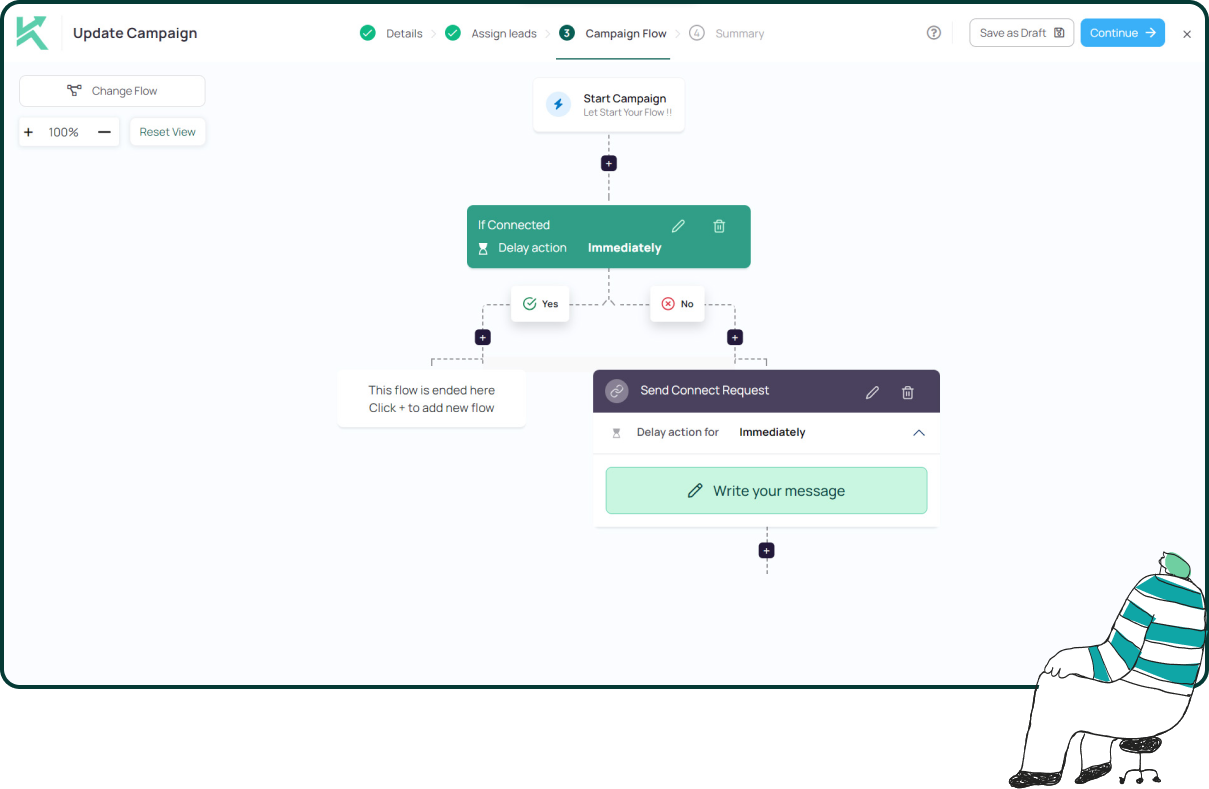
11x Your LinkedIn Outreach With
Automation and Gen AI
Harness the power of LinkedIn Automation and Gen AI to amplify your reach like never before. Engage thousands of leads weekly with AI-driven comments and targeted campaigns—all from one lead-gen powerhouse platform.
Frequently Asked Questions
No. If you don’t have specific context or relevance, a blank invite is often better than sending a vague note. Add a note only when it creates clarity, builds trust, or filters for genuine interest.
Not significantly in most cases. Acceptance rates between blank invites and notes are often similar. However, a transparent and relevant note can improve reply rates and qualified conversations downstream.
The best-performing notes are short (under 300 characters), specific, and contextual. They typically reference a shared interest, recent post, mutual connection, or clearly state why you’re reaching out without pitching.
If your goal is simply to grow your network, blank requests work well. But if your goal is lead generation or sales conversations, a short and relevant note can act as a filter and improve conversion quality.
Yes. LinkedIn limits notes to 300 characters. That’s why clarity and specificity matter — you don’t have room for fluff or long sales messages.
Reply rate and qualified calls matter more. Acceptance rate only tells you whether someone accepted your invite. It does not measure whether they are interested in having a conversation.
The most effective strategy is warm-up first, then connect. Engage with posts, create familiarity, and use social signals to time outreach. This increases trust and improves downstream conversion compared to cold-first outreach.