LinkedIn automation in 2026 sits in a strange place.
It’s everywhere — and yet more people than ever are seeing warnings, temporary restrictions, and sudden drops in account visibility.
The issue isn’t automation itself.
It’s that many automation tools are still operating on assumptions from 2019, when volume mattered more than relevance and repetition went largely unnoticed.
Today, LinkedIn doesn’t penalize the act of automation.
It penalizes careless behaviour — patterns that look repetitive, indifferent to context, or disconnected from how real professionals actually use the platform.
Automation that respects timing, intent, and context still works.
Automation that treats LinkedIn like a contact database does not.
LinkedIn doesn’t ban automation. It bans behaviour that looks careless, repetitive, or indifferent to context.
This guide breaks down what actually works in 2026 — what gets accounts restricted, what keeps them safe, and how modern tools (including Konnector.AI) approach outreach without tripping LinkedIn’s enforcement systems.
Will LinkedIn Ban Me for Using Automation in 2026?
Short answer: Yes — if you automate the wrong way.
Real answer: LinkedIn bans patterns, not tools.
In 2026, LinkedIn’s detection systems focus on:
-
- Repetitive sequencing(same action → same delay → same follow-up)
- Context-blind messaging (messages unrelated to profile, activity, or role
- Velocity mismatches (sudden spikes in connections or messages)
- Tool fingerprints (outdated browser automation behaviour)
Automation that mimics focused human work survives.
Automation that mimics bulk processing does not.
What Is the Current LinkedIn Weekly Connection Request Limit (2026)?
As of 2026, LinkedIn enforces dynamic limits, not a single fixed number.

Accounts with strong engagement history, high acceptance rates, and consistent activity may safely sit at the upper end. New or recently restricted accounts should stay lower.
Acceptance rate matters more than volume. Anything below ~20% consistently puts your account at risk.
Read more—-> LinkedIn Limits in 2026: A Comprehensive, Fact-Checked Guide
Chrome Extension vs Cloud-Based Tools: Which Is Safer?
This is one of the most searched questions — and for good reason.
| Automation Type | Pros | Cons |
|---|---|---|
| Chrome Extensions |
|
|
| Cloud-Based Tools |
|
|
In 2026, cloud-based tools with conservative activity models are statistically safer than browser extensions.
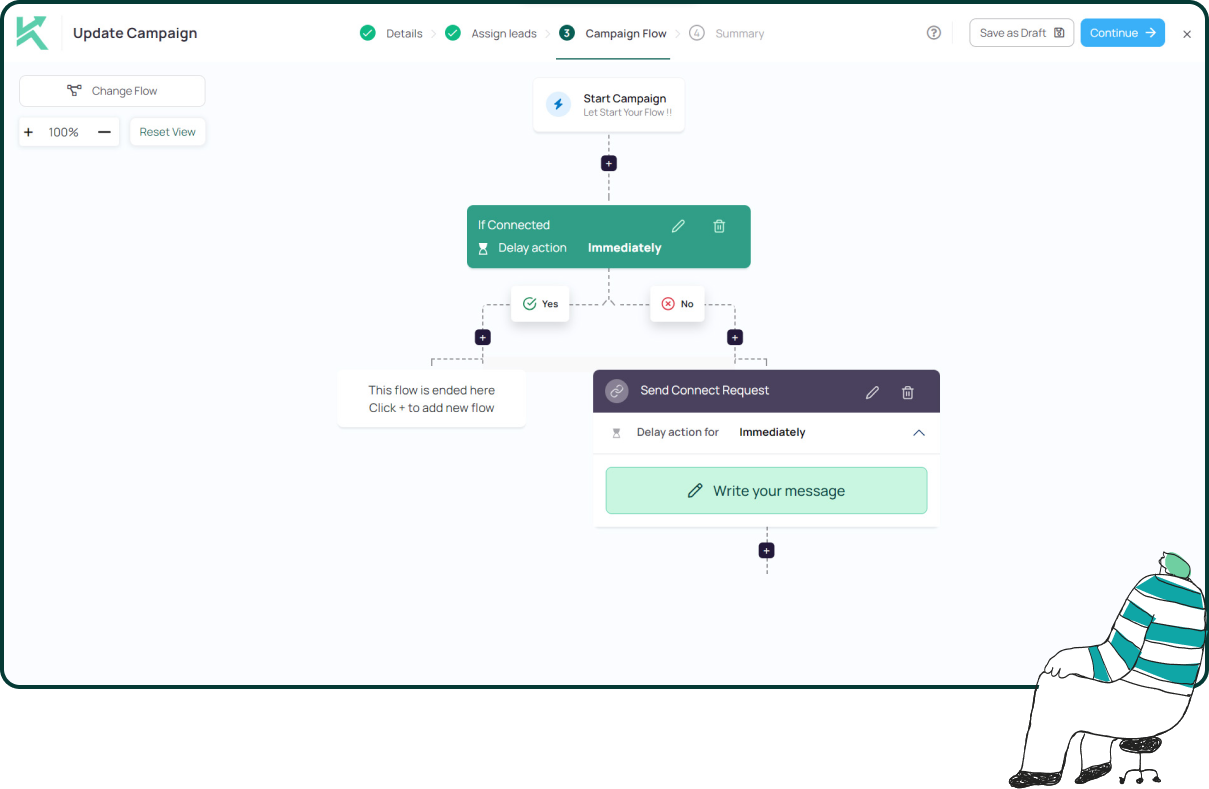
Konnector.AI uses a hybrid execution model, combining controlled browser-based actions with cloud-orchestrated logic. This allows actions to run in a real LinkedIn session when required, while decision-making, pacing, and sequencing are managed centrally, reducing repetitive browser-level abuse patterns without misrepresenting itself as an official LinkedIn API.
How Do I Avoid LinkedIn Jail (Temporary Restrictions)?
LinkedIn Jail usually lasts between 3 and 14 days.
Avoiding it comes down to discipline, not clever hacks.

Konnector supports warm-up style actions(views, follows, engagement) as part of outreach flows, not as volume drivers, but as visibility signals.
Read more—-> How to Prevent Your LinkedIn Account from Being Banned After Using Automation Tools
Can LinkedIn Detect “Human-Like” Randomized Delays?
Yes — and this surprises many people.
LinkedIn doesn’t look for randomness.
It looks for natural variance around intent.
Pure random delays (e.g. 37s, 92s, 14s) repeated across accounts are a red flag.

True human behaviour isn’t random — it’s purpose-driven.
What Should I Do If My LinkedIn Account Gets Restricted?
If you get restricted:
1. Stop all automation immediately
2. Log in manually and acknowledge LinkedIn’s notice
3. Avoid any activity for 48–72 hours
4. Resume with manual actions only
Do not:
• Appeal aggressively
• Switch IPs mid-restriction
• Create replacement “ghost” profiles
Most restrictions are behavioural resets, not permanent bans.
Read more—-> What to Do If Your LinkedIn Account is Restricted?
The Real Rule for LinkedIn Automation in 2026
Automation works in 2026 only when it respects three fundamentals:
• Timing — actions occur when they make sense, not simply because a step exists in a sequence. • Context — messages align with who the person is, what they do, and how they engage on LinkedIn. • Restraint — volume is controlled, consistent, and subordinate to acceptance and response quality.
The safest automation doesn’t try to look human.
It behaves like a focused professional doing intentional work.
When automation ignores these principles, LinkedIn sees it as noise.
When it follows them, LinkedIn treats it as normal platform usage — even at scale.
If you treat LinkedIn like a database, you’ll eventually get restricted.
If you treat it like a professional network, automation becomes a force multiplier for what already works manually.
This shift in thinking is why some tools fail and others succeed in 2026.
Konnector.AI is built for this exact reality — combining conservative execution, intent-driven lead discovery, warm-up visibility actions, and structured personalization without crossing into risky automation behaviour or pretending to be an official LinkedIn API.
If you’re the kind of reader who cares less about blasting out the most messages and more about protecting your account, your reputation, and your long-term outreach results, it’s worth seeing how Konnector approaches LinkedIn automation differently.
11x Your LinkedIn Outreach With
Automation and Gen AI
Harness the power of LinkedIn Automation and Gen AI to amplify your reach like never before. Engage thousands of leads weekly with AI-driven comments and targeted campaigns—all from one lead-gen powerhouse platform.
Frequently Asked Questions
Yes, LinkedIn automation is safe in 2026 when used conservatively. LinkedIn does not ban automation outright but restricts accounts that show repetitive, high-volume, or context-blind behaviour. Tools that respect timing, relevance, and consistency are far less likely to trigger enforcement.
LinkedIn typically bans patterns, not tools. Accounts get restricted due to spam reports, low acceptance rates, sudden activity spikes, or outdated automation behaviour — not simply because automation is used.
LinkedIn uses dynamic limits in 2026. Most stable accounts safely send around 80–120 connection requests per week, or 15–25 per day, depending on account history and acceptance rate.
A healthy acceptance rate is generally above 20%. Consistently low acceptance rates signal poor targeting or spam-like behaviour and increase the risk of restrictions.
Chrome extensions carry a higher detection risk in 2026 because they are tightly tied to your local browser fingerprint and are more vulnerable to LinkedIn interface changes. Cloud-based or hybrid tools are generally safer when properly throttled.
Tools that use conservative cloud execution, structured personalization, and controlled pacing are statistically safer than aggressive browser-only automation or API-mimicking tools.
“LinkedIn Jail” refers to temporary account restrictions, usually lasting 3 to 14 days. These are typically behavioural resets rather than permanent bans and are triggered by excessive or spam-like activity.
Yes. LinkedIn looks for behavioural consistency, not randomness. Artificially random delays repeated across actions or accounts can still be flagged. Purpose-driven, naturally paced activity is safer.
Sales Navigator does not protect accounts from bans, but it improves targeting quality. Better targeting often leads to higher acceptance rates, which indirectly reduces automation risk.
LinkedIn does not explicitly detect AI-written text, but generic, repetitive, or low-context messages — whether written by AI or humans — are more likely to be reported by users.