For a long time, automation success was judged by one thing alone: output.
More profile visits. More connection requests. More messages sent per day.
Speed was performance.
Volume was validation.
That definition worked when LinkedIn’s systems were simpler and automation signals were easier to bypass. It no longer works today.
In 2025, performance is not about how fast you move. It is about how long you can keep moving.
LinkedIn Has Changed the Rules
LinkedIn’s priority today is trust.
Not just who you connect with, but how you behave while doing it.
Not just what actions you take, but how consistently and naturally those actions occur over time.
Behind the scenes, LinkedIn evaluates behaviour patterns across sessions, devices, and timelines. The platform is no longer reacting to individual actions. It is interpreting intent.
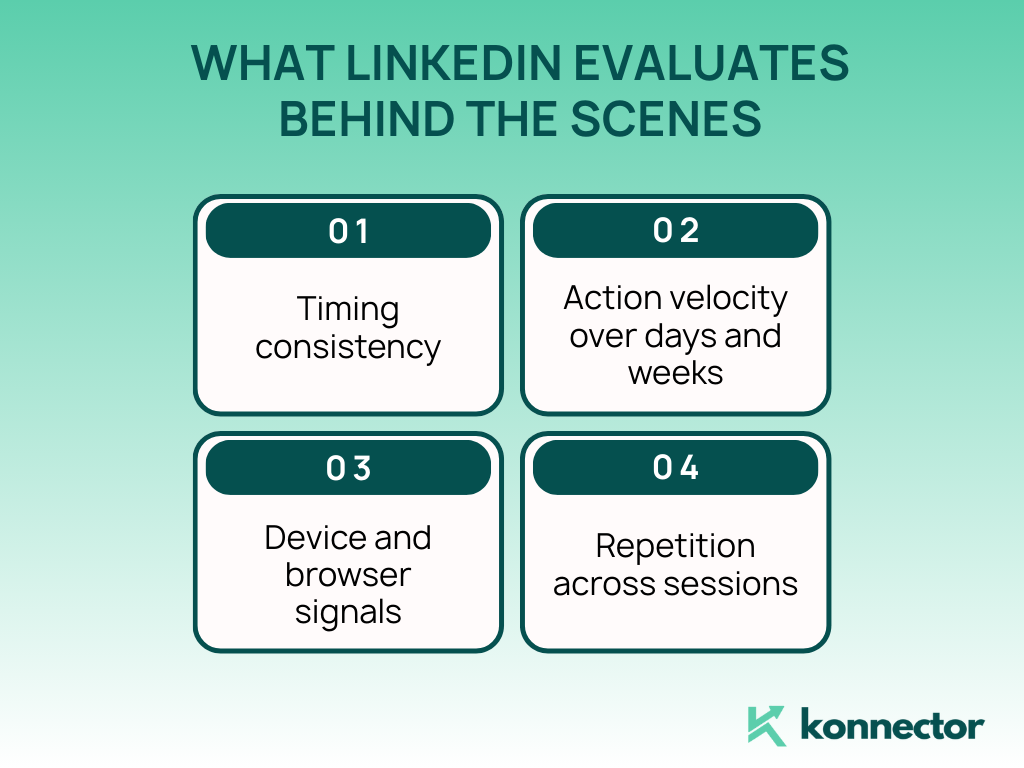
What LinkedIn Evaluates Behind the Scenes
Timing consistency: It is one of the strongest signals LinkedIn uses to identify automated behaviour. Real users do not act at perfectly even intervals. They pause to read, get distracted, switch tabs, or stop mid-task. Automation, when poorly paced, tends to operate on clean, predictable timing. Over days and weeks, this consistency forms a behavioural rhythm that feels efficient but unnatural.
Action velocity over days and weeks: LinkedIn does not evaluate actions in isolation. It looks at how activity accumulates over time. When similar volumes of profile visits, connection requests, or messages occur day after day with minimal variation, it signals orchestration rather than intent. Even moderate activity can look risky if it follows the same pattern consistently.
Device and browser signals: Every session carries technical identifiers such as browser type, version, extensions, and interaction behaviour. Browser-based automation exposes these signals repeatedly, tying automated actions to the same device fingerprint. Over time, this creates a recognisable pattern that is easier to flag.
Repetition across sessions: One-off behaviour rarely triggers restrictions. Repetition does. When the same actions occur in the same order, with similar timing, across multiple sessions, LinkedIn begins to recognise structure. Humans vary naturally. Automation must be designed to do the same.
This is why automation tools are now judged by behaviour, not volume.
How Browser Extension Automation Really Works
Browser-based automation tools operate inside your live browser session.
They click where you click.
They scroll where you scroll.
They type where you type.
On the surface, this feels safe because everything looks familiar. You can see the actions happening in real time. It feels controlled.
But technically, it creates exposure.
The Risk Is Not What You Do, But How Visible It Is
When automation runs inside your browser, LinkedIn sees everything tied to that session.
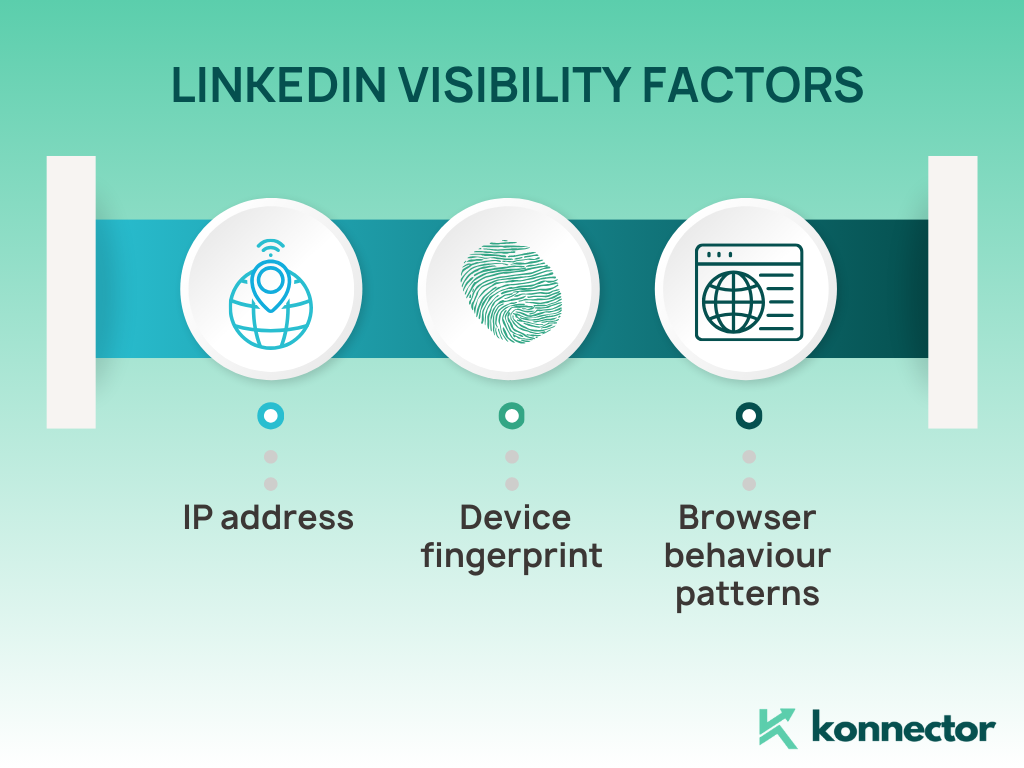
- Your real IP address
- Your device fingerprint
- Your browser behaviour patterns
Even when daily limits are respected, browser extensions often repeat the same interaction flows with machine-level consistency. Timing becomes predictable. Behaviour becomes recognisable.
That pattern similarity is often what triggers restrictions, not aggressive volume.
Why Browser-Based Automation Breaks at Scale
Many users report similar experiences.
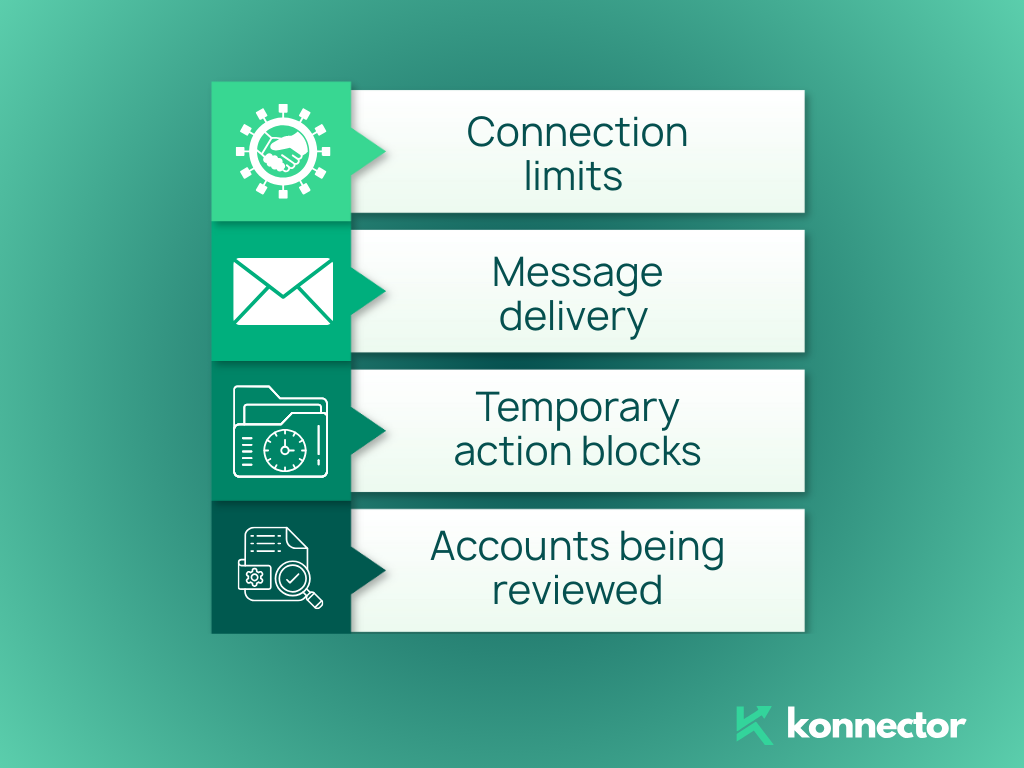
- Connection limits appearing earlier than expected
- Message delivery suddenly dropping
- Temporary action blocks without a clear cause
- Accounts being reviewed despite “safe” usage
The intent is usually fine.
The execution is not invisible enough.
Browser extensions were built for control and immediacy, not long-term stability.
Cloud-Based Automation Takes a Different Approach
Cloud-based automation does not try to imitate human clicks.
Instead, it focuses on orchestration.
Actions are queued, scheduled, and distributed intelligently. Behaviour is paced across time, not executed instantly.
What Changes From LinkedIn’s Perspective
LinkedIn no longer sees mechanical repetition.
It sees normal professional behaviour.
- Natural spacing between actions
- Variable timing across sessions
- Activity that aligns with real-world usage patterns
Cloud automation is not about looking human in the moment. It is about behaving human over time.
Why Safety Has Become the Real Performance Metric
Old performance metrics rewarded intensity.
- Maximum daily actions
- Fastest campaign execution
- High-volume outreach
Modern performance rewards continuity.
- Uninterrupted campaign runtime
- Inbox access preservation
- Account credibility
- Results that compound week after week
An outreach system that constantly gets paused, reviewed, or reset is not high-performing, even if the initial numbers look impressive.
Safety enables momentum. Momentum creates real results.
Konnector’s Philosophy: Safety Is the System
Konnector was built with a clear principle.
If LinkedIn does not trust your account, nothing else matters.
That is why safety is not a setting or a workaround. It is embedded into how campaigns run.
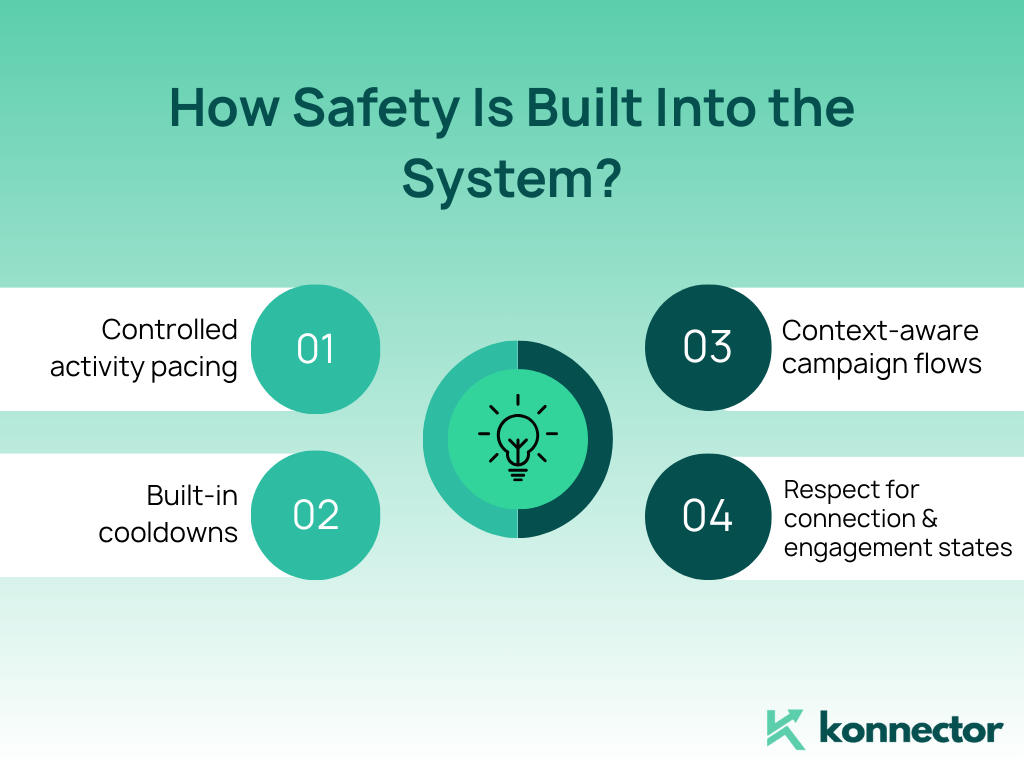
How Safety Is Built Into the System?
Controlled activity pacing: Every action is intentionally spaced to avoid unnatural bursts. Instead of executing tasks as fast as possible, activity is distributed across time to reflect how real professionals use LinkedIn during a workday. This prevents predictable patterns from forming and reduces behavioural risk.
Built-in cooldowns: Natural pauses are introduced between actions, sessions, and campaign steps. These cooldowns allow activity to breathe, creating variation that mirrors real usage. The result is outreach that feels continuous without feeling mechanical.
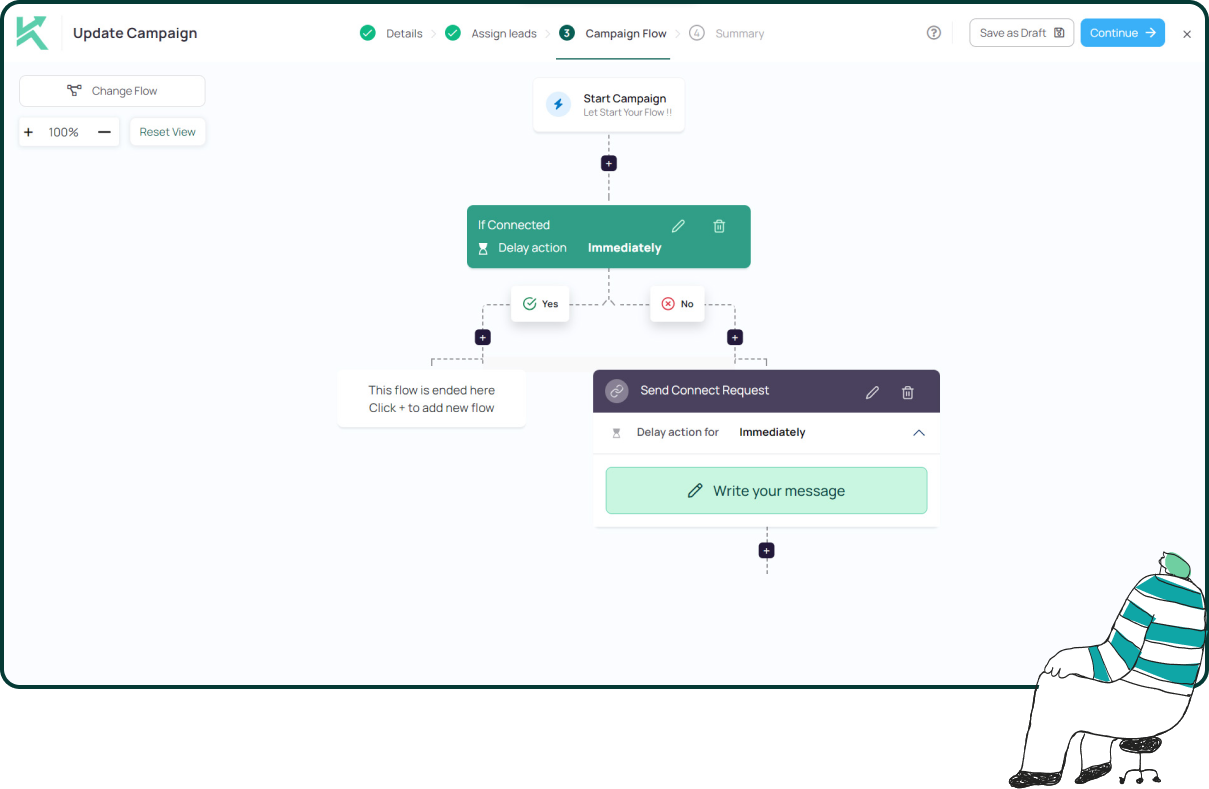
Context-aware campaign flows: Campaign logic adapts based on what has already happened. Messaging, follow-ups, and next steps are influenced by connection status, previous interactions, and campaign progression. This avoids repetitive or out-of-sequence actions that can trigger detection.
Respect for connection and engagement states: Outreach behaviour changes based on whether a lead is new, connected, engaged, or inactive. Actions are never forced where they do not belong. This ensures communication remains relevant, timely, and aligned with how LinkedIn expects users to interact.
Scale comes only after trust is established.
Automation supports conversations, not pressure.
The Hidden Cost of Unsafe Automation
Unsafe automation does more than risk restrictions.
It interrupts momentum.
It damages response quality.
It erodes brand trust.
Every block forces a reset.
Every reset costs time.
Safe automation compounds. Unsafe automation fragments.
Choosing Between Browser Extensions and Cloud Automation
Browser extensions still have a place for light, manual assistance.
But for consistent LinkedIn outreach, especially in B2B sales, recruiting, and founder-led growth, cloud-based automation offers a clear advantage.
Not because it is faster.
Because it is sustainable.
The Future of LinkedIn Automation
Automation is no longer a growth hack.
It is an operational decision.
The teams that win going forward will prioritise account health, behavioural trust, and long-term visibility.
Safety is not a limitation. Safety is the new performance metric.
Konnector is built to help you automate LinkedIn outreach quietly, consistently, and without fear.
11x Your LinkedIn Outreach With
Automation and Gen AI
Harness the power of LinkedIn Automation and Gen AI to amplify your reach like never before. Engage thousands of leads weekly with AI-driven comments and targeted campaigns—all from one lead-gen powerhouse platform.
Frequently Asked Questions
Browser extension automation is not inherently unsafe, but it carries higher risk at scale. Because actions run inside your live browser session, LinkedIn can observe device signals, timing patterns, and repeated behaviour more easily. Over time, this increases the likelihood of restrictions.
Cloud-based automation distributes actions over time, outside of your live browser session. This allows for variable pacing, natural cooldowns, and behaviour that aligns more closely with how real users operate on LinkedIn across days and weeks.
LinkedIn looks beyond action volume. It evaluates timing consistency, action velocity over time, device and browser signals, and repetition across sessions. Predictable behaviour is often a stronger signal than high activity.
Browser extensions can be useful for light, manual assistance or one-off tasks. However, for consistent outreach, sales, recruiting, or founder-led growth, cloud-based automation is generally more sustainable and safer long term.
Konnector is designed around controlled pacing, built-in cooldowns, context-aware campaign flows, and respect for connection and engagement states. Safety is embedded into how campaigns run, not added as an optional feature.
Not at all. Automation that runs consistently without interruptions often outperforms aggressive automation that gets paused or restricted. Safety enables momentum, and momentum is what drives long-term outreach results.