If you’ve been in the B2B trenches long enough, you’ve probably watched LinkedIn outreach evolve from the Wild West of copy-paste messages to something that actually resembles… strategy. But here’s the debate that’s tearing sales teams apart in 2026: should you warm up prospects with thoughtful comments before sliding into their DMs, or just go straight for the inbox?
Let’s be honest—most “LinkedIn outreach guides” are written by people who haven’t sent a cold message in years. This isn’t that. We’re diving into the data, the psychology, and the real-world tactics that separate the 5% reply rates from the 50% reply rates. Because in LinkedIn outreach, that difference isn’t just a vanity metric—it’s the difference between hitting quota and updating your resume.
By the end of this deep dive, you’ll know exactly which approach fits your ICP, your sale cycle, and your appetite for playing the long game versus burning through lists.
The Data Doesn’t Lie: Comment-First vs DM-First Performance Metrics
Here’s where the rubber meets the road. After analyzing thousands of LinkedIn outreach campaigns across SaaS, consulting, and enterprise sales in 2026, the numbers tell a pretty clear story—but it’s not as simple as “one approach is always better.”
| Metric | Comment-First Outreach | DM-First (Cold) Outreach |
|---|---|---|
| Connection Acceptance | 45% – 60% | 20% – 30% |
| Reply Rate | 25% – 50% | 5% – 15% |
| Trust Factor | High (Earned) | Low (Interruption) |
| Scalability | Lower (Manual/Semi-Auto) | High (Fully Automated) |
| Best For | High-ticket Enterprise, Tier 1 Leads | Volume-based SaaS, Broad ICP |
The standout stat? Comment-First outreach delivers a 2.5x higher connection rate than cold DMs. That’s not a marginal improvement—that’s a fundamentally different game. When you engage with someone’s content before reaching out, you’re not a random stranger anymore. You’re someone who “gets it,” someone who showed up before asking for something.
But here’s the nuance the data reveals: DM-First still has a place. If you’re running a volume play—testing a new market, validating messaging, or working a broad ICP—the scalability of automated outreach can help you learn fast. The trick is knowing when to use which approach, and more importantly, how to execute each one properly.
Which Converts Better: Commenting or Direct Messaging on LinkedIn?
This is the question every SDR, founder, and sales leader asks when building their LinkedIn outreach strategy. The short answer: Comment-First outreach converts significantly better for high-value B2B leads. But let’s unpack why, because understanding the psychology here will change how you approach LinkedIn forever.
When you comment thoughtfully on a prospect’s post, you’re doing something most sellers won’t: you’re giving before you ask. You’re demonstrating subject matter expertise. You’re showing up in their notifications without triggering their “salesperson radar.” Most importantly, you’re building what psychologists call the mere-exposure effect—the more someone sees your name in a positive context, the more they trust you.
The data backs this up. Prospects who have interacted with your comments are 47% more likely to respond to your eventual follow-up DM. That’s because by the time you send that message, you’re not cold anymore—you’re warm. You’ve earned a seat at the table.
Direct messaging, on the other hand, is an interruption. It’s you showing up in someone’s inbox uninvited. Now, that doesn’t mean it can’t work—but it requires exceptional personalization, impeccable timing, and a message so relevant it overcomes the friction of being unsolicited. Most cold DMs fail because they’re template-driven, generic, and focused on what the sender wants rather than what the recipient needs.
The bottom line: Comment-First wins on conversion because it’s relationship-first. DM-First can work at scale if you have tight targeting and killer copy—but even then, you’re fighting uphill.
How to Use a Comment-to-DM Strategy Effectively (The 2026 Playbook)
Alright, you’re sold on the Comment-First approach. But here’s where most people screw it up: they leave lazy comments that do nothing to differentiate them. “Great post!” and “Thanks for sharing!” are the LinkedIn equivalent of showing up to a networking event and just nodding. No one remembers you.
If you want the Comment-to-DM strategy to actually work—if you want to be memorable, credible, and someone worth responding to—here’s the exact framework:

Step 1: Identify Trigger Posts Using Sales Navigator
Don’t just comment on random posts. Use Sales Navigator’s Content Search to find posts from your exact ICP that are getting engagement. Look for posts where:
• The prospect is asking a question or seeking advice (they’re in “receive mode”)
• The topic relates directly to a problem your solution solves
• The post is recent (within 24 hours) so your comment appears near the top
This is strategic commenting. You’re not just throwing darts—you’re surgically placing yourself in front of the right people at the right time.
Step 2: Leave an “Expert Add-On” Comment (Not Generic Fluff)
Here’s the part that separates amateurs from pros. Your comment needs to do one of three things:
• Add a specific insight: “I love your point on [Topic]. We’ve found it also applies to [Related Sub-topic], especially when [Specific Context].”
• Ask a thoughtful question: “Have you found this approach works differently for [Specific Scenario]? We’ve been testing it with [Context] and seeing mixed results.”
• Share a contrarian take (politely): “Interesting perspective. I wonder if the opposite is true for [Scenario]—we’ve seen that [Alternative Approach] sometimes outperforms in [Context].”
Notice what all of these have in common? Specificity. You’re not saying “great post”—you’re proving you actually read it, thought about it, and have something valuable to add. That’s how you earn attention.
Step 3: The 24-Hour Rule for Connection Requests
Timing matters. If they reply to your comment (even with a simple “thanks” or a like), you’ve got a green light. Send a connection request within 24 hours, and reference the specific exchange:
“Hey [Name], enjoyed our quick exchange on your post about [Topic]. Would love to connect and keep the conversation going!”
This isn’t a cold connection request—it’s a warm follow-up to a real interaction. Acceptance rates on these requests sit around 55-60%, compared to 20-30% for cold requests with generic notes.
Once they accept, wait 2-3 days, then send your actual outreach DM. By this point, you’ve had two positive touchpoints (comment + connection). You’re not a stranger—you’re someone who’s already added value. That context changes everything.
What Is the Ideal LinkedIn Outreach Message Length in 2026?
Let’s kill a myth right now: long, detailed messages do NOT demonstrate value. They demonstrate that you don’t respect someone’s time. The data is crystal clear on this: the most effective LinkedIn outreach messages stay under 300 characters.
Why? Because your prospect is reading your message on their phone while standing in line at Starbucks. They’re not settling in with a cup of coffee to read your three-paragraph manifesto about how your AI-powered platform revolutionizes their workflow. They’re scanning. They’re skimming. They’re deciding in 3 seconds whether this is worth their time.
Short, “low-friction” messages that offer immediate value get 19% more responses than long, pitch-heavy paragraphs. Here’s what that looks like in practice:
❌ Bad (too long, too pitchy):

✅ Good (short, value-first):

See the difference? The second message is 123 characters. It references something specific. It offers value without asking for anything. It’s frictionless. That’s what works in 2026.
Pro tip: If you can’t explain your value prop in under 300 characters, you don’t understand your value prop well enough. Ruthlessly edit. Every word should earn its place.
How Many Follow-Ups Should You Send on LinkedIn? (The Multi-Touch Cadence)
Here’s a hard truth: most deals don’t happen on the first message. They don’t even happen on the second. But most salespeople give up after one or two attempts because they’re afraid of being “annoying.” Meanwhile, their competition is running a disciplined multi-touch cadence and booking all the meetings.
The data shows the “sweet spot” is 3 to 4 touchpoints, spaced 3 to 5 days apart. A proper multi-touch cadence can improve your overall conversion rate by 49%. That’s not a rounding error—that’s the difference between a good quarter and a great quarter.
But here’s the critical part most people miss: each follow-up must provide new value. You can’t just keep saying “Hey, circling back on this” or “Just wanted to bump this to the top of your inbox.” That’s lazy. That’s annoying. That’s why people ignore you.
Here’s a proven 4-touch LinkedIn outreach cadence:
Touch 1 (Day 0): The Hook – Reference a specific trigger (their post, recent company news, a shared connection) and offer a low-friction piece of value.
Example: “Hey [Name], saw [Company] just raised a Series B. Congrats! Put together a quick breakdown of how 3 companies in your space used that momentum to 2x their pipeline. Want me to send it?”
Touch 2 (Day 4): The Case Study – Share a relevant success story with hard numbers.
Example: “[Name], quick follow-up—[Similar Company] was in a similar spot last year. They used [Specific Approach] to increase their close rate by 34%. Documented the whole playbook if you want to see it.”
Touch 3 (Day 9): The Insight – Drop a tactical tip or industry trend they might not know about.
Example: “Saw this stat yesterday and thought of you: 67% of B2B buyers now expect a self-serve option before talking to sales. Does [Company] have that in place? Happy to share what’s working for others if helpful.”
Touch 4 (Day 14): The Breakup – Acknowledge you might have missed the mark, but leave the door open.
Example: “[Name], I know I’ve reached out a few times—might’ve missed the mark on timing or relevance. No worries either way. If this ever becomes a priority, you know where to find me. Best of luck with [Specific Initiative].”
Notice what’s happening here? Every touchpoint stands on its own. Each one offers something new. You’re not begging for a meeting—you’re demonstrating expertise and staying top of mind. This is how professionals follow up.
3 LinkedIn Outreach Strategies to Outrank Your Competition
Alright, we’ve covered the fundamentals. Now let’s talk about the tactics that separate the top 1% of LinkedIn outreachers from everyone else. These are the strategies that don’t just get you replies—they get you remembered, respected, and referred.
Strategy 1: The “Micro-Niche” Observation
Stop using templates. I know, I know—everyone says that, but they still do it because personalization feels slow. But here’s the thing: real personalization isn’t about inserting someone’s name and company. It’s about proving you’ve done your homework.
Instead of opening with the generic “I see you’re the VP of Sales at [Company],” open with a micro-niche observation—a specific detail from their profile, recent activity, or content that 99% of people wouldn’t notice.
Example:

See what just happened? You didn’t just say “I listened to your podcast.” You cited a specific concept, shared how you applied it, got a result, and asked a thoughtful question. That’s not a sales pitch. That’s a peer-to-peer conversation starter.
This level of personalization takes time—which is exactly why it works. You can’t scale it to 500 prospects. But you don’t need to. When you’re targeting high-value accounts, 20 messages like this will outperform 200 templated ones every single time.
Strategy 2: Low-Friction Calls to Action (Stop Asking for Meetings)
Here’s a pattern you’ll see in almost every failed cold outreach message: it ends with a request for a 30-minute meeting. “Are you free Tuesday at 2 PM?” or “Let’s hop on a quick call next week.”
Why does this fail? Because a meeting is high-friction. You’re asking someone to commit 30 minutes of their calendar to a stranger based on a 200-character message. That’s a big ask. Too big for a first touchpoint.
In 2026, the Low-Friction CTA is what wins. Instead of asking for time, offer something they can consume right now with zero commitment.
High Friction (what doesn’t work):

Low Friction (what works):

Or even lower friction:

Now you’re not asking for anything. You’re giving. And if what you’re giving is actually valuable? They’ll come back. They’ll reply. They’ll ask for more. That’s when you suggest the call.
The meeting is the reward for providing value first, not the opening ask.
Strategy 3: Leveraging “Trigger Events” for Perfect Timing
Timing is everything in sales, and LinkedIn gives you a front-row seat to your prospect’s trigger events—those moments when they’re most receptive to new solutions because their world just changed.
Outreach based on a Trigger Event has a 27% higher reply rate than random outreach. Why? Because your message isn’t random—it’s contextually relevant to what’s happening in their world right now.
Key trigger events to monitor:
• Job changes: Someone just got promoted or started a new role. They’re evaluating their stack, building their team, and looking for wins.
• Funding rounds: Company just raised money. They’re hiring, expanding, and have budget to solve problems.
• New job postings: They’re hiring for a role related to your solution. That signals they have the problem you solve.
• Company news or press: Product launch, new market entry, or major partnership announcement. Change creates opportunity.
• Prospect posts about a challenge: They literally tell you what they’re struggling with. This is the ultimate trigger.
Set up Sales Navigator alerts for these triggers, and when one fires, reach out immediately. Not next week. Not when you get around to it. Within 24-48 hours.
Example (job change trigger):

That’s not a sales pitch. That’s you showing up at the exact moment they need help, with exactly the kind of help they need. That’s what trigger-based outreach looks like when done right.
The Final Verdict: Which LinkedIn Outreach Strategy Should You Use?
| Use Comment-First if: | Use DM-First if: |
|---|---|
| You’re targeting a narrow list of high-value accounts (ABM play) | You’re testing a new market and need rapid feedback on messaging |
| Your deal sizes are $50K+ and require trust and credibility to close | You’re running a volume-based SaaS motion with a clear, broad ICP |
| You’re willing to invest time for higher quality conversations | Your product has clear, immediate ROI that’s easy to communicate quickly |
| You want to protect your LinkedIn sender reputation and avoid spam flags | You have tight personalization and you’re not just blasting templates |
| You’re building long-term authority in your niche, not just closing this quarter | You’re willing to accept lower conversion rates in exchange for scale |
Most successful LinkedIn outreach strategies in 2026 aren’t purely one or the other—they’re hybrid. Use Comment-First for your Tier 1 accounts (the whales you absolutely need to land), and use DM-First for Tier 2 and 3 accounts where you can afford to test, learn, and optimize at scale.
LinkedIn Outreach in 2026 Is About Respect, Not Reach
Here’s the truth nobody wants to hear: most LinkedIn outreach fails not because of bad tactics, but because of bad intent. When you’re focused on what you can get rather than what you can give, people feel it. They ignore you. They block you. They tell their colleagues to avoid you.
The best LinkedIn outreach—whether Comment-First or DM-First—is built on a simple principle: respect the person on the other end. Respect their time by being concise. Respect their intelligence by being specific. Respect their inbox by providing value before asking for anything.
Do that consistently, and you won’t need to choose between Comment-First and DM-First. You’ll have people reaching out to you.
Now get out there and start building relationships that actually convert with Konnector.AI as the only ally you need!
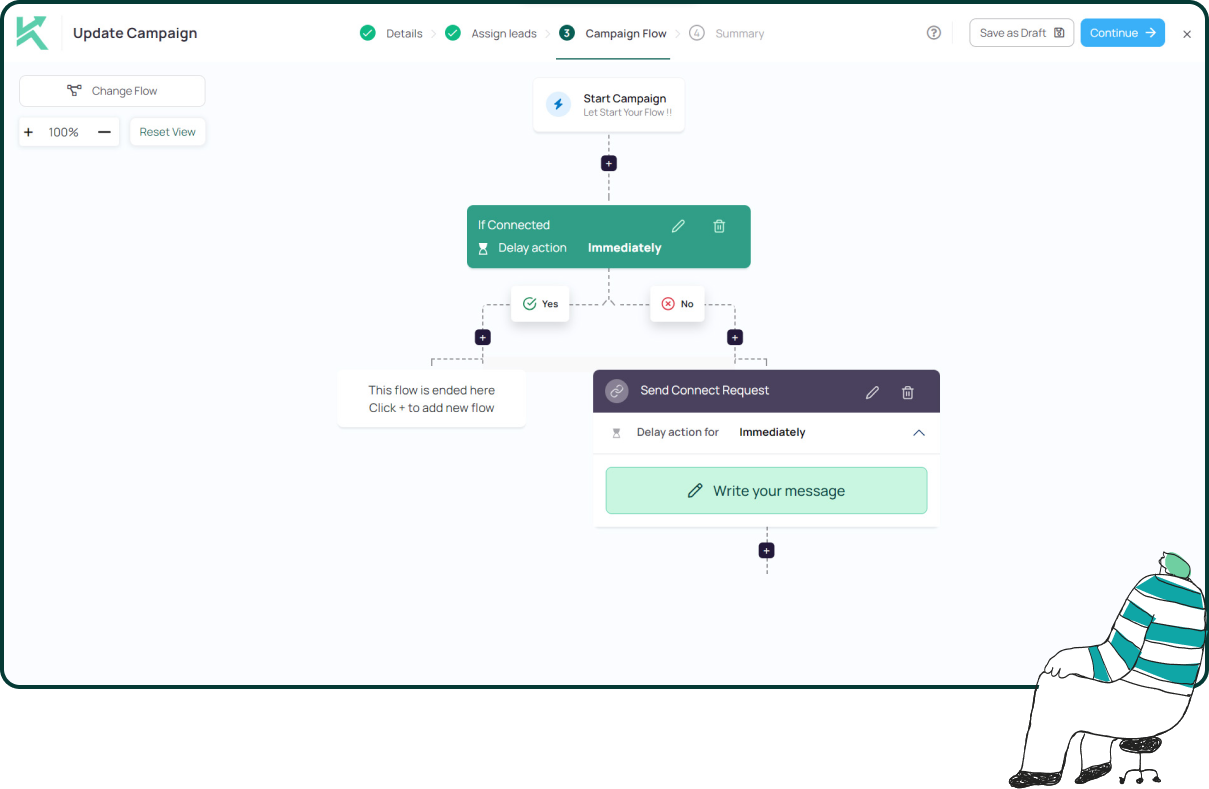
11x Your LinkedIn Outreach With
Automation and Gen AI
Harness the power of LinkedIn Automation and Gen AI to amplify your reach like never before. Engage thousands of leads weekly with AI-driven comments and targeted campaigns—all from one lead-gen powerhouse platform.
Frequently Asked Questions
Comment-First LinkedIn outreach is a strategy where you engage with a prospect’s content through thoughtful comments before sending a direct message, helping build familiarity and trust.
DM-First outreach involves sending a direct message without prior engagement, typically used for volume-based campaigns or rapid market testing.
Data shows Comment-First outreach delivers higher reply and connection rates for high-value B2B deals, while DM-First works better for scalable, volume-driven motions.
Yes. Comment-First outreach is particularly effective for enterprise and high-ticket deals where trust, credibility, and relationship-building are critical.
Yes, but only when paired with strong targeting, short message length, and clear, immediate value. Generic cold DMs perform poorly in 2026.
The most effective LinkedIn outreach messages are under 300 characters, with short, value-first messages outperforming long pitches.
A structured cadence of 3–4 follow-ups, spaced 3–5 days apart and offering new value each time, delivers the best results.
A Comment-to-DM strategy involves engaging on a prospect’s post first, then sending a connection request and later a DM that references the interaction.
Trigger events like job changes, funding rounds, or prospect posts increase reply rates by making outreach timely and contextually relevant.
Yes. The most effective LinkedIn outreach strategies in 2026 use a hybrid approach—Comment-First for Tier 1 accounts and DM-First for Tier 2 and Tier 3 accounts.