Most LinkedIn outreach fizzles because it’s all about you, not them. People dodge the pitch. But when your message feels like an open door—not a sales trap—that’s when things start clicking.
- Fact: The average LinkedIn outreach reply rate is between 10% and 25%—so more than 3 out of 4 messages go unanswered.
[Source] - Mission: Make your DM feel like a safe, quick conversation. Ditch the pitch, invite the response.
Why Most LinkedIn Outreach DMs Fail—And How to Flip the Script
- LinkedIn outreach only works when you lower resistance and make replying easy.
- The best messages use micro-commitments, true specificity, and safety language (not pressure tactics).
- This guide delivers 5 copy-ready LinkedIn outreach templates plus follow-up scripts that nudge replies without nagging.
- All of it can be automated (the right way) with Konnector.ai—so you get more YES and fewer left-on-reads.
What Is LinkedIn Outreach, Really?
- LinkedIn outreach is how modern pros start meaningful business conversations—fast. It’s more than sending a message. It’s about starting a dialogue that moves both sides forward.
- Done right, it’s not “cold.” It’s smart, warm, and hyper-targeted: connection requests, DMs, InMails, likes, comments, even profile visits.
Pro tip: The real work starts before you ever hit ‘Send.’ Get noticed with smart engagement, then message like a human.
Why Most LinkedIn Outreach Gets Ignored
| Recipient Instinct | Your Message Signals | How to Fix It |
|---|---|---|
| Threat | “I’m about to get pitched hard” | Add a soft, safe CTA. E.g., “No worries if not.” |
| Low relevance | Bland intro, nothing personal | Include one line only they’d recognize |
| Overwhelm | Wall of text, multiple asks | Keep it 3–5 lines, one action only |
| Vague intent | “Let’s connect!” but why? | State your goal up front—in a single sentence |
| Social risk | Asking for a call too soon | Start with a micro-commitment: “Want a 30-second version?” |
Psychology Tricks That Power High-Performing LinkedIn Outreach
- Micro-Commitment: Your ask should be so small, replying is easier than ignoring you.
- Specificity: Make it obvious you’re not copying/pasting. Mention their latest post, project, or even a unique pain point.
- Reciprocity: Give something—an insight, resource, or even a compliment—before you ask.
- Safety Language: Signal that a “no” is perfectly fine. That’s how you get more “yes.”

Best micro-commitment CTAs:
“Worth sending?”, “Want a quick example?”, “Would a 2-line idea help?”
The easier the ask, the higher the reply rate.
5 LinkedIn Outreach DM Templates That Spark Real Conversations
- Every template includes: when to use, why it works, copy/paste DM, and a follow-up script.
Template 1: The “Noticed-You” Opener
- Use when: You’ve engaged with their content or profile, want to build instant rapport.
- Why it works: Real specificity + “safe to answer” question.
DM:
Hi {{First Name}}, loved your take on {{specific topic}}.
The point about {{unique insight}} really stood out.
Curious: Is {{priority}} a focus for you right now, or something else?
- Follow-up (2–3 days):
All good if you’re swamped! Just wanted to see if {{topic}} is top-of-mind for your team, since I’m seeing a lot of shift in {{industry}}. Happy to share a 3-bullet cheat sheet if you’re working on it!
Template 2: The “2-Line Value Drop”
- Use when: You can share a tactic, tool, or quick win relevant to them.
- Why it works: No pitch, just value—plus an easy opt-in.
DM:
Hi {{First Name}}, noticed you’re at {{company}}.
Quick tip that’s been crushing it for {{their industry}}: {{tactic}}.
Worth sending a 30-sec example?
- Follow-up:
Can send you a short swipe file or 3 killer templates for {{their use case}}—promise, no pitch!
Template 3: The “Permission Pitch”
- Use when: You want to introduce your solution without scaring them off.
- Why it works: Permission, relevance, and a risk-free “no.”
DM:
Hi {{First Name}}, super quick check before I drop anything in.
Are you running any LinkedIn outreach for {{goal}}?
If yes, happy to show how Konnector.ai makes it 3x faster (no spam). If not, zero pressure!
- Follow-up:
If it’s ever useful, I can share a 1-min walkthrough: real flows (engage → connect → DM → follow-up) that don’t feel automated.
Read more—-> LinkedIn Outreach: How to Use AI to Personalize Messages Without Sounding Creepy
Template 4: The “Signal-Based” DM (They Engaged First)
- Use when: They viewed your profile, liked, or commented. Strike while you’re top-of-mind!
- Why it works: Shows you noticed them; leverages their intent.
DM:
Hi {{First Name}}, noticed you checked out {{post/topic}}—thanks for that!
Usually, folks are looking for ideas on {{pain point}}.
Want a quick example of how other teams are tackling it?
- Follow-up:
If helpful, I’ll keep it to 3 bullets—no call, no fluff!
Template 5: The “Referral Route”
- Use when: You need an intro or to reach the right decision-maker—without burning bridges.
- Why it works: Respects their time, makes the “no” easy.
DM:
Hi {{First Name}}, quick one—totally fine if not.
Trying to connect with whoever handles {{area}} at {{company}}.
Is that you, or is there someone better I should chat with?
- Follow-up:
If it helps, here’s my 1-line context: {{your offer or value}}.
Super low pressure, just happy to route right.
Read more—-> 10 Proven LinkedIn Lead Generation Strategies For Your B2B Pipeline
Cheat Sheet: Which LinkedIn Outreach Template Should You Use?

How to Follow Up Like a Pro (Without Getting Marked as Spam)
| Follow-Up | Timing | What to Say |
|---|---|---|
| #1: Value add | 2–3 days later | “Thought you’d like this one-bullet insight…” |
| #2: Switch format | 5–7 days | “Want 2 bullets or a quick example? No call, just value.” |
| #3: Graceful exit | 10–14 days | “No worries if not—if you ever want a LinkedIn outreach playbook, reply YES.” |
How Konnector.ai Makes LinkedIn Outreach Effortless
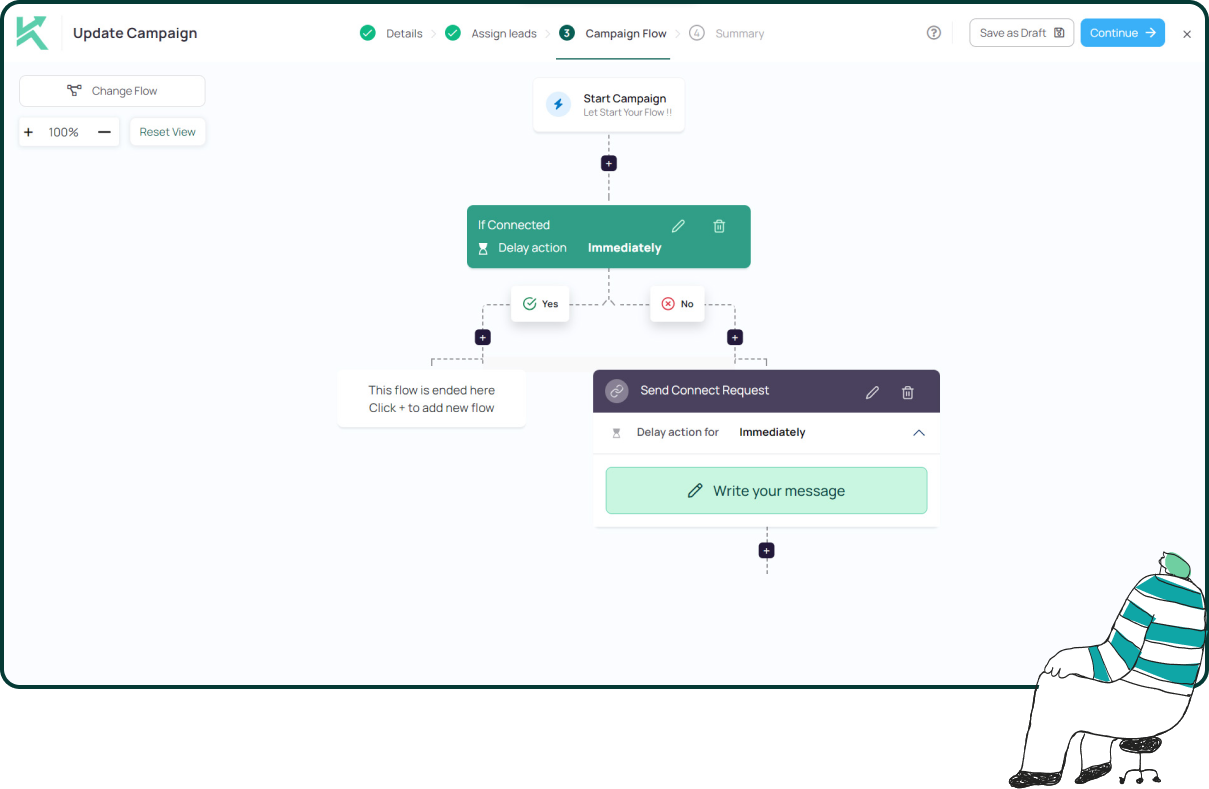
- Design personalized LinkedIn outreach flows—engagement, connect, DM, follow-up, all mapped out in clicks.
- Segment leads with tags so every message lands in the right context (new lead, warm lead, referral, etc).
- Trigger next steps when someone views your profile or engages—so you reply while they still remember you.
- Keep it human, not robotic—every DM feels one-on-one, not blasted from a bot.

Pro move: The best LinkedIn outreach isn’t about “more.” It’s about “right person, right time, right message.” Konnector.ai gets you there—at scale.
Top 5 Mistakes That Kill LinkedIn Outreach Reply Rates
| Mistake | Why it Fails | How to Fix |
|---|---|---|
| Pitching in message #1 | Too soon, feels unsafe | Warm up first, or use a micro-commitment |
| Sending essays | No one reads long messages | 3–5 lines max, then CTA |
| Generic “love your work!” | Screams copy-paste | Mention a real detail or recent post |
| Multiple CTAs | Confuses the recipient | One ask per message |
| No CTA | No reason to reply | End with a micro-ask (e.g., “Worth sending?”) |
Wrapping Up: LinkedIn Outreach Is a People Game, Not a Numbers Game
- Forget mass messaging. The secret to LinkedIn outreach that actually drives business is getting laser-specific—right person, right message, right moment. That’s how connections turn into conversations, and conversations into customers.
- Success isn’t about flooding inboxes—it’s about using strategy, psychology, and smart tools to start the *right* conversations and keep them moving forward (that’s where Konnector.ai shines).
Ready to take LinkedIn outreach from “just sending messages” to building a real pipeline?
With Konnector.ai, you don’t just automate DMs—you automate engagement that feels one-to-one, spot signals in real time, and trigger outreach flows your competitors can’t touch.
Stop blending in. Start building a system that actually delivers replies, relationships, and revenue—on autopilot.
Try Konnector.ai today and see what strategic LinkedIn outreach can really do for your business.
11x Your LinkedIn Outreach With
Automation and Gen AI
Harness the power of LinkedIn Automation and Gen AI to amplify your reach like never before. Engage thousands of leads weekly with AI-driven comments and targeted campaigns—all from one lead-gen powerhouse platform.
Frequently Asked Questions
LinkedIn outreach is the process of contacting professionals on LinkedIn (via connection requests, DMs, and InMail) to start conversations that can lead to partnerships, sales opportunities, job referrals, or collaborations.
A simple LinkedIn outreach flow is: identify the right person → engage with a post (optional but powerful) → send a short connection note → send a first DM → follow up with added value.
A strong LinkedIn outreach message includes (1) one specific detail about them, (2) a clear reason you’re reaching out, and (3) a low-pressure question like “Want a quick example?” to make replying easy.
Templates work best as a structure — but you should personalize at least one line (recent post, role, company change, priority). That single “proof of relevance” is what keeps your LinkedIn outreach from feeling copy-paste.
Keep LinkedIn outreach messages short: aim for a few lines that are skimmable, with one idea and one CTA. Longer messages increase friction and reduce replies.
For most LinkedIn outreach, 1–2 follow-ups are enough. If there’s still no response, a final “close-out” message is better than continuing to push.
A common best practice is to wait 3–5 business days before following up, and always add something new (a resource, example, or tailored insight) instead of repeating your ask.
Reply rates vary heavily by audience and warmth, but benchmark studies show that cold LinkedIn outreach can often sit in single digits for replies, and improves with personalization and better targeting.
Benchmarks often show mid-week and working hours perform well, and sending in the recipient’s local time zone helps. (Exact “best time” varies by industry and audience.)
InMail can help you reach people you’re not connected to, but DMs after a connection are often more natural for building a conversation. Most teams use both depending on whether the prospect is a 1st-degree connection yet.