Let’s start with something simple: people love sharing opinions.
Whether it’s about workplace trends, marketing tools, or even something fun and hypothetical, most professionals on LinkedIn are happy to vote when asked a question. It makes them feel included, valued, and heard. And that’s exactly why LinkedIn polls are one of the easiest and most underrated tools for boosting engagement and generating leads.
In fact, poll posts often attract significantly more interaction than regular posts.
More clicks + More comments = More impressions + More conversations.
So if you’re not using polls as part of your content strategy yet, you’re leaving engagement (and potential leads) on the table.
Let’s break down exactly how they work and how to use them strategically.
Benefits at a glance:

- Poll posts often receive more comments because people love explaining their choices.
- Higher engagement can increase reach since LinkedIn’s algorithm may show your post to more people.
- Polls can spark discussions and even go viral when they touch a trending topic
- You can include a link in the post text to drive traffic to a landing page or lead form.
- Poll insights can guide your future content by revealing what your audience thinks and struggles with.
How to create a poll on LinkedIn
Creating a LinkedIn poll takes less than a minute once you know where to click:
- Open LinkedIn and go to your Home page (or your profile).
- Click the field that says Start a post.

- In the post pop-up, click More (or the + / more options icon).

- Select the Poll icon (it usually looks like a small chart).

- Add your question, answer options, and the poll duration.

- Hit Post.
If you want the official process, you can also refer to LinkedIn’s Help Center instructions for creating polls.
LinkedIn poll template
Think of the poll template as a quick framework you fill in before you publish. Every LinkedIn poll has three main parts:
1) Question
Your poll question needs to be planned in advance because LinkedIn keeps it short. The poll question character limit is 140 characters.
Tip: Keep your question concise in the poll field, then use the post caption to add context, examples, or a quick story.
2) Answer options
You can add up to 4 answer options, and each option has a 30-character limit.
This is where strategy matters. Your options should be:
- easy to understand
- clearly different from each other
- tempting to choose quickly
3) Poll duration
You can choose how long your poll runs. LinkedIn typically offers:
- 1 day
- 3 days
- 1 week
- 2 weeks
Short polls can create urgency, while longer polls can help you collect more responses and extend reach.
Are LinkedIn polls anonymous?
No, LinkedIn polls are not anonymous.
As the poll creator, you can see who voted and which option they selected. That’s actually useful because it lets you understand responses by role, industry, or seniority.
For everyone else viewing the poll, results are shown in percentages only.
Can you create a LinkedIn poll with an image?
Unfortunately, LinkedIn currently doesn’t allow images inside poll posts.
When you attach a poll, the media option disappears. So your post needs to work through:
- strong caption text
- clear context
- hashtags for discoverability
You can still include links in the caption, which is helpful for driving traffic to a resource or lead form.
Attract users to your poll with the “Boost post” action
Sometimes you’ll want your poll to reach beyond your immediate network. In those cases, targeted promotion can help.
One approach is to:
- Search for specific LinkedIn users using filters
- Share your poll with that audience
- Increase visibility by encouraging discussion in comments
Some automation tools also offer “boost post” features where selected users are mentioned in the comments to draw attention to the poll. This can help expand reach both within and outside your network.
Example of LinkedIn poll as part of a funnel
Polls are not just engagement tools. They can also be the first step of a simple funnel.
Here are a few practical funnel approaches:
- Poll → Blog article: Post a poll on a relevant topic and include a link to an article that explores the issue deeper.
- Poll → Giveaway: Use a quiz-style poll and select a random participant as a winner.
- Poll → Downloadable resource: Offer templates, guides, or cheat sheets via a link to a landing page.
The key is that the poll creates interest first, and the resource captures intent second.
Read more—->
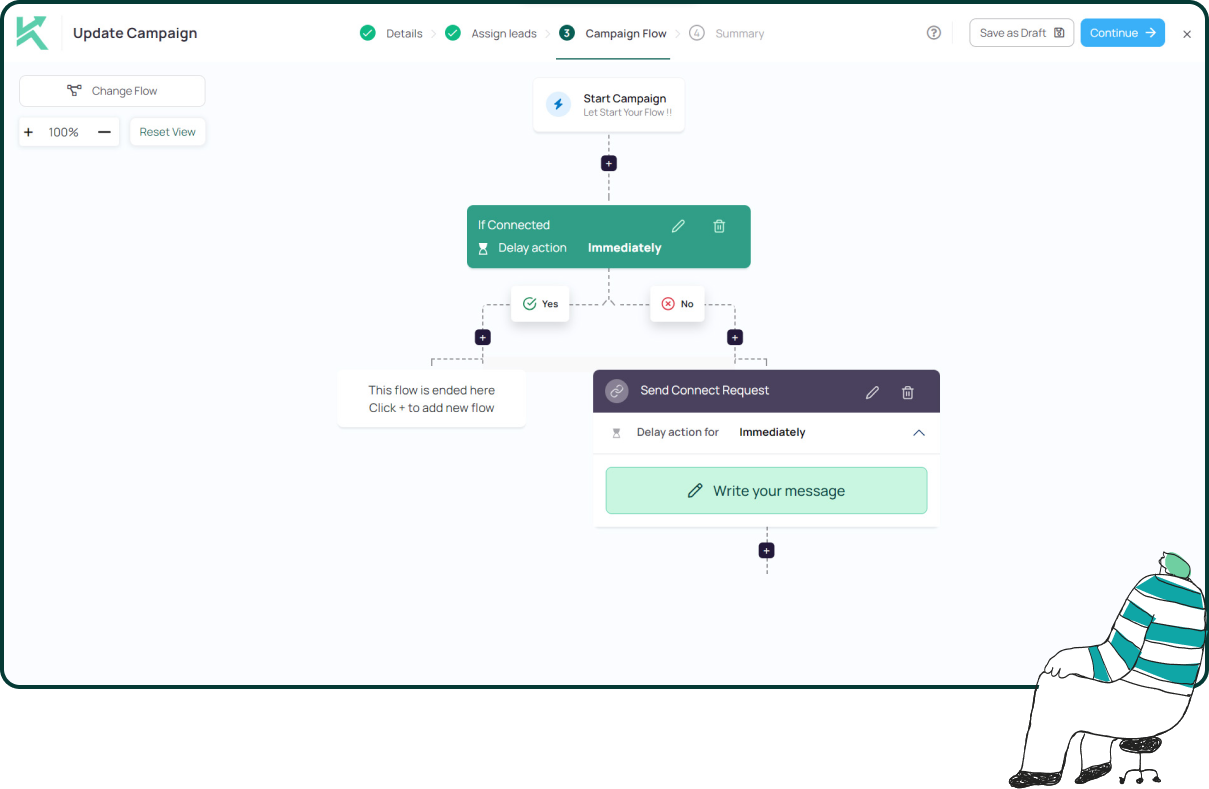
How you can use Konnector.ai to promote funnels with polls
If you’re using a LinkedIn automation tool, you can turn poll engagement into structured follow-up.
- Create and publish your LinkedIn poll.
- Prepare a resource (white paper, ebook, templates, presentation).
- In your post caption, ask people to comment something like “I want the book” to receive it.
- Wait about a week so engagement collects naturally.
- Gather people who commented into a follow-up campaign (for example, invite + follow-up, or message to connections).
- Send the resource to everyone who requested it.
This approach keeps your outreach warm because you’re responding to interest, not forcing a pitch.
9 LinkedIn poll examples to inspire for new clients
If you want poll ideas you can copy quickly, here are some proven directions that work for marketing and lead generation.
LinkedIn poll ideas for marketing
Idea #1 – Add options to make everyone curious about the results
Curiosity is a powerful driver. When people vote, they instantly see how others voted, so they’re motivated to participate just to view the “majority opinion.”
Example question: “How do you prefer to learn new things?”
Idea #2 – Add your contact information in the post text
Turn your poll post into a soft “business card” by adding a short self-introduction and contact details in the caption.
End with a simple call to action encouraging comments or messages.
Idea #3 – Use polls to present a podcast
If you have a podcast (or video series), use a poll to understand how your audience prefers consuming content.
You can share a short text summary in the caption and link to the podcast episode. One fun answer option can be a humorous choice like “I’ll read a summary later.”
Digital marketing poll questions for LinkedIn
Idea #1 – Consider using a poll to gather participants for your event
Polls are a great “warm-up” for webinars or live sessions. Ask if people would attend, and you’ll quickly see demand.
Idea #2 – Gain industry insights
Ask peers what they think will happen next in the industry. These polls position you as a conversation starter and often attract thoughtful comments.
Business poll questions for LinkedIn
Idea #1 – Highlight a problem and give a solution
Use the poll to surface a pain point, then link to a resource that helps solve it. The people who vote are often the people who need that solution.
Idea #2 – Use imaginary questions sometimes
Business can be serious, but polls don’t always need to be. Hypothetical questions often increase engagement because they’re easy and fun to answer.
One smart tactic is to include an “Other” option and ask people to explain in the comments.
Lead generation LinkedIn poll ideas
Idea #1 – Share guides via polls
Polls can be the first step of a lead-generation flow where the poll introduces a topic and a linked resource captures emails or contact details.
This works especially well with templates, cheat sheets, research, and guides.
Idea #2 – Quiz for audience engagement
Create a quiz-style poll based on your educational content. This attracts people who like learning and filters out people who aren’t interested in the topic.
All in all: How to find intriguing LinkedIn poll questions
The best polls feel relevant and timely. Over time, you’ll notice patterns in what your audience responds to most strongly.
Here are reliable places to find strong poll topics:

- Forums: Join communities in your niche to discover repeated questions and pain points.
- News outlets: Track current events and emerging trends in your industry.
- SEO search: Use tools like SEMrush or Google Keyword Planner to identify popular queries.
- Trend analysis: Watch trending discussions on LinkedIn, Twitter/X, and Reddit.
- Competitor analysis: Review competitor posts to see what gets strong engagement.
- Customer feedback: Use surveys, calls, and DMs to learn what your audience actually needs.
- AI: Take ideas from ChatGPT or Claude to create polls suited to your profile
Final thoughts
The real power of LinkedIn polls isn’t the feature itself. It’s what polls unlock: conversation.
When your poll question hits the right nerve, engagement becomes effortless. That engagement boosts visibility. And that visibility brings the right people to you.
Polls are simple, but when used strategically, they’re one of the most effective ways to start warm conversations and turn attention into leads.
11x Your LinkedIn Outreach With
Automation and Gen AI
Harness the power of LinkedIn Automation and Gen AI to amplify your reach like never before. Engage thousands of leads weekly with AI-driven comments and targeted campaigns—all from one lead-gen powerhouse platform.
Frequently Asked Questions
LinkedIn polls are used to gather audience opinions, increase engagement, start conversations, and collect insights. They also help businesses identify interested prospects and generate leads through interactive content.
Yes. Polls attract people who are genuinely interested in your topic. When someone participates, they’re signaling intent or curiosity, which makes them a warmer lead compared to cold outreach prospects.
No. The person who creates the poll can see who voted and which option they selected. However, other participants can only see percentage results, not individual votes.
You can add up to four answer options in a LinkedIn poll. Each option has a character limit, so responses should be short and easy to understand.
It depends on your goal. Short polls create urgency and quick engagement, while longer polls help collect more responses and reach a wider audience.
No. LinkedIn does not allow images in posts that contain polls. However, you can still include descriptive text, links, and hashtags in your caption.
A successful poll has a relevant question, clear answer choices, and a topic that resonates with your target audience. Questions that spark curiosity or highlight a common problem tend to perform best.
You can increase participation by choosing relevant topics, writing an engaging caption, tagging relevant professionals, sharing your poll with targeted audiences, and responding to comments to keep the conversation active.
Yes. If a poll sparks discussion or touches on a trending topic, it can receive high engagement and be shown to a wider audience by LinkedIn’s algorithm.