LinkedIn Weekly Connection Request Limit (2026): The Complete Answer
Quick answer: LinkedIn’s standard weekly connection request limit is 100 invitations per week for most users. Accounts with a high Social Selling Index (SSI) score or LinkedIn Sales Navigator can extend this to 200–250 per week. The limit resets exactly seven days after your first invitation of the cycle.
If you have ever seen the message “You’ve reached the weekly invitation limit” mid-campaign, this guide explains exactly what triggered it, how the limit works across different account types, and what you can do to maximise safe outreach — without risking your account.

What Is the LinkedIn Weekly Connection Request Limit?
LinkedIn enforces a weekly cap on connection requests — not a daily one — to protect users from spam and maintain platform quality. The cap is not publicly documented by LinkedIn as a fixed number; it is dynamic and depends on account signals. Based on extensive community testing and third-party research in 2026, the confirmed ranges are:
| Account Type | Safe Weekly Limit | Maximum (High SSI) |
|---|---|---|
| LinkedIn Free | 80 requests/week | 100 requests/week |
| LinkedIn Premium | 100 requests/week | 200 requests/week |
| LinkedIn Sales Navigator | 150 requests/week | 200–250 requests/week |
| LinkedIn Recruiter Lite | 100 requests/week | 200 requests/week |
Important: These are behavioural ceilings, not guaranteed quotas. LinkedIn’s algorithm adjusts your personal limit based on acceptance rate, pending invites, account age, and reported spam signals.
How Does LinkedIn Calculate Your Weekly Limit?
LinkedIn’s connection limit system is reputation-based, not subscription-based. Several factors determine exactly how many requests your account can send in a given week:

1. Social Selling Index (SSI) Score
Your SSI score (available free at linkedin.com/sales/ssi) measures your profile quality, network-building activity, engagement, and relationship building. Accounts scoring 70 or above are typically allowed up to 200 requests per week. Accounts scoring below 50 are often capped at 80 or fewer.
2. Connection Request Acceptance Rate
This is the single biggest factor. If a high percentage of your sent requests are accepted, LinkedIn sees you as a genuine networker and relaxes your limit over time. If people ignore your requests or click “I don’t know this person,” your limit drops — fast. Maintaining an acceptance rate above 30% is the minimum threshold to avoid algorithmic tightening. Aim for 40–60% for healthy account standing.
3. Pending (Unanswered) Invite Count
LinkedIn monitors how many of your outgoing requests remain unaccepted. Keep your pending invite backlog under 500. The hard cap LinkedIn begins to flag is around 700 pending invitations. A large pending backlog signals poor targeting and low genuine interest, which tightens your sending capacity.
4. Account Age and History
New LinkedIn accounts (under three months old) face tighter restrictions, typically capped near 50–80 requests per week, even with good behaviour. As your account ages and builds a track record, limits expand organically. “Warming up” a new account by starting with 20 requests per week and increasing gradually is the recommended approach.
5. Automation Detection
LinkedIn actively detects bot-like behaviour: sending all 100 requests on Monday morning, identical send times each day, or unnatural activity spikes. Even if you are within the numerical limit, sudden bulk activity triggers spam detection. Spread requests evenly — 20–30 per day — to mimic natural human behaviour.
When Does the LinkedIn Connection Limit Reset?
The weekly limit does not reset on a fixed calendar schedule (e.g., every Monday). It resets exactly seven days after you send your first connection request of the current cycle.
Example: If you send your first request on Thursday at 2 PM, your full limit refreshes the following Thursday at 2 PM. This rolling reset means you can plan outreach windows strategically — and it means contacting LinkedIn support will not speed up the reset process.
What Happens When You Hit the Limit?
When you reach your weekly ceiling, LinkedIn displays the message: “You’ve reached the weekly invitation limit.” At this point:
- All further connection request attempts are blocked until the limit resets.
- For first-time violations, restrictions are usually lifted within a few hours to one week.
- Repeated violations escalate to longer bans, account reviews, and potentially permanent restriction.
- Recovery: Wait for the reset, reduce volume when you return, focus on improving acceptance rate before scaling back up.
If you receive a restriction, do not immediately relaunch outreach automation. Send a few manual, personalised requests first to signal genuine human behaviour to LinkedIn’s algorithm.

Does LinkedIn Premium or Sales Navigator Increase the Connection Limit?
This is one of the most common misconceptions in LinkedIn outreach.
LinkedIn Premium alone does not meaningfully increase your weekly connection request limit. The limit is determined by account reputation, not the subscription tier. Premium users appear to send more because they have better targeting tools (InMail, advanced search filters) — not because they have a higher numerical cap.
LinkedIn Sales Navigator does provide a moderate advantage: mature, high-SSI Sales Navigator accounts can typically send 200–250 requests per week. The real value of Sales Navigator, however, lies in its precision targeting — finding the right people means higher acceptance rates, which organically increases your limit over time.
LinkedIn Connection Limits vs. Other Platform Limits (2026 Overview)
| Activity | Free Account | Sales Navigator |
|---|---|---|
| Connection requests | ~100/week | ~200–250/week |
| Messages (new conversations) | ~100/week (recommended) | ~150/week (recommended) |
| Profile views | ~150/day | 600–800/day |
| InMail credits | None | 50/month |
| Maximum total connections | 30,000 (hard cap) | 30,000 (hard cap) |
| Event invitations | 1,000/week | 1,000/week |
| Personalised note invites (free) | 5/month | Unlimited (within weekly cap) |
Book a demo with Konnector.ai to make the most of your LinkedIn outreach.
5 Proven Ways to Maximise Outreach Within LinkedIn’s Limits
1. Optimise Your LinkedIn Profile First
Your profile is the first thing a recipient sees before accepting. A complete, professional profile with a clear headline, summary, and recent activity significantly increases acceptance rates — which in turn increases your sending capacity. Treat your profile as a landing page, not a CV.
2. Target More Precisely
Casting a wide net hurts your acceptance rate. Use LinkedIn’s search filters — job title, company size, industry, seniority level, geography — to identify people genuinely likely to connect. Better targeting creates a positive feedback loop: higher acceptance rate → better reputation → higher limits.
3. Always Personalise Your Request
Generic requests (“I’d like to add you to my network”) are ignored or declined far more often than personalised ones. Reference a shared group, a recent post they published, or a mutual connection. Even a short, specific two-sentence note dramatically lifts acceptance rates. Note: free accounts are now limited to only 5 personalised note invites per month, making Premium or Sales Navigator worthwhile for serious outreach.
4. Withdraw Old Pending Requests Regularly
Requests that sit unanswered for more than 2–3 weeks signal poor targeting. Periodically withdraw old pending requests to keep your pending backlog below 500. Be aware that after withdrawing, you cannot resend a request to the same person for three weeks.
5. Spread Requests Evenly Throughout the Week
Sending 100 requests on a single morning is a red flag for LinkedIn’s algorithm. Distribute requests across 5–6 days, sending 20–25 per day at varied times. Consistent, natural-looking behaviour keeps you below the algorithm’s spam detection threshold and protects your account health long-term.
Beyond Connection Requests: Alternative Outreach Paths
When you have hit your weekly limit — or want to reach more people without burning connection credits — these LinkedIn-native options bypass the connection limit entirely:
LinkedIn Groups
Members of the same LinkedIn Group can send direct messages to each other without needing to be connected. Join relevant industry groups, engage genuinely with content, and you unlock direct messaging to thousands of 2nd and 3rd-degree connections — none of which count against your weekly invitation limit.
LinkedIn Events
Signing up for a LinkedIn Event gives you access to all attendees and lets you send them direct messages. Messages arrive in the “Message Requests” folder rather than the main inbox, but this is still a legitimate, limit-free channel for targeted outreach.
Open Profiles (InMail)
Users who set their profile to “Open” can receive free InMail messages from anyone, regardless of connection status. Premium and Sales Navigator users can identify and message Open Profiles without spending InMail credits and without touching the connection limit.
Omnichannel Outreach
The most effective modern approach combines LinkedIn with email. Identify prospects on LinkedIn, find their verified email address, and run parallel sequences across both channels. This extends your reach well beyond LinkedIn’s weekly caps while maintaining a personalised, human-feeling touchpoint strategy.
Stop Guessing. Let Konnector.ai Handle LinkedIn Limits Intelligently.
Managing LinkedIn’s weekly connection limits manually — tracking pending requests, monitoring acceptance rates, spacing out daily sends, switching between connection requests, InMails, and group messages — is a full-time job on its own.
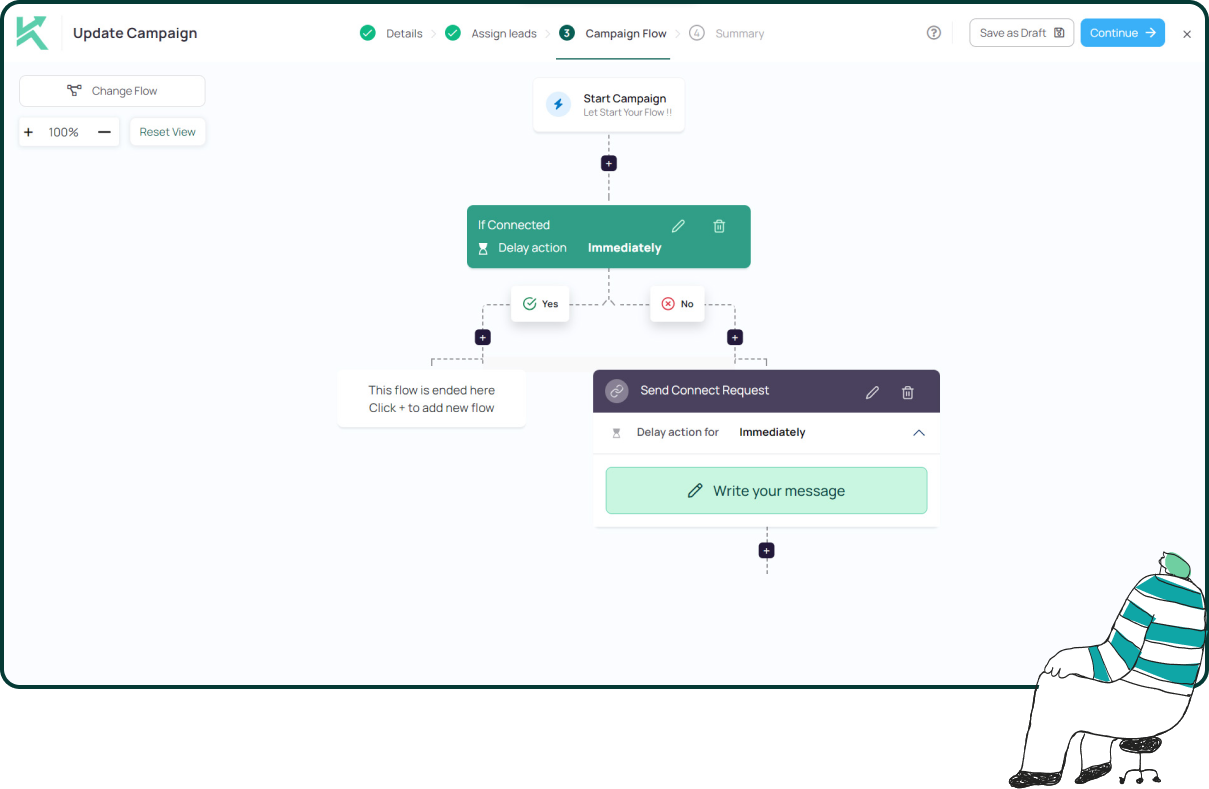
Konnector.ai is built specifically for professionals and sales teams who need to maximise LinkedIn outreach while staying completely within LinkedIn’s guidelines. Konnector.ai automatically paces your connection requests to match your account’s safe threshold, monitors your SSI and acceptance rate in real time, withdraws stale pending invites before they hurt your reputation, and blends LinkedIn with email in coordinated omnichannel sequences — all from a single dashboard.
No more burned accounts. No more manual counting. Just consistent, safe, high-conversion LinkedIn outreach — at scale.
📅 Book a Free Demo → See exactly how Konnector.ai manages your LinkedIn limits and scales your pipeline.
⚡ Sign Up Free → Start your first intelligent LinkedIn outreach sequence today — no credit card required.
11x Your LinkedIn Outreach With
Automation and Gen AI
Harness the power of LinkedIn Automation and Gen AI to amplify your reach like never before. Engage thousands of leads weekly with AI-driven comments and targeted campaigns—all from one lead-gen powerhouse platform.
Frequently Asked Questions
LinkedIn allows roughly 500–700 pending connection requests at a time. If you reach this threshold, LinkedIn temporarily blocks new invitations until you withdraw older pending requests.
No. Withdrawing pending invitations does not restore your weekly sending quota. The limit is based on how many invitations you send, not how many remain pending.
No. Personalized invitations do not reduce the limit, but they significantly improve acceptance rates. Accounts with higher acceptance rates typically experience fewer restrictions and higher sending thresholds.
Yes. If a large number of your invitations are ignored or marked as “I don’t know this person,” LinkedIn may temporarily restrict your ability to send new connection requests.
No. All automation tools operate within LinkedIn’s platform limits. Safe tools simply automate timing, targeting, and sequencing — they do not bypass LinkedIn’s invitation caps.
Yes. New or inactive accounts often start with lower trust scores, meaning the platform may temporarily limit invitations to 20–50 per week until the account builds activity and engagement.
No. Users with LinkedIn Open Profile enabled allow Premium members to message them without sending a connection request. These messages do not count toward the weekly connection limit.
Yes. If LinkedIn detects aggressive outreach patterns, spam complaints, or very low acceptance rates, the platform may temporarily lower your weekly sending capacity.
A healthy acceptance rate is typically 30–50% or higher. Accounts with strong acceptance rates tend to experience fewer invitation restrictions and higher trust scores.
Yes. Sending large numbers of requests in a short period can trigger LinkedIn’s behavioral spam detection systems, which may temporarily block invitations.