You send hundreds of LinkedIn outreach messages every week. You personalize the templates. You target the right prospects. Yet your response rate sits stubbornly below 5%, and pipeline growth remains flat.
If this sounds familiar, you’re not alone. Most LinkedIn outreach campaigns fail—not because the strategy is flawed, but because execution misses critical elements that separate successful outreach from ignored spam.
In 2026, LinkedIn’s algorithm has grown smarter, buyers have become more selective, and the bar for effective LinkedIn outreach has risen significantly. Here’s why your LinkedIn outreach is failing and exactly how to fix it.

Reason 1: Your LinkedIn Outreach Looks Like Everyone Else’s
Open your LinkedIn inbox right now. You’ll find dozens of messages following the same tired formula: generic compliment, vague value proposition, aggressive call to action.
“Hi [Name], I noticed your impressive background in [industry]. We help companies like yours achieve [generic benefit]. Would you be open to a quick call?”
This template-driven LinkedIn outreach fails because prospects receive 10-20 identical messages weekly. Your message gets deleted within seconds because it signals automation, not genuine interest.
The Fix: Use pattern interruption in your LinkedIn outreach. Reference specific content the prospect posted, mention a mutual connection authentically, or lead with a relevant insight instead of a pitch. Tools like Konnector.ai help you identify prospects actively posting about topics relevant to your solution, allowing you to engage with their content before sending connection requests. This creates familiarity and context that generic LinkedIn outreach lacks.
Reason 2: You’re Reaching Out at the Wrong Time
Timing determines LinkedIn outreach success more than most sales professionals realize. Messaging a prospect who changed jobs three months ago yields different results than reaching someone who started a new role last week.
Similarly, contacting a CMO during Q4 budget planning receives different reception than the same message in January when budgets reset and new initiatives launch.
Most LinkedIn outreach fails because it ignores buying signals entirely. You’re pitching marketing automation to prospects who haven’t posted about lead generation challenges or mentioned related pain points.
The Fix: Implement intent-based LinkedIn outreach using social signals. Konnector.ai’s social signals feature monitors when prospects post about specific topics, attend relevant webinars, engage with competitor content, or show other buying intent signals. This allows you to time your LinkedIn outreach for maximum relevance. Instead of cold messaging 500 random prospects, you message 50 prospects actively discussing problems your solution solves.
Reason 3: Your Follow-Up Strategy Doesn’t Exist
Here’s a sobering statistic: 80% of sales require five or more touchpoints, yet most LinkedIn outreach campaigns stop after one or two messages.
You send a connection request. It gets accepted. You send a pitch message. No response. You move on.
This single-touch LinkedIn outreach approach fails because busy executives don’t respond to every message immediately. Your prospect may have been in meetings, traveling, or simply overwhelmed when your message arrived.
The Fix: Build multi-touch LinkedIn outreach sequences that combine multiple channels and touchpoints. A proper sequence includes:
- Day 1: Engage with prospect’s recent post
- Day 3: Send personalized connection request
- Day 5: Send value-first message (no pitch)
- Day 10: Share relevant case study or insight
- Day 15: Email follow-up with additional context
- Day 20: Final LinkedIn message with clear call-to-action
Konnector.ai automates these sequences while maintaining natural timing and personalization. Book a demo to see how multi-touch LinkedIn outreach increases response rates from 5% to 20%+.
Read more—-> Mastering the Art of Followup Messaging: A Guide for SDRs
Reason 4: You’re Targeting Volume Over Relevance
The biggest LinkedIn outreach mistake is prioritizing quantity over quality. Sales leaders set KPIs around messages sent rather than conversations started, leading teams to blast hundreds of poorly targeted prospects weekly.
This volume-first LinkedIn outreach fails because it generates low acceptance rates, poor reply rates, and eventual spam flags that restrict your account.
LinkedIn’s algorithm monitors engagement metrics. When your connection requests get ignored 70% of the time and your messages receive 3% response rates, the platform reduces your reach and applies sending limits.
The Fix: Shift from volume-based to relevance-based LinkedIn outreach. Start with tighter targeting criteria:
- Prospects who match your Ideal Customer Profile precisely
- Decision-makers with budget authority in their role
- Professionals showing active engagement on LinkedIn (posting, commenting)
- Companies in growth phase or experiencing relevant trigger events
Reduce your daily LinkedIn outreach volume by 50% while improving targeting precision by 100%. You’ll see higher acceptance rates, better conversations, and improved platform standing that allows sustainable scaling.
Reason 5: Your Message Leads With Your Needs, Not Theirs
Most LinkedIn outreach fails the fundamental sales test: it focuses on what you want instead of what the prospect needs.
“I’d love to schedule a call to discuss how our solution can help your team.”
This approach centers your desire for a meeting rather than the prospect’s desire to solve a problem. Busy executives don’t care about your sales quota or product features. They care about challenges keeping them from hitting their goals.
The Fix: Restructure your LinkedIn outreach around prospect priorities. Lead with insights, questions, or observations that demonstrate understanding of their situation:
- “Saw your post about scaling outbound—we just published research on why 70% of SDR teams miss quota. Thought you’d find the section on list quality interesting.”
- “Noticed [Company] expanded to EMEA recently. Most of our clients hit this challenge around headcount coordination across regions—happy to share what worked.”
Value-first LinkedIn outreach that leads with helping rather than selling generates 3-4x higher response rates.
Read more—-> 25 Best LinkedIn Outreach Templates That Actually Get Replies
Reason 6: You’re Using Risky Automation That Gets Accounts Banned
Many sales teams turn to LinkedIn outreach automation to scale their efforts, then wonder why accounts get restricted or banned within weeks.
The problem isn’t automation itself—it’s using browser-based extensions that create obvious automation patterns LinkedIn easily detects. These tools operate from your local IP address, send messages in predictable intervals, and exhibit behavioral patterns that trigger spam flags.
The Fix: Use cloud-based LinkedIn outreach automation built specifically to avoid detection. Konnector.ai operates from dedicated IPs, introduces random delays between actions, varies activity patterns daily, and automatically stays within LinkedIn’s safety limits.
Safe automation allows you to scale LinkedIn outreach from 50 messages daily to 500+ across multiple team members without risking account restrictions. The platform handles timing, personalization variables, and multi-channel sequencing while you focus on conversations with prospects who respond.
Sign up today and transform your LinkedIn outreach from manual, time-consuming work into an automated engine that generates consistent pipeline.
Reason 7: You’re Not Leveraging Social Proof and Credibility
LinkedIn outreach from unknown senders faces an immediate credibility gap. Prospects don’t know you, haven’t heard of your company, and have no reason to trust your message.
Most LinkedIn outreach fails to bridge this gap, expecting prospects to accept connection requests and respond to pitches from complete strangers.
The Fix: Build credibility before direct outreach:
- Share valuable content consistently so prospects recognize your name
- Get introductions from mutual connections whenever possible
- Reference clients in similar industries or company stages
- Link to relevant case studies or published insights in your messages
- Optimize your LinkedIn profile with social proof (testimonials, logos, results)
When prospects visit your profile after receiving your LinkedIn outreach message, they should see a credible professional with relevant expertise, not an empty profile with no activity history.
The Complete LinkedIn Outreach Fix: A Strategic Framework

Successful LinkedIn outreach in 2026 requires combining all these fixes into a cohesive strategy:
Week 1-2: Build your target list using strict ICP criteria: Use Konnector.ai to identify prospects showing buying signals through social engagement and content interaction.
Week 3-4: Engage with target prospects’ content authentically: Comment on posts, share their insights, and build visibility before sending connection requests.
Week 5-8: Launch multi-touch LinkedIn outreach sequences: combining platform activity (profile views, post likes) with personalized messages and email follow-up. Monitor acceptance rates (target 35%+) and reply rates (target 18%+).
Week 9+: Optimize based on performance data: Double down on messaging frameworks generating responses. Refine targeting based on which segments engage most. Scale what works while maintaining quality metrics.
Stop Failing at LinkedIn Outreach—Start Converting
LinkedIn outreach fails when you treat it like email marketing: blast messages to large lists and hope for responses. It succeeds when you approach it like modern sales: research prospects, identify intent signals, engage contextually, and follow up persistently.
The difference between 5% response rates and 20%+ response rates isn’t luck—it’s strategy, timing, personalization, and the right tools.
Konnector.ai helps B2B sales teams fix every major LinkedIn outreach failure point: we identify high-intent prospects through social signals, automate multi-touch sequences that feel human, maintain account safety through cloud-based sending, and integrate with your CRM to track pipeline impact.
Stop losing deals to ignored LinkedIn outreach messages. Book a personalized demo to see how we help sales teams turn LinkedIn into their highest-performing channel—or start your free trial and fix your LinkedIn outreach today.
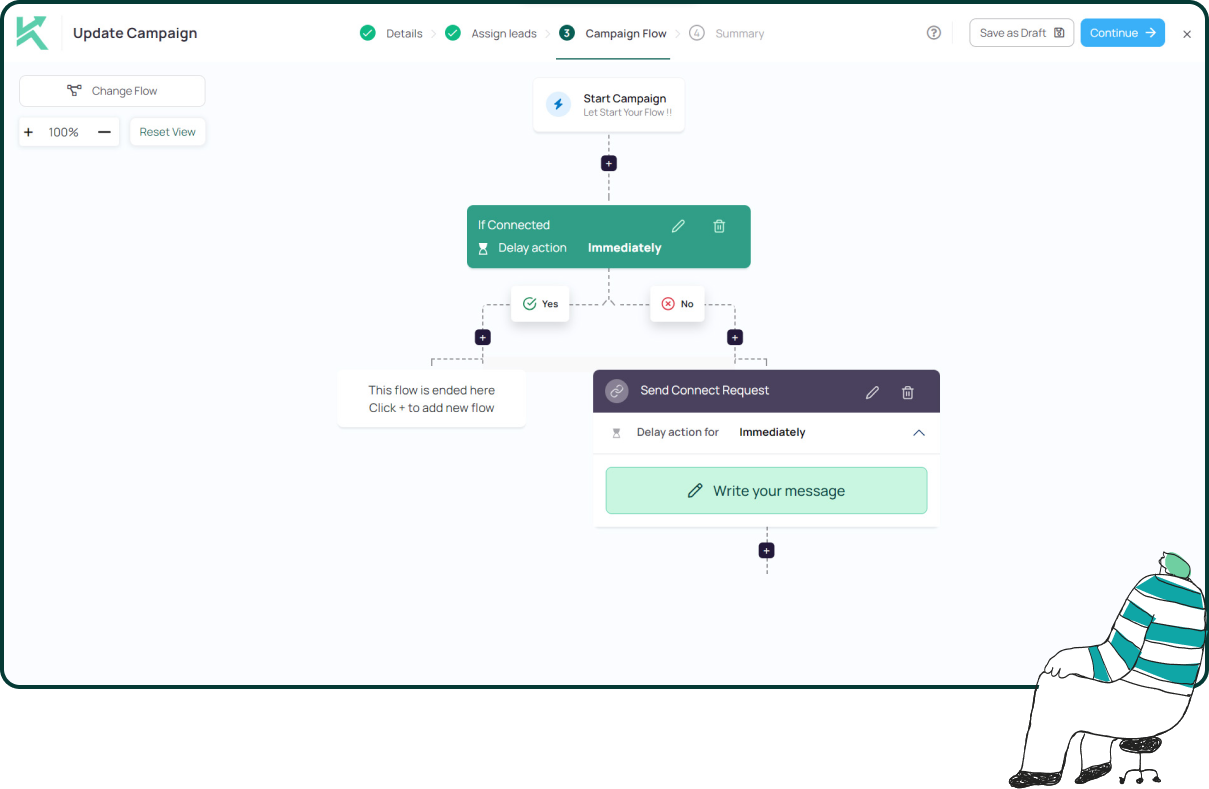
11x Your LinkedIn Outreach With
Automation and Gen AI
Harness the power of LinkedIn Automation and Gen AI to amplify your reach like never before. Engage thousands of leads weekly with AI-driven comments and targeted campaigns—all from one lead-gen powerhouse platform.
Frequently Asked Questions
LinkedIn outreach fails due to generic messaging that looks like every other pitch, poor timing without buying signals, lack of follow-up sequences, volume-over-relevance targeting, and messages focused on seller needs rather than prospect problems. Most campaigns stop after 1–2 touchpoints when 80% of conversions require 5+ touches. Fix this by personalizing based on social signals, implementing multi-touch sequences, and leading with value instead of pitches.
The biggest mistake is prioritizing quantity over quality. Sending hundreds of poorly targeted messages results in low acceptance rates (under 30%), poor reply rates (under 5%), and higher chances of triggering spam detection. Instead, reduce volume and focus on highly relevant prospects who match your Ideal Customer Profile and show engagement signals.
Effective outreach requires 5–7 touchpoints over 3–4 weeks. This includes engagement, connection requests, value-driven messages, insights, and follow-ups. Most outreach fails because it stops too early, while decision-makers typically respond after multiple touchpoints.
Social signals are indicators of intent based on LinkedIn activity, such as posting, commenting, attending events, or engaging with content. Using these signals allows you to reach prospects when they are most relevant and increases response rates significantly.
Yes, when using cloud-based tools that mimic human behavior, use dedicated IPs, and operate within limits. Unsafe automation methods, like browser extensions, can trigger detection due to repetitive patterns.
Prospects ignore messages that are generic, overly sales-focused, poorly timed, or lacking credibility. Messages that fail to address the prospect’s needs or context are often skipped.
Generic outreach typically sees 3–5% response rates. Well-structured campaigns using personalization, intent signals, and follow-ups can achieve 18–25% response rates. Acceptance rates should ideally be above 35%.
Improve targeting, reduce volume, use multi-touch sequences, personalize messaging, leverage social signals, and track performance metrics like acceptance and reply rates. Consistency and relevance are key to improving outcomes.
Effective outreach tools provide segmentation, automation, and engagement tracking. Platforms like Konnector help identify intent signals, automate workflows, and manage outreach safely at scale.
Low acceptance rates usually result from poor targeting, lack of personalization, or irrelevant messaging. Sending connection requests without context or to the wrong audience reduces trust and visibility.
Yes, personalization significantly improves response rates. Even a simple reference to a recent post, role, or shared interest can increase engagement compared to generic templates.
Timing is critical. Reaching out when prospects are active or discussing relevant topics increases the chances of response. Outreach without context often gets ignored.
Yes, consistent content builds credibility and familiarity. Prospects are more likely to respond when they recognize your name or have seen your insights before.
A strong strategy combines intent-based targeting, personalized messaging, multi-touch sequences, and consistent engagement. It focuses on building relationships rather than pushing immediate sales.
High-volume outreach often fails because it sacrifices relevance. Sending too many generic messages reduces trust, lowers engagement, and increases the risk of restrictions.