LinkedIn drives 75–85% of all B2B social media leads. It is the highest-value prospecting channel available to any B2B sales team. And yet most LinkedIn outreach campaigns fail — not because the platform does not work, but because the playbook being used was built for 2020.
In 2026, 79% of B2B decision-makers actively ignore cold direct messages. Generic outreach without engagement sits at sub-2% response rates. LinkedIn’s new 360Brew algorithm penalises volume-first approaches algorithmically. And LinkedIn’s own detection systems are restricting accounts whose outreach looks like spam.
The problem is not LinkedIn. The problem is execution. Below is a data-backed diagnosis of the eight most common reasons LinkedIn outreach fails — and the precise fix for each one.

Reason 1: You Are Sending Generic Messages Nobody Reads
This is the root cause behind the majority of failed LinkedIn outreach campaigns. 72% of professionals only engage with personalised outreach. Buyers in 2026 have developed what researchers are calling “template blindness” — the ability to identify and discard automated, generic messages before they finish the first sentence.
The classic failure patterns:
“Hi [FirstName], I loved your profile and thought we should connect!”
“I help companies like yours with [generic outcome]. Would love to share more.”
“I noticed we’re both in [industry] and wanted to reach out.”
These messages do not just fail to convert — they actively damage your account. Every “I don’t know this person” report and every ignored message lowers your account’s Trust Score, reducing your future visibility and sending capacity.
The Fix
Replace name-swap personalisation with signal-based personalisation. Reference something real and specific: a post they published last week, a company milestone, a market shift relevant to their industry, a comment they left in a shared group. Outreach tied to a prospect’s recent activity achieves 32% higher response rates than generic templates, according to Sales Navigator data.
Practical formula: [Specific observation about them] + [Why it’s relevant to you or them] + [Soft, open-ended reason to connect]. No pitch. No product mention. No calendar link.
AI can accelerate personalisation at scale — but only when it analyses real prospect data (recent posts, role changes, company news) rather than inserting dynamic fields into a boilerplate. Konnector.ai’s AI comment and message engine generates contextual, human-sounding outreach by reading the actual content of each prospect’s profile and activity — not just their name and company.
Reason 2: Your ICP Is Wrong (Or Missing Entirely)
Sending the right message to the wrong person is indistinguishable from sending the wrong message. Both end in silence. And the damage goes beyond the wasted send — every ignored request by a poor-fit prospect degrades your account’s reputation with LinkedIn’s algorithm.
The most common ICP failure modes:
- Targeting by job title alone without filtering by company size, industry, or seniority
- Building a list of 10,000 contacts and blasting it without segmentation
- Including everyone at a target company rather than the decision-maker with the actual budget problem
- Mixing warm and cold contacts in the same sequence without differentiated messaging
The Fix
Define your ICP with at least five criteria: job title, seniority level, company size (headcount and/or revenue), industry vertical, and one buying signal (recent funding, tech stack indicator, job change, content engagement). LinkedIn Sales Navigator’s advanced filters and the 2026 AI Sales Assistant make this precision targeting available in minutes.
Then segment before you send. High-intent contacts (profile visitors, post engagements, event attendees) go into one sequence. Cold ICP-matched contacts go into another. The message, timing, and follow-up logic should be completely different for each group. Narrow lists of 100–500 targeted contacts consistently outperform broad lists ten times their size because every send carries a higher probability of relevance.
See our complete guide on best time for LinkedIn Outreach for a full ICP-to-list building walkthrough.
Reason 3: You Are Going In Cold With No Warm-Up
Pure cold outreach — a connection request to someone who has never encountered your name, your content, or your company — sits at the bottom of every performance benchmark in 2026. Comment-first outreach delivers 2.5x higher connection rates than cold direct messages. Connection acceptance rates jump from 20% for cold approaches to 45–60% when preceded by meaningful content engagement.
The reason is not mysterious: people accept connection requests from people they recognise. Recognition is built by appearing in their LinkedIn feed before you appear in their inbox.
The Fix
Build a pre-connection warm-up routine into every outreach sequence. Before sending a request:
- Visit the prospect’s profile (generates a notification)
- Like or save a relevant post of theirs (builds a second notification)
- Leave a substantive, specific comment on one of their posts (builds visible association in front of their audience)
- Send the connection request referencing the interaction 24–48 hours later
By the time your connection request arrives, you are a familiar face, not a cold solicitor. The prospect has already seen your name, checked your profile, and registered that you engage meaningfully in their space. This is the structural reason why a 15-minute daily LinkedIn routine built around social signals produces dramatically better results than a purely outbound message-blasting approach.
Reason 4: You Are Pitching Too Early
The “pitch slap” — sending a product pitch, a demo link, or a calendar booking URL in your first message — is the single most reliable way to destroy a promising conversation before it starts. Buyers in 2026 recognise the intent pattern immediately and dismiss it. Research consistently shows that leading with a sales pitch in the first LinkedIn message produces sub-5% reply rates.
The first message’s job is not to close a meeting. Its job is to open a conversation. Meetings happen naturally once trust is established. They almost never happen when asked for before trust exists.
The Fix
Restructure your sequence logic: first message = conversation opener, not pitch. Lead with a relevant insight, a genuine question, or a useful resource with no strings attached. Never include a Calendly link, a demo request, or a product description in the first message.
The soft ask comes in message 3 or 4, after you have demonstrated value through the first two touchpoints. By that point, the prospect has received two or three interactions that added something to them — and the meeting ask feels like a natural next step, not a cold demand.
Keep first messages short. Messages under 300 characters get 19% more responses than longer ones. Brevity signals confidence and respect for the recipient’s time. A dense block of text announcing your company’s services reads like spam because it usually is.
Reason 5: Your LinkedIn Profile Is Killing Your Conversion
Every prospect checks your profile before accepting a connection request or replying to a message. Your profile is not a backstory — it is the conversion layer that determines whether your outreach investment pays off. A weak profile eliminates a significant percentage of otherwise-convertible prospects before they ever respond.
LinkedIn’s 2026 algorithm (360Brew) also checks your profile quality as a credibility signal before distributing your content. A sparse, inactive, or generic profile reduces your organic visibility and your outreach conversion simultaneously.
The Fix
Rewrite your profile as a prospect-facing landing page, not a resume:
- Headline: Name the problem you solve, not your job title. “Helping B2B SaaS teams book more qualified demos without burning LinkedIn accounts” outperforms “Head of Sales” every time.
- About section: Written to your ICP, not to a recruiter. Open with their pain point, not your credentials.
- Recent activity: Post or engage 2–3 times per week. An inactive profile signals an untrustworthy sender. Only 3% of LinkedIn members post more than once per week — those who do have an outsized visibility advantage.
- Featured section: A relevant case study, a useful resource, or a clear CTA that gives prospects a next step even if they do not respond to your message.
Reason 6: You Have No Follow-Up Sequence
One message and done. It is the most common structural mistake in LinkedIn outreach, and it leaves the majority of potential pipeline untouched. Follow-up messages generate 42% of all campaign replies — yet 48% of sales professionals never send a second message.
This is not a minor oversight. It means nearly half of all possible responses are abandoned before they have a chance to materialise. The prospect who was genuinely interested but opened your message at a bad moment, or wanted to reply but got pulled into a meeting, never hears from you again.
The Fix
Build a minimum 3–4 touch sequence into every LinkedIn outreach campaign, with clear content logic at each step:
| Touch | Timing | Message Content |
|---|---|---|
| 1 | 1–3 days post-acceptance | Value-first opener: insight, resource, or genuine observation. Zero pitch. |
| 2 | 5–7 days later | New angle or soft nudge. Acknowledge they may be busy. Brief, human. |
| 3 | 5–7 days later | Specific value-add: relevant data, case study, or market observation tailored to their company or role. |
| 4 | 4–5 days later | Clear, low-pressure CTA: “Worth a 15-minute call to explore this?” One question. No calendar link yet. |
After four touches with no response, stop. Persistent outreach beyond this point generates spam reports that permanently damage your Trust Score. Sequenced follow-ups spaced 2–5 business days apart improve conversions by 49% over single-message outreach.
Reason 7: You Are Triggering the Volume Tax
The “Volume Tax” is LinkedIn’s algorithmic penalty for accounts that send high-volume outreach with low engagement ratios. It is the mechanism by which LinkedIn enforces quality over quantity — and it is the single biggest reason well-intentioned outreach campaigns suddenly stop working.
When you send 500 messages a week but only 25 people reply, LinkedIn’s algorithm flags your account as a spam risk. The consequences are severe and compound over time:
- Your profile disappears from LinkedIn search results
- Future messages are routed to the “Other” inbox instead of the primary inbox
- Your weekly connection request limit is reduced algorithmically
- Content you post receives dramatically reduced organic distribution
LinkedIn’s 2026 detection algorithms achieve 97% accuracy for identifying obvious automation and spam-like patterns. Accounts that hit the Volume Tax often do not receive a warning — they simply notice that their outreach has stopped producing results, without understanding why.
The Fix
Invert the strategy: fewer sends, higher relevance. Data shows that accounts sending fewer than 25 highly targeted connection requests per week achieve acceptance rates nearly double those of high-volume senders. The algorithm rewards quality signals — high acceptance rates, high reply rates, low spam reports — by expanding your Trust Score and your effective sending capacity over time.
Concretely: if your acceptance rate drops below 20%, stop sending and fix the targeting and messaging problem before resuming at any volume. Audit your pending invite backlog and withdraw requests older than 14–21 days to keep your pending ratio healthy. And never use automation tools that run headless browsers or shared data-centre IPs — these create the detectable signature that triggers the most severe restrictions. Our full guide on LinkedIn’s headless browser detection covers exactly how this works and how to avoid it.
Konnector.ai monitors your acceptance rate in real time and automatically reduces volume before LinkedIn acts — protecting your account before the damage occurs. Book a demo to see how this works in practice.
Reason 8: You Are Not Measuring Anything
The most common reason LinkedIn outreach stays broken is that no one can identify where it is breaking. Most teams measure only the end state (meetings booked) without tracking the intermediate signals that reveal exactly which part of the funnel is failing.
If acceptance rate is strong but reply rate is weak, the connection request is working but the first message is not. If reply rate is decent but meeting bookings are low, the sequence is generating interest but the CTA is not landing. These are completely different problems requiring completely different fixes — but without stage-level measurement, they look identical.
The Fix
Track four metrics weekly, without exception:
- Connection acceptance rate — target 30–45%. Below 20% = pause and fix.
- First-message reply rate — target 10–15%. Below 5% = messaging or targeting problem.
- Positive reply rate — target 50%+ of all replies showing genuine interest. High reply volume with low positive rate means your message is prompting polite declines, not real conversations.
- Social Selling Index (SSI) — check weekly at linkedin.com/sales/ssi. A declining SSI is an early warning signal that your account’s reputation is eroding before any restrictions are applied.
When a metric drops, isolate the stage and fix it before scaling volume. This diagnostic discipline is what separates outreach programmes that improve over time from those that plateau or collapse.
Your LinkedIn Outreach Health Scorecard
Use this table to diagnose where your LinkedIn outreach is failing and prioritise which fix to implement first.
| Symptom | Root Cause | First Fix |
|---|---|---|
| Acceptance rate below 20% | Poor ICP targeting or weak profile | Tighten ICP filters; optimise profile headline and activity |
| Acceptance rate good, reply rate below 5% | Generic or pitch-first first message | Rewrite opening message with signal-based personalisation, no pitch |
| Good reply rate, few meetings booked | Weak CTA or pitching too early in sequence | Move CTA to message 3 or 4; make the ask conversational |
| Results declining week on week | Volume Tax triggered; Trust Score eroding | Reduce volume; audit pending invites; increase targeting precision |
| Messages landing in “Other” inbox | Trust Score too low; spam signals detected | Pause automation; manual sends for 7–14 days; fix messaging quality |
| Account restricted or flagged | Automation detected or limits exceeded | Stop all automation; manual activity only; check tool infrastructure |
| High early engagement, drops off | No follow-up sequence beyond message 1 | Build a 3–4 touch sequence with varied content at each step |
| Low engagement despite good messaging | Going in cold with no warm-up | Add 2–3 day warm-up (post engagement, profile view) before connecting |
 Stop Guessing. Build a LinkedIn Outreach System That Actually Works.
Most LinkedIn outreach fails because it is built on assumptions that are three years out of date — wrong playbook, wrong volume, wrong timing, wrong message structure. The fixes are available. The data is clear. The barrier is execution at scale.
Konnector.ai is built for B2B teams who have tried LinkedIn outreach and watched it underdeliver. The platform combines social signal intelligence (so you reach prospects already showing intent), AI-personalised messaging that reads actual prospect activity, real-time acceptance rate monitoring that protects your account before LinkedIn acts, and safe multi-account coordination across your entire sales team — from a single dashboard.
Not more automation. Smarter outreach.
📅 Book a Free Demo → We can chat your current LinkedIn outreach setup and show you exactly where the failures are happening — and how to fix them.
⚡ Sign Up Free → Start your first signal-based, intent-driven LinkedIn outreach campaign today. No credit card required.
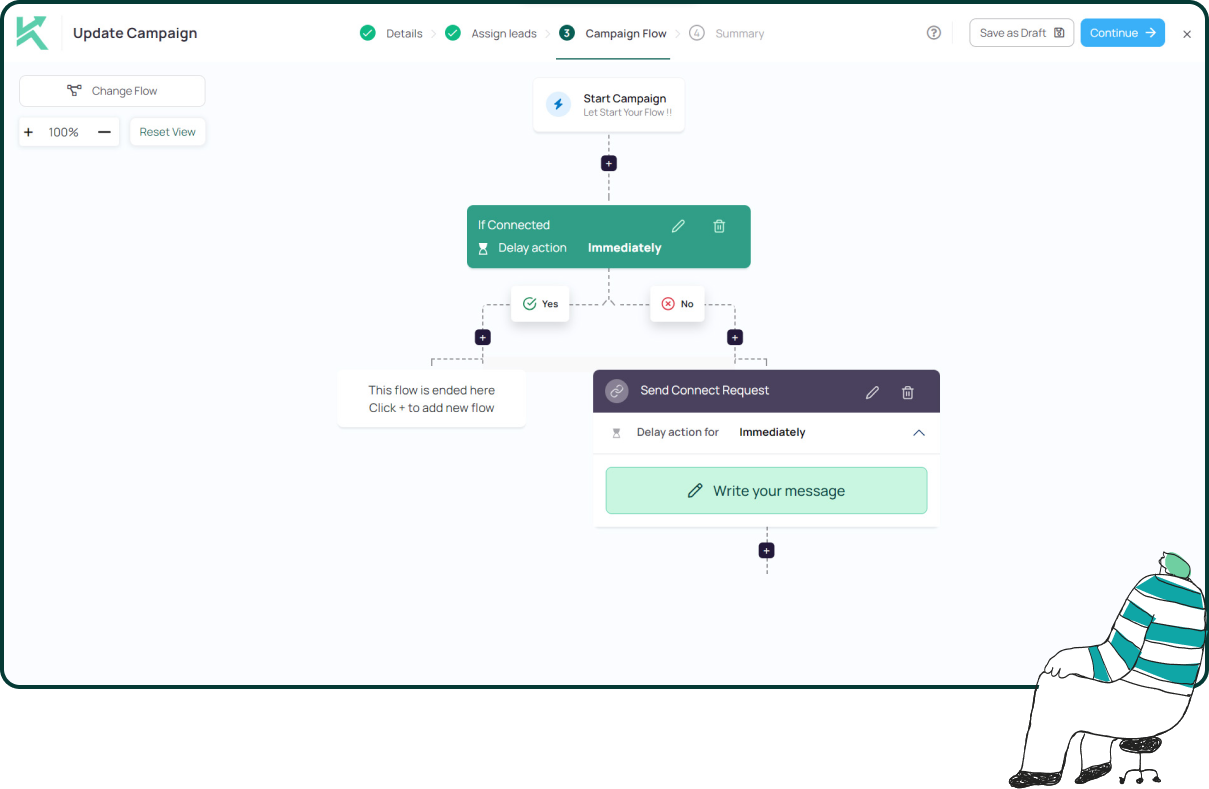
11x Your LinkedIn Outreach With
Automation and Gen AI
Harness the power of LinkedIn Automation and Gen AI to amplify your reach like never before. Engage thousands of leads weekly with AI-driven comments and targeted campaigns—all from one lead-gen powerhouse platform.
Frequently Asked Questions
A healthy LinkedIn connection acceptance rate ranges between 30–45%. Above 40% indicates strong targeting and messaging alignment. If your acceptance rate drops below 20%, LinkedIn begins limiting your reach and sending capacity, making it critical to fix targeting before increasing volume.
Most LinkedIn accounts are limited to ~100 connection requests per week. Accounts with high Social Selling Index (SSI) scores and strong engagement may reach 150–200 per week. The limit resets on a rolling 7-day basis from your first sent request.
Yes — but strategically. Full manual personalisation isn’t scalable, but signal-based personalisation (referencing a prospect’s post, comment, event, or activity) significantly improves response rates without sacrificing efficiency.
The highest-performing window is Tuesday to Thursday, 9:00 AM – 11:00 AM (prospect’s local time). Secondary windows include 12:00 PM – 2:00 PM. Avoid late nights and weekends, as they reduce response rates and can trigger spam-like behaviour patterns.
A LinkedIn warm-up involves engaging with a prospect before sending a connection request — such as viewing their profile, liking posts, or leaving thoughtful comments. This increases familiarity and can improve response rates by up to 30%+.
Most responses come after the 2nd or 3rd touchpoint. A strong sequence includes 3–4 follow-ups spaced across 7–14 days. Stopping after one message leaves a significant portion of potential replies untapped.
Cold outreach targets prospects with no prior interaction, while warm outreach targets users who have already shown intent signals (liked your post, viewed your profile, attended an event). Warm outreach consistently delivers higher acceptance and reply rates.
Yes. Engaging with a prospect’s content before outreach increases profile visibility, trust, and familiarity, leading to significantly higher acceptance and reply rates compared to cold outreach alone.
A safe daily limit is 20–40 connection requests and 50–100 messages per account, depending on account health. Exceeding this — especially with low engagement — increases the risk of restrictions and reduced visibility.
Common signs include:
Drop in connection acceptance rates
Messages landing in the “Other” inbox
Reduced profile views
Lower content engagement
Sudden reduction in weekly sending limits
These signals typically indicate algorithmic suppression rather than an explicit warning.