LinkedIn outreach has come a long way from the days of copy-paste templates and clumsy mail-merge sequences. In 2026, the gap between brands that thrive on LinkedIn and those that get ignored comes down to one thing: agentic AI.
AI agents do not simply swap a first name into a scripted message and hit send. They observe, reason, and adapt in real time, turning every touchpoint into a contextually relevant conversation. If you are still relying on legacy automation bots, this article will show you why the market has moved on — and how Konnector.AI is leading the charge.
The 2026 Standard: Moving from “Mail Merge” to “Conversational Logic”
The Role of Variables
Let us be clear: the humble {first_name} variable is not going anywhere. Addressing someone by their correct name remains the essential handshake of B2B outreach. Get it wrong, and no amount of clever copy will recover the conversation.
But in 2026, getting the name right is table stakes. Prospects have been conditioned by years of automated messages that open with their first name and then immediately pivot to a generic pitch. The name alone no longer signals personalization — it signals automation.
The Hybrid Approach
This is where Konnector.AI takes a different path. The platform supports multiple custom variables that let you layer foundational personalization — names, company names, job titles — on top of each other to craft messages that feel handcrafted at scale. Instead of relying on a single token, you can weave several data points into a single message, making each touchpoint feel specific to the recipient.

The Expectation Shift
The psychology of the inbox has changed. In 2026, a prospect who sees their correct name thinks “baseline competence.” A prospect who sees their correct name alongside a reference to their company, role, or a recent initiative thinks “this person did their homework.” That distinction is where reply rates live or die.
👉 Read more: The Power of AI Messaging on LinkedIn
Beyond Logic Gates: The Rise of Autonomous Decision-Making
For decades, automation has been built on a comforting illusion: predictability.
If you map enough steps in advance, define enough rules, and space messages out carefully, outcomes should follow. That logic made sense when systems were simple and user behavior was static.
But modern digital behavior isn’t linear.
People don’t operate on schedules.
They surface intent in bursts — often briefly, often silently — and then disappear again.
This is where traditional automation quietly breaks.
It doesn’t fail because it’s broken.
It fails because it’s blind to timing.
Dynamic Triggering
Legacy bots operate on rigid schedules: send message on Day 1, follow up on Day 3, close the sequence on Day 7. The problem? Your prospect might not even be online on any of those days.
AI agents flip this model. Instead of firing messages on a fixed calendar, they monitor whether a prospect is active on LinkedIn and time the outreach accordingly. The result is that your personalized {first_name} message lands when the prospect is most likely to see it — not when an arbitrary timer says so.

At Konnector.AI, we take this a step ahead. You can choose the right intervals, so that you don’t look pushy and there is a higher probability of engaging your prospect.
Contextual Anchoring
Konnector.AI takes dynamic triggering a step further with what we call contextual anchoring. The platform uses your custom variables but anchors them to a specific, recently scraped data point. For example:
“Hi {first_name}, caught your recent insight on [Topic]. It resonated with what we are building at [Company]…”
This approach transforms a variable-driven message into a conversation starter that feels genuinely personal — because it references something the prospect actually said or did.
Intent Recognition
One of the most exciting frontiers in agentic AI is intent recognition: the ability to distinguish between a “soft no” and a “not yet.” A prospect who replies “Not the right time” is giving a very different signal from one who says “Not interested.”
Across the industry, AI agents are being trained to read these nuances and adjust follow-up logic accordingly. The tone of the human dictates the tone of the next touchpoint, ensuring that persistence never crosses the line into annoyance.
Technical Scalability and Account Longevity
Scalability used to mean doing more, faster.
In early automation models, success was measured by volume… how many profiles touched, how many messages sent, how quickly sequences completed. That approach worked briefly, until platforms evolved.
Today, scalability without restraint is a liability.
LinkedIn doesn’t evaluate actions in isolation. It evaluates patterns over time. Consistency, pacing, and contextual behavior now matter more than raw output, and systems that ignore this trade-off tend to burn accounts long before they deliver results.
This is where longevity becomes a technical requirement, not a best practice.
The “Human-Centric” Algorithm
LinkedIn has spent the last several years refining its detection systems, and in 2026 the platform actively rewards activity patterns that resemble focused, intentional work. Batch processing hundreds of connection requests in a ten-minute window is a fast track to restrictions.
AI agents solve this by mimicking organic behavior: spacing actions out across the day, varying message lengths, and interspersing outreach with genuine engagement like profile views and content interaction.
Warm-Up and Activity Simulation
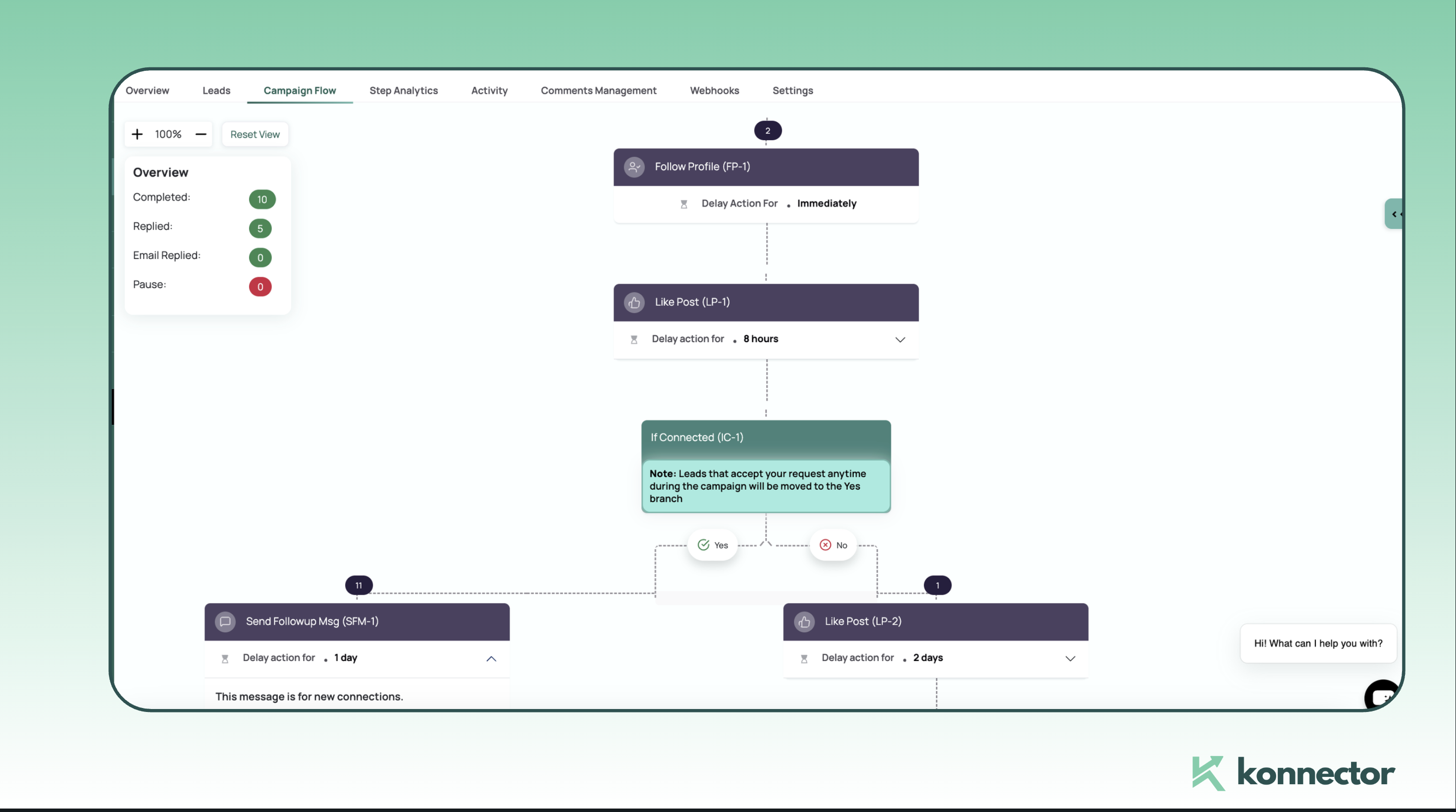
Before a single {first_name} message is ever sent, Konnector.AI’s agents perform a series of micro-actions: viewing profiles, following relevant accounts, and engaging with content. These micro-actions serve two purposes. First, they prime LinkedIn’s algorithm to see your account as an active, engaged user rather than a dormant one that suddenly springs to life. Second, they create a natural activity footprint that makes your subsequent outreach blend seamlessly into the platform’s expected behavior patterns.
Here is an example of Konnector’s campaign flow:
Cloud-Native Resilience and Zero-Trust Security
In 2026, LinkedIn has adopted what the security industry calls a Zero-Trust architecture. In simple terms, Zero Trust means that no device, user, or application is automatically trusted — even if it sits inside a corporate network. Every single request is verified, authenticated, and authorized independently. For outreach tools, this means that the days of a simple browser extension logging in on your behalf and staying logged in indefinitely are numbered.
Konnector.AI’s cloud-native infrastructure is purpose-built for this reality. Because the platform operates through secure, authenticated sessions in the cloud rather than piggy-backing on your local browser, it is designed to keep high-value accounts safe even as LinkedIn rolls out increasingly stringent security updates.
👉 Unlock the ultimate LinkedIn outreach flow with Konnector.AI
Data-Driven Personalization: The Konnector.AI Edge
Effective personalization isn’t driven by templates — it’s driven by signal density.
The more touchpoints a system observes across LinkedIn, the more accurately it can infer relevance, timing, and message framing. Single-source scraping creates blind spots that compound as scale increases.
Multi-Point Data Scrapers
Most outreach tools pull data from a prospect’s headline, job title, and company name. Konnector.AI goes deeper. Its multi-point data scrapers can extract information from recent post comments, shared group interactions, and content engagement patterns.
This means your custom variables are not limited to static profile fields. You can reference a comment a prospect left on an industry post, a group they recently joined, or a topic they have been engaging with — all without lifting a finger.
The “Active Window” Strategy
Timing matters almost as much as content. Konnector.AI’s agents can identify leads who are currently active on LinkedIn, allowing you to prioritize outreach to people who are online right now. When your message arrives while a prospect is already scrolling through their feed, the notification has a dramatically higher chance of being seen and acted upon.
Why Experts Are Choosing AI Agents over Legacy Bots

Resource Efficiency
A well-configured AI agent can comfortably handle the prospecting workload of a five-person SDR team. It identifies leads, personalizes messages using multiple custom variables, times delivery for maximum visibility, and adjusts follow-up cadence based on engagement signals — all without PTO requests, onboarding cycles, or the fatigue that comes with repetitive manual work.
Consistency at Scale
Human SDRs are brilliant at building relationships, but they are inconsistent at volume. One rep might craft a beautifully personalized message on Monday morning and send a half-hearted template on Friday afternoon. AI agents remove that variability. Every message maintains the same standard of personalization and tone, whether it is the first of the day or the five-hundredth.
Future-Proofing
LinkedIn’s algorithm shifts periodically, and what worked six months ago may trigger restrictions today. Konnector.AI’s adaptive learning models continuously monitor platform changes and adjust behavior patterns in real time, ensuring your outreach strategy stays ahead of the curve rather than scrambling to catch up after a penalty.
👉 LinkedIn Outreach: How to Use AI to Personalize Messages Without Sounding Creepy
VI. The New Era of LinkedIn Growth
Success on LinkedIn in 2026 is not about choosing between automation and personalization. It is about using agentic AI to scale them both simultaneously. The brands winning the outreach game are the ones that combine the efficiency of automation with the nuance of human conversation — and they are doing it through intelligent agents that learn, adapt, and improve with every interaction.
If your current tool still treats outreach as a glorified mail merge, it is time for an upgrade.
See how Konnector.AI turns {first_name} into a full-scale conversation. Book a demo.
11x Your LinkedIn Outreach With
Automation and Gen AI
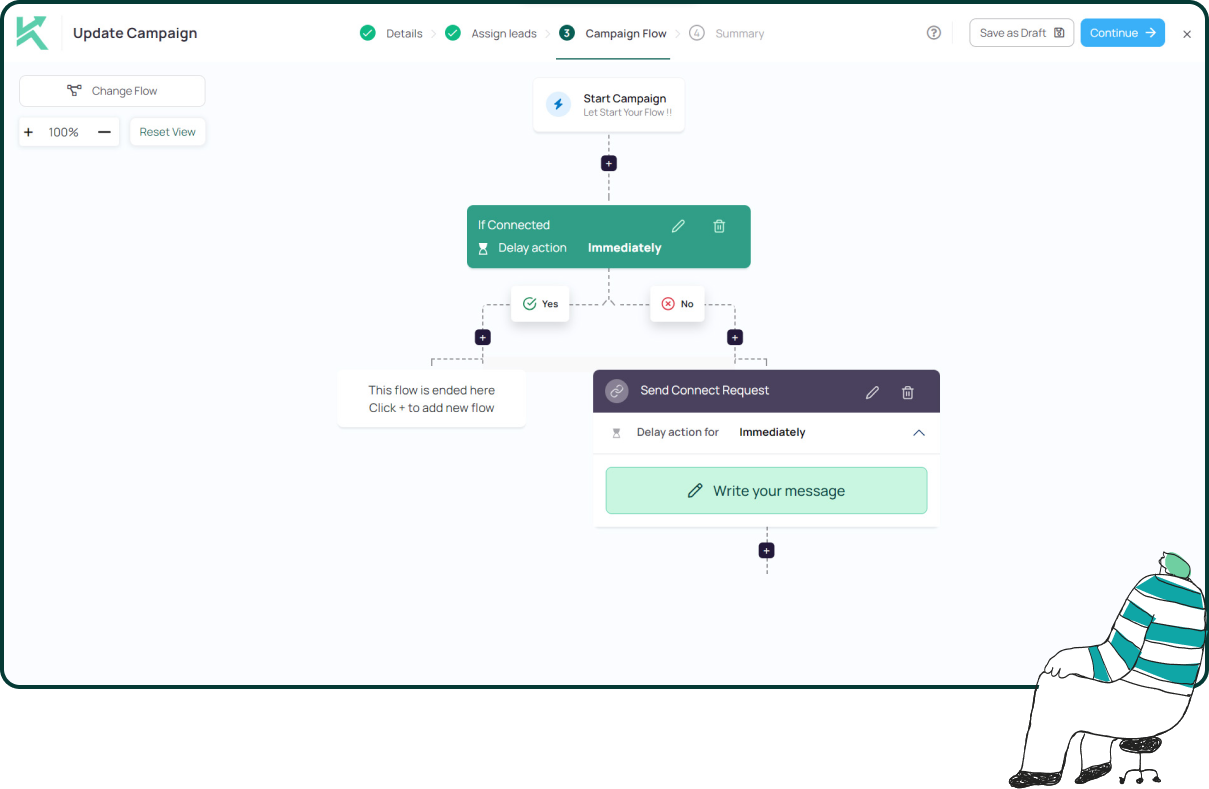
Harness the power of LinkedIn Automation and Gen AI to amplify your reach like never before. Engage thousands of leads weekly with AI-driven comments and targeted campaigns—all from one lead-gen powerhouse platform.
Frequently Asked Questions
Agentic AI refers to artificial intelligence systems that can independently observe their environment, make decisions, and take actions toward a goal without step-by-step human instruction. Traditional LinkedIn automation follows a rigid script: send message A on Day 1, message B on Day 3. An agentic AI system, by contrast, evaluates context, adjusts timing based on prospect activity, personalizes content using multiple data points, and adapts follow-up strategy based on responses. It behaves more like an experienced sales rep than a pre-programmed bot.
Instead of relying on fixed time delays, AI agents monitor whether a prospect is active on the platform. They use signals like recent logins, content engagement, and online status to time outreach for moments when the prospect is most likely to see the notification. This dynamic triggering replaces the arbitrary "Day 1, Day 3" schedule of legacy tools.
Yes. Platforms like Konnector.AI support multiple custom variables that pull data from various profile fields, recent activity, group memberships, and content engagement. The AI weaves these data points into each message so that every outreach feels individually crafted, even when hundreds of messages are being sent in a single campaign.
Reputable AI agent platforms are specifically engineered to avoid account restrictions. They mimic organic human behavior by spacing actions throughout the day, varying message content, and performing warm-up micro-actions like profile views and follows before initiating outreach. Konnector.AI's cloud-native infrastructure is designed to keep accounts safe under LinkedIn's evolving Zero-Trust security model.
Zero Trust is a cybersecurity framework in which no device, user, or application is automatically trusted. Every request is independently verified and authenticated. LinkedIn has adopted elements of this architecture, which means outreach tools that rely on simple browser sessions or cookie-based logins face increasing scrutiny. Cloud-native platforms like Konnector.AI are built to operate within this stricter security environment.
A bot follows a fixed decision tree: if condition X, then action Y. An AI agent uses reasoning and contextual awareness to decide what to do next. For example, a bot sends the same follow-up regardless of the prospect's reply. An AI agent can recognize whether a response is a "soft no," a request for more information, or genuine interest — and adjust its next action accordingly.
AI agents can handle the volume and consistency of outreach that would typically require a team of five or more SDRs. However, they work best as a force multiplier rather than a full replacement. The ideal model is to let AI agents handle prospecting, initial outreach, and follow-up cadence while human reps focus on high-value conversations, relationship building, and closing.
Konnector.AI's multi-point data scrapers go beyond basic profile fields like job title and company name. They can pull information from recent post comments, shared group interactions, content engagement patterns, and other publicly available activity. This data feeds into your custom variables so your outreach references things the prospect has actually said or engaged with.
All signs point to yes. As LinkedIn's detection systems grow more sophisticated and prospect expectations for personalization increase, the gap between AI-driven outreach and legacy automation will only widen. Brands that adopt agentic AI now are positioning themselves ahead of a curve that the rest of the market will eventually be forced to follow.
You can request a demo directly at konnector.ai. The platform is designed for teams of all sizes and offers guided onboarding to help you set up your first AI-powered outreach campaign within minutes.
You can request a demo directly at konnector.ai. The platform is designed for teams of all sizes and offers guided onboarding to help you set up your first AI-powered outreach campaign within minutes.