LinkedIn Lead Generation across Europe isn’t harder because it’s bigger.
It’s harder because it’s different.
For one, there are more borders, which means more nuance. Europe isn’t one buying culture. What feels natural in the Netherlands can feel overly familiar in Italy, and what works in Ireland may fall flat in Germany. Cross-border outreach only works when you respect how conversations actually happen locally.
There are also waymore compliance signals to respect. GDPR and ePrivacy-style rules quietly shape every step of LinkedIn Lead Generation—how you identify prospects, what context you use to message them, and how carefully you transition conversations off LinkedIn into email or calls.
Lastly, there is more scrutiny on automation. LinkedIn keeps a close eye on automated behaviour. Scaling outreach in Europe doesn’t mean “doing more faster”—it means moving deliberately, safely, and in ways that still feel human.
The teams that win LinkedIn Lead Generation in Europe don’t chase volume.
They build trust, country by country, conversation by conversation.
The Europe-ready LinkedIn Lead Generation stack
Successful LinkedIn Lead Generation in Europe starts with structure, not speed.
Before messages, templates, or automation come into play, you need a stack that’s build around how Europe actually buys.
An ideal LinkedIn Lead Generation stack is built to handle three things at once:
- Targeting precision across multiple countries, languages, and seniority levels
- Conversation consistency so no lead falls through the cracks when teams get busy
- Safety and compliance that protect your LinkedIn account while you scale
This isn’t about piling on tools.
It’s about designing a clean, intentional system where prospecting, messaging, and follow-ups work together—especially when your campaigns cross borders.
Here’s how to put the right LinkedIn Lead Generation stack together:

1) Prospecting layer (who you target)
- LinkedIn search + filters (baseline targeting) This is where most LinkedIn Lead Generation starts. Native LinkedIn filters help you quickly narrow down roles, locations, industries, and companies—useful for early testing, small markets, or validating whether an audience is active on LinkedIn at all. It’s simple, accessible, and effective for lightweight prospecting, but it has limits when you scale across multiple European regions.
- Sales Navigator (recommended for cross-border targeting depth) Sales Navigator is where LinkedIn Lead Generation becomes systematic across Europe. It allows you to segment by seniority, function, company size, and geography with far greater precision, while also supporting saved lead lists and account tracking. For cross-border campaigns, this means you can maintain clean country-specific lists, monitor role changes, and spot intent-like signals—without rebuilding your targeting every time you enter a new market.Read more—> How to Use LinkedIn Sales Navigator for Free with Konnector.ai?
2) Conversation layer (how you start + follow up)
- Manual-first messaging standards (message quality, relevance, personalization)
Strong LinkedIn Lead Generation in Europe starts with messages that could realistically be sent by a human. Manual-first standards force teams to focus on clarity, relevance, and tone before thinking about scale. This means every message has a clear reason for being sent, references the prospect’s role or context, and avoids sounding transactional—an especially important factor in European markets where trust is built more cautiously. - Konnector-style automation framework (structured sequencing, safety pacing, reply detection, stop rules, tagging, and campaign logic)
Automation in LinkedIn Lead Generation should exist to protect consistency, not replace judgment. A Konnector-style framework ensures follow-ups go out on time, activity stays within safe limits, and conversations automatically pause when a prospect replies. Tagging and campaign logic keep leads organized across countries and segments, so even when teams are busy with delivery, no conversation feels rushed, repetitive, or forgotten.
3) Proof + conversion layer (why they respond)
- Localized credibility
In European LinkedIn Lead Generation, trust travels locally. Prospects are far more responsive when they see proof that feels familiar—case studies from nearby regions, similar industries, or comparable regulatory environments. A clear “why now” hook tied to regional trends helps your outreach feel timely rather than generic or imported from another market. - Conversion assets
Cross-border campaigns convert better when the next step feels relevant and low-risk. Instead of one generic asset, strong LinkedIn Lead Generation uses one focused landing page per region or segment, supported by a single core deck and a simple ROI narrative. This keeps conversations moving forward without overwhelming prospects with too many materials. - Workflow discipline
Scaling LinkedIn Lead Generation across Europe breaks down quickly without structure. Clear tagging, defined pipeline stages, and weekly review rituals ensure every lead is tracked, followed up, and learned from. Discipline here is what turns individual conversations into a predictable system—without losing the human element.Before tactics: the compliance + platform reality (in plain English)
- LinkedIn states it doesn’t allow third-party software or browser extensions that scrape, modify the appearance of, or automate activity on LinkedIn.But, with the safety we follow- you can get the best of both worlds. Automation combined with quality leads of LinkedIn and your outreach campaign will be a success.
- LinkedIn warns that using prohibited tools violates the User Agreement and can lead to restrictions or shutdown.
Implication: If you’re building “LinkedIn Lead Generation” at scale in Europe, your system must prioritize account safety and human-like behavior patterns, and avoid prohibited automation patterns.
GDPR “legitimate interests” is not a free pass
- The EDPB’s 2024 legitimate interest guidelines emphasize that just because direct marketing may be a legitimate interest doesn’t mean it always is—some direct marketing may require another legal basis (like consent).
- The guidelines also highlight that you must assess context, expectations, and balancing of rights—especially when individuals wouldn’t reasonably expect their data to be used for marketing.
- ePrivacy-style rules can add extra conditions for unsolicited electronic marketing communications, and these can vary by country implementation.
Cross-border LinkedIn Lead Generation: the 6-part campaign blueprint
Cross-border LinkedIn Lead Generation works best when it’s approached with structure and intent, not guesswork.
When campaigns span multiple European markets, small differences start to matter—language, buying behaviour, response expectations, and follow-up timing. What feels natural in one country may feel slightly off in another, even when the audience looks similar on paper.
This is why cross-border LinkedIn Lead Generation benefits from a clear campaign blueprint. Instead of relying on isolated tactics, the approach below focuses on building a repeatable system that adapts to different markets while keeping targeting, messaging, and follow-ups consistent.
The six-part framework that follows outlines how teams can plan, execute, and scale LinkedIn Lead Generation campaigns across Europe—without losing relevance or momentum along the way.

Part 1: Market slicing (Europe is not one market)
- Tier 1: Countries with strong English business usage (e.g., Ireland, Netherlands, Nordics) → faster test cycles
- Tier 2: Countries where local language improves response rates (e.g., France, Spain, Italy, DACH) → localization matters
- Tier 3: Smaller markets with tight communities (e.g., Baltics, Luxembourg) → reputation compounding is real
Do this in Konnector-style campaign setup:
- Create 1 campaign per country-language pair (not “Europe general”).
- Keep ICP constant, localize only the wrapper: language, examples, and one “cultural proof” line.
- Tag every lead with: Country, Language, ICP Segment, Offer, and Source list.
Part 2: List building that doesn’t collapse under follow-up
- Build lists around roles + triggers, not generic titles.
- Use Sales Navigator best practices (saved searches, lead lists, account mapping) to maintain consistency across countries.
Europe-specific list rules:
- Prefer role relevance over volume: GDPR expectations and deliverability both reward precision.
- Separate by seniority: Director+ responds differently than Manager-level; don’t force one script.
- Respect time zones: even within Europe, outreach timing changes how “spammy” you feel.
Part 3: The “warm-first” loop (the fastest way to not look foreign)
- Day 0–2: view profile + follow + like/comment on 1 relevant post (if available)
- Day 2–4: connection request with a micro-context line
- Day 4–10: message sequence with one idea, one proof point, one question
Why this works across borders: engagement is a universal trust signal. It reduces the “random outreach from another country” feeling and increases acceptance odds.
Part 4: Messaging that translates (without sounding translated)
Your Europe-proof message structure:
- Line 1: Relevance anchor (role + specific context)
- Line 2: Cross-border credibility (client type, region, or measurable outcome)
- Line 3: Low-friction question (permission-based)
Template A: English-first (works well in many EU business contexts)
- Connect note: “Hi {{FirstName}}, noticed you lead {{Function}} at {{Company}}—loved your point on {{Topic}}. Open to connecting?”
- Message 1: “Thanks for connecting. Quick one—are you currently focused on {{UseCase}} across {{Region/Country}}? I’m seeing {{1 trend}} show up a lot in {{their market}}.”
- Message 2: “If helpful, I can share a short checklist we use to {{Outcome}} without increasing team workload. Want it?”
Template B: Local-language assist (best practice)
- Open in their language for 1–2 lines, then offer English: “Happy to continue in English if easier.”
- Keep sentences short; avoid slang and heavy idioms.
Part 5: Sequencing that doesn’t trigger “spam” signals
LinkedIn Lead Generation fails in Europe when sequencing is:
- Too fast: feels automated
- Too generic: feels irrelevant
- Too persistent: feels disrespectful
Konnector-style sequencing rules (practical):
- Use smart delays between steps (and vary them).
- Stop on reply immediately (reply detection + stop rules).
- Separate “new connection” vs “existing connection” follow-ups (Europe especially punishes tone-deaf familiarity).
- Add a “profile viewed” branch (if someone shows intent, your message can shift to: “noticed you checked my profile—was there something you were looking for?”).
Part 6: The cross-border conversion move (how you get to calls)
- Offer a regional choice: “Want to see examples from UK councils or Irish orgs?” (swap to your relevant proof)
- Offer a low-commitment next step: “Want the 1-page checklist?” before “Book a demo”
- Use a soft calendar prompt: “If it’s useful, I can walk you through it in 12 minutes—what’s better next week, Tue or Thu?”
Cross-border psychology: People don’t reject meetings; they reject risk. Your job is to make the next step feel safe, relevant, and reversible.
Tools that actually matter for LinkedIn Lead Generation in Europe
LinkedIn Lead Generation in Europe isn’t driven by having more tools—it’s driven by having the right ones.
When you’re working across multiple countries, the tools you choose need to support precision, consistency, and control. They should help you manage complex targeting, maintain conversation quality, and scale activity without increasing risk or noise.
This section focuses on the tools that genuinely support LinkedIn Lead Generation in a European context—tools that make cross-border campaigns easier to run, safer to scale, and simpler to optimise over time.
1) LinkedIn Sales Navigator (targeting + list discipline)
- LinkedIn itself publishes Sales Navigator best practices (useful for teams standardizing prospecting workflows).
2) A sequencing system that prioritizes safety + consistency
- Why you need it: cross-border campaigns break when follow-ups become inconsistent, teams get busy, and conversations aren’t tracked.
- What it should do (Konnector-aligned): structured campaign flows, smart delays, tagging, reply-based stop rules, and “intent triggers” like profile-viewed follow-ups.
3) A compliance-aware ops layer (especially if you move off LinkedIn)
- Document your basis and safeguards: EDPB guidance stresses that legitimate interest depends on context and balancing—so your process should reflect that.
- Use opt-outs and transparency: especially in electronic mail contexts (UK ICO guidance is a solid reference point).
Common Europe cross-border mistakes (and the fix)
- Mistake: One message for “Europe”
Fix: Country-language segmentation + localized proof line - Mistake: Pitching in the first message
Fix: Permission-based micro-asks (“Want the checklist?”) - Mistake: Treating automation as “more volume”
Fix: Treat automation as “more discipline” (pacing + stop rules + consistency) - Mistake: Ignoring LinkedIn’s restrictions
Fix: Avoid prohibited automation patterns and keep activity human-like.
A practical 30-day cross-border LinkedIn Lead Generation plan (Konnector-ready)
Running cross-border LinkedIn Lead Generation becomes far more effective when it’s broken into clear, manageable phases.
A 30-day plan helps teams focus on building momentum without rushing decisions or overloading campaigns too early. It creates space to test targeting, observe how different markets respond, and refine messaging before scaling further.
The Konnector-ready plan below is designed to help you move from setup to execution with clarity—so each week builds logically on the last, and your LinkedIn Lead Generation efforts stay organised, measurable, and consistent across borders.

Week 1: Foundations
- Pick 2 countries + 1 ICP segment
- Build two Sales Navigator lists (100–300 leads each)
- Create campaign tags + pipeline statuses
Week 2: Warm-first activation
- Run engagement-first touches
- Send connection requests with micro-context
- Track acceptance rates by country
Week 3: Sequence optimization
- Launch a 3–4 step follow-up sequence
- Add “profile viewed” branch messaging
- Measure: reply rate, positive reply rate, meeting rate
Week 4: Expand safely
- Add 1 more country (only after baseline KPIs hold)
- Add 1 more persona (only after message-market fit)
- Build a “best replies” library to standardize what works
What “good” looks like (benchmarks that matter)
- Acceptance rate: signals targeting + trust
- Reply rate: signals relevance + message quality
- Positive reply rate: signals offer clarity
- Meeting rate: signals conversion design
- Restriction-free continuity: signals safety + sustainability (critical given LinkedIn’s anti-automation stance).
Closing: the Konnector way to win Europe
- Europe rewards precision. Country-level segmentation beats “spray and pray.”
- Europe rewards respect. Warm-first signals and permission-based messaging travel well.
- Europe rewards discipline. The winners aren’t the loudest—they’re the most consistent.
If you want LinkedIn Lead Generation across Europe to feel human and scalable, build your system around safe pacing, smart sequencing, and intent-based follow-ups. That’s exactly where a Konnector-led workflow shines—so your team can run cross-border campaigns without losing the plot (or the relationship). Connect with our team today to see how we can fit into your needs and help your outreach plan become a success.
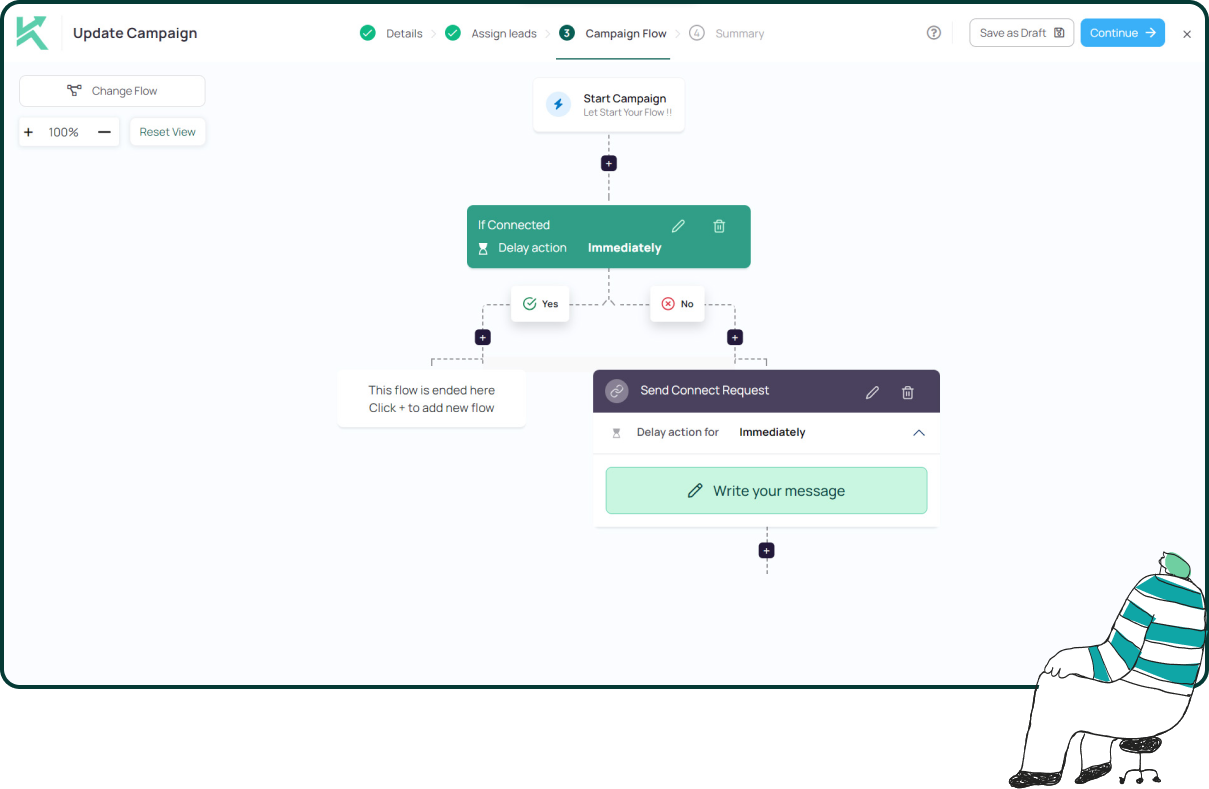
11x Your LinkedIn Outreach With
Automation and Gen AI
Harness the power of LinkedIn Automation and Gen AI to amplify your reach like never before. Engage thousands of leads weekly with AI-driven comments and targeted campaigns—all from one lead-gen powerhouse platform.
Frequently Asked Questions
LinkedIn Lead Generation in Europe refers to using LinkedIn to identify, engage, and convert business prospects across European markets while accounting for regional buying behaviour, language preferences, and compliance requirements.
European markets are more fragmented. Differences in culture, language, and privacy expectations mean outreach needs to be more precise, localized, and respectful to perform well.
LinkedIn Lead Generation can be GDPR-compliant when done responsibly. This includes targeting role-relevant professionals, minimising data use, being transparent, and handling any off-LinkedIn communication carefully.
Yes, but only when automation is used to support structure and consistency—not aggressive volume. Safe pacing, human-like behaviour, and stop rules are essential for European campaigns.
Sales Navigator is widely used for targeting, while structured automation platforms like Konnector help manage sequencing, follow-ups, and campaign organisation across multiple regions.
In many European countries, starting in the local language can improve response rates. However, English-first messaging also works well in several markets when written clearly and respectfully.
The most effective approach is to separate campaigns by country or language, keep ICPs consistent, and localise only the messaging and proof points.
A strong message focuses on relevance, includes a clear reason for reaching out, avoids hard selling, and ends with a low-friction question that invites conversation.
Most teams start seeing early signals—such as connection acceptance and replies—within 2–4 weeks, with consistent pipeline impact building over 30–60 days.
Konnector helps teams structure campaigns, manage safe sequencing, track conversations, and maintain follow-up discipline—making it easier to run scalable LinkedIn Lead Generation without losing control or relevance.