Quick answer: Schedule automated LinkedIn outreach between 9 AM and 11 AM on Tuesday, Wednesday, or Thursday in your prospect’s local time zone. Tuesday consistently produces the highest reply rates across industries. Avoid Saturdays entirely and any sends outside normal working hours — both hurt response rates and trigger LinkedIn’s spam detection.
The Data on Timing and LinkedIn Outreach

Analysis of over 20 million LinkedIn outreach attempts confirms clear patterns. Tuesday has the highest reply rate at 6.90%, followed by Monday at 6.85%. Weekend response rates drop to 6.40% on Saturday — and messages sent on Saturday are effectively delayed until Monday, burying your outreach under everything that arrived over the weekend.
The best daily windows for LinkedIn outreach are:
- 9 AM – 11 AM: Peak window. Professionals have cleared their inboxes and are in a business mindset but not yet in back-to-back meetings. LinkedIn’s own data confirms InMails sent between 9 AM and 10 AM on weekdays consistently achieve the highest response rates.
- 12 PM – 2 PM: Strong secondary window. Lunch breaks are active LinkedIn sessions for many professionals, particularly in B2B and professional services.
- 4 PM – 5 PM: Works for some audiences. End-of-day browsing as professionals wind down from focused work. Weaker than the morning window but viable for follow-ups.
Weekday messages also receive responses in an average of 22 hours, compared to 48 hours on weekends — a difference that matters when your sequence depends on timely follow-up triggers.
Timing by Industry: Not All ICPs Are the Same
General timing guidelines are a useful baseline, but the highest-performing LinkedIn outreach teams tailor windows to their specific ICP:
| Industry / ICP | Best Outreach Window | Notes |
|---|---|---|
| B2B / SaaS | Before 9 AM weekdays | High message volume in this sector; early sends avoid peak inbox competition |
| Marketing and agencies | 9 AM – 11 AM, 3 PM – 4:30 PM | Active during natural breaks in creative workflow |
| Healthcare | 5:30 AM – 7 AM, 12 PM – 1 PM | Demanding schedules make off-peak windows more accessible |
| Financial services | 8 AM – 10 AM (avoid market hours) | Traditional business hours; avoid 9:30 AM – 4 PM when markets are open |
| Technology / startups | 6:30 AM – 8 AM, 8 PM – 10 PM | Flexible schedules; wider active windows than most sectors |
| Legal and professional services | Tues – Thurs, 9 AM – 11 AM | Highest response rate of any non-recruiting industry at 10.42% |
Why Timing Is Also a Safety Issue for LinkedIn Outreach
Timing your automated LinkedIn outreach correctly is not just about response rates — it directly affects your account’s safety. LinkedIn’s detection systems analyse whether your activity looks human. Sends at 3 AM, perfect fixed intervals at the same time every day, or sharp weekend spikes all produce bot-like signatures that get flagged regardless of message volume.
The correct approach mirrors how a real person works: outreach distributed across business hours with natural variation in send times, no activity during nights and weekends, and no burst sending that concentrates your weekly quota into a single session. This is also why randomised, non-linear delays matter beyond just the headline send time.
Want your LinkedIn outreach scheduled automatically in the right windows for your ICP, with built-in pacing and variation? Book a Konnector.ai demo and see exactly how smart scheduling protects your account while maximising reply rates.
Time Zone: The Variable Most Teams Get Wrong
The single most overlooked timing mistake in LinkedIn outreach is scheduling relative to your own time zone rather than your prospect’s. A 9 AM send in London hitting a New York-based VP at 4 AM achieves nothing. Segment your outreach by region — Americas, EMEA, APAC — and schedule each batch to land during that region’s optimal window.
For global sales teams running outreach across multiple time zones simultaneously, this segmentation is a non-negotiable. Tools like Konnector.ai handle timezone-aware scheduling automatically, ensuring every send lands in the right window without manual campaign duplication. Sign up free and run your first time-zone-optimised outreach campaign today.
The One Timing Rule That Overrides All Others
LinkedIn’s own data surfaces a counterintuitive finding: timing alone is a weak predictor of response rate. The same analysis that informed best-practice windows found that personalisation and message brevity outperform timing as response-rate drivers. A perfectly timed generic message still fails. A well-personalised message sent at a slightly suboptimal hour still converts.
The correct hierarchy for LinkedIn outreach performance is: personalisation first, timing second, volume third. Nail who you are messaging and what you are saying before optimising the clock. Once messaging is strong, timing is the multiplier that pushes good results to excellent.

Schedule LinkedIn Outreach in the Right Window, Automatically
Konnector.ai schedules every connection request and follow-up message within the optimal time window for your prospect’s time zone and industry — with natural variation in send times built in. No manual campaign duplication. No 3 AM sends. Just LinkedIn outreach that lands when it is most likely to be read and replied to, at every step of your sequence.
📅 Book a Free Demo → See time-zone-aware LinkedIn outreach scheduling in action.
⚡ Sign Up Free → Launch your first optimally timed LinkedIn outreach campaign today.
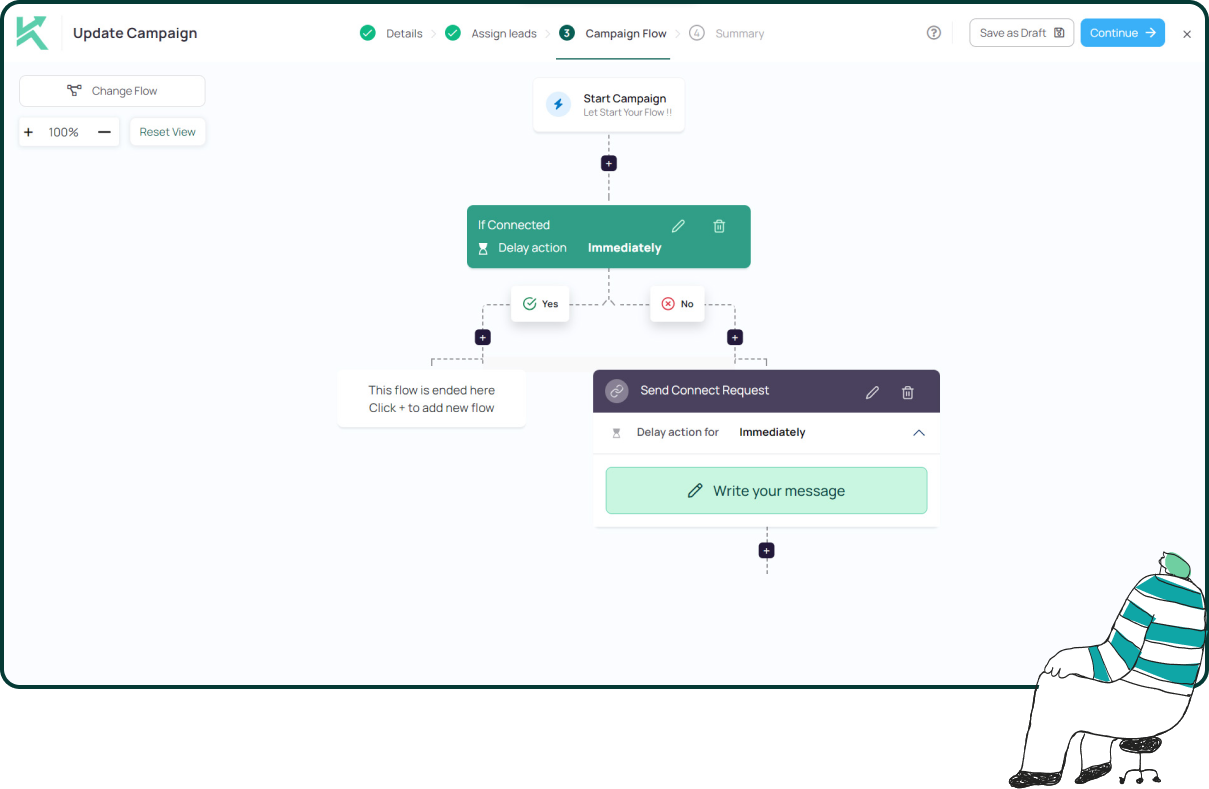
11x Your LinkedIn Outreach With
Automation and Gen AI
Harness the power of LinkedIn Automation and Gen AI to amplify your reach like never before. Engage thousands of leads weekly with AI-driven comments and targeted campaigns—all from one lead-gen powerhouse platform.
Frequently Asked Questions
9 AM to 11 AM in your prospect's local time zone, on Tuesday, Wednesday, or Thursday. Tuesday consistently produces the highest reply rates. Mid-morning works best because professionals are focused and not yet pulled into meetings.
Tuesday (6.90% reply rate) performs best, closely followed by Monday (6.85%) based on analysis of 20 million+ LinkedIn outreach attempts. Wednesday and Thursday are also strong performers.
Yes for most B2B outreach. Saturday performs the worst and messages often get buried until Monday. Sunday evening (6–8 PM) can work for niche audiences like freelancers, but it’s not reliable for consistent results.
Yes. Sending messages outside normal working hours—late nights, early mornings, or weekends—creates unnatural activity patterns that LinkedIn can flag. Staying within business hours improves both safety and performance.
Yes, significantly. B2B and SaaS audiences respond best before 9 AM. Healthcare professionals engage early morning or during lunch breaks. Marketing audiences are active between 9–11 AM and 3–4:30 PM. Financial services prefer 8–10 AM, while tech audiences can be more flexible, including evenings.
Start with 20–30 messages per day for new accounts and gradually scale to 50–70 per day. Consistency and pacing matter more than volume spikes.
Yes. Even light personalisation (name, company, or context) significantly increases reply rates. Fully generic messages are increasingly ignored and can trigger spam signals.
2–3 days between follow-ups works best. This keeps your outreach visible without overwhelming the recipient or appearing automated.
Yes. Connection requests typically have higher acceptance and reply rates because they create a low-friction entry point and build long-term network value.
Keep it between 40–80 words. Short, clear, and conversational messages outperform long pitches. The goal is to start a conversation, not close a deal in the first message.