Automation used to be a productivity story. Now it is a trust story.
For the last two years, founders and growth leaders have been told that AI agents will run their pipeline, write their copy, qualify their leads, and book their meetings. Some of that has happened. A lot of it has not. What has happened, almost universally, is a sharp rise in the cost of getting automation wrong. A spammy LinkedIn® outreach sequence does not just fail to convert. It damages your domain reputation, gets your account flagged, and trains your prospects to ignore your future messages even when you do show up properly.
This is the gap that the Human-in-the-Loop strategy fills. It is not a fancy term for “we still need humans.” It is a specific system design choice that decides where humans add judgment to an automated workflow, and where they get out of the way. Done well, it lets a small team operate at the volume of a large one without losing the quality that made customers say yes in the first place.
This guide explains what Human-in-the-Loop automation actually is, why it matters more in 2026 than it did in 2024, where it goes wrong, and how to design a system that works specifically for B2B outreach, sales, and growth. Konnector.ai sits inside this conversation as a worked example, because the social selling and LinkedIn® outreach space is where the gap between fully manual and fully automated is most visible right now.
What is Human-in-the-Loop automation in simple terms?
Human-in-the-Loop, often shortened to HITL, is a system design where automation handles the volume and repetition, and humans handle the decisions that need judgment, context, or relationship awareness. The human is not sitting at the end of the pipeline reviewing every output. They are placed at specific checkpoints inside the workflow, where their decision changes what happens next.
A useful way to think about it: full automation runs end to end without stopping. Full manual work runs end to end without help. HITL runs automatically until it hits a decision the system was not built to make confidently, then it pauses and asks a human to decide. The human’s answer feeds back into the system, which continues from there.
The shift in framing matters. In the old “human reviews the AI” model, the human is a quality control layer. They check after the fact. In the HITL model, the human is part of the system itself. They are the reason the system can be trusted to run at scale.
Why is Human-in-the-Loop the right strategy for B2B automation in 2026?
Three things have changed in the last 18 months that make pure automation a worse bet than it used to be.
First, platforms have become significantly stricter. LinkedIn®’s behavioural detection systems are now sensitive to patterns that used to fly under the radar: identical message structures, predictable timing, sudden volume spikes from a single account. A fully automated outreach engine that worked in 2023 now gets accounts restricted in weeks. Konnector.ai’s safety framework was built specifically for this new reality, but the underlying lesson applies to every channel. Predictable automation gets penalised.
Second, prospect tolerance for templated outreach has collapsed. Founders especially can spot an AI-written cold message inside the first sentence. The quality bar has moved from “is this personalised” to “did a real person actually think about me before sending this.” Pure automation cannot clear that bar consistently. It generates output that is technically personalised but feels mechanical.
Third, the cost of brand damage from bad automation is now permanent in a way it was not before. A prospect who reports your message as spam does not just block you. They train every algorithm that touches your account to deprioritise you. One bad campaign can shape six months of deliverability.
HITL solves for all three. The automation handles the work that does not need judgment. The human steps in for the moments that decide whether the prospect feels respected or sold to. The result is volume without the brand risk.
How is Human-in-the-Loop different from full automation and full manual work?

Most teams swing between two extremes. They start manual because they want every message to be perfect. Then they hit a wall, automate everything, and watch reply rates collapse. Then they pull back. HITL is the middle path, but it is more specific than just “automate some, do some manually.”
| Dimension | Fully Manual | Fully Automated | Human-in-the-Loop |
|---|---|---|---|
| Daily output | 20 to 40 prospects | 500 to 1,000 prospects | 200 to 500 prospects |
| Quality of personalisation | High but inconsistent | Low to moderate | High and consistent |
| Scalability | Low. Tied to your hours | High. Tied to your tools | High. Tied to your judgment frequency |
| Risk of platform restriction | Very low | High. Pattern detection flags accounts | Low. Human variance breaks pattern detection |
| Founder time per day | 3 to 4 hours | Less than 30 minutes | 15 to 30 minutes |
| Reply rate ceiling | 15 to 25 percent | 2 to 5 percent | 10 to 18 percent |
| Brand risk | Low | High | Low to moderate |
| Best suited for | Top 50 ABM accounts | Newsletter signups, low-value tier | Pipeline generation, ICP outreach |
The interesting row in this table is the second-last one: founder time per day. HITL takes less of a founder’s time than fully manual outreach because the human is no longer doing the work. They are making the decisions that direct the work. Fifteen minutes of judgment can shape four hours of automation. That is the leverage.
Where exactly should the human sit in the loop?
This is where most teams get HITL wrong. They put the human at the wrong checkpoint and then conclude that HITL does not save them time. There are four checkpoints that matter for B2B outreach automation, and a well-designed system uses humans at one or two of them, not all four.

Checkpoint 1: Targeting decisions. Who do we reach out to? This is the highest-leverage place to put a human. A bad targeting decision wastes the entire downstream automation. A good one makes the rest of the system look brilliant. Tools like Konnector.ai use Social Signals Intelligence to automate the surfacing of high-intent prospects, but the founder still decides which signals matter for their business that month.
Checkpoint 2: Message approval. Should this specific message go to this specific person? Most founders default to putting humans here because it feels safest. It is also the most expensive checkpoint, because the volume of messages is huge. If you are reviewing every single message, you are not running HITL. You are running slow manual work with extra steps.
Checkpoint 3: Reply triage. What do we do with the responses? This is where HITL pays off most visibly. AI can categorise replies into “interested,” “not now,” “wrong person,” and “remove me.” A human decides what to actually say to the “interested” replies, because that is the moment where a real conversation starts and a templated answer kills the deal.
Checkpoint 4: Exception handling. What do we do when something unexpected happens? A prospect mentions a specific competitor. Someone you reached out to last quarter just got promoted. Your tracked account just announced a layoff. Pure automation either ignores these signals or applies a template. A human routes them.
The rule of thumb: put humans at checkpoints 1 and 3. Automate checkpoints 2 and 4 with clear escalation rules. This gives you the volume of automation and the judgment of manual work, without paying for both.
What does a Human-in-the-Loop workflow actually look like in practice?

Here is what a working day looks like for a founder running HITL outreach with a tool like Konnector.ai. This is not theoretical. It is the pattern that tools like Konnector.ai’s daily founder routine are built around.
Morning, 10 minutes. The founder opens the Social Signals dashboard, not the LinkedIn® feed. The dashboard surfaces posts that high-fit prospects are engaging with, mentions of relevant keywords inside their ICP, and shifts in tracked accounts. The founder spends ten minutes reviewing the surfaced signals and deciding which threads to engage with that day. That decision feeds the automation.
Mid-morning, automated. The system runs comments, connection requests, and outreach messages based on the morning’s signal review. The founder is not in this part. They are running the company. The system uses pre-approved message frameworks with prospect-specific variables pulled from public profile data and recent activity.
Afternoon, 5 minutes. The founder reviews AI-generated comment drafts on high-signal posts. They approve, edit, or reject each one. This is the highest-leverage five minutes in the day, because well-placed comments on the right posts generate inbound interest at a fraction of the cost of outbound messaging.
End of day, 10 minutes. The founder reviews replies from the day’s outreach. The system has already categorised them. The founder’s job is to write personal responses to anyone who showed real interest. Templated follow-ups go out automatically for soft signals. Anyone who said “not now” gets nurtured automatically.
Total founder time: 25 minutes. Total volume processed: enough to keep a healthy pipeline filling. Quality: maintained because the founder is making decisions that matter, not approving every message that goes out.
Konnector.ai’s video library has walkthroughs for several of these specific moves:
Why does pure automation fail in B2B outreach?

Pure automation fails for a reason that takes founders a while to fully accept. The reason is not that AI cannot write good messages. It can. The reason is that volume changes the meaning of a message.
A perfect AI-written message sent to one prospect lands well. The same message sent to a thousand prospects lands as spam, even if each one is technically personalised. This is because prospects do not just read your message. They read the context around it. A message that arrives during a known automation pattern, on a day when their entire feed is full of similar messages, gets read as part of that pattern. It does not matter how good the words are.
This is the insight that most automation strategy blogs miss. They focus on message quality. The actual variable is signal density. How many automated messages is the prospect getting that week? How many of them feel templated? Where does yours sit in that mix?
HITL solves this not by writing better messages, but by varying the timing, the trigger, and the response patterns in ways pure automation cannot replicate. A human who reviews signals before sending breaks the pattern. A human who responds to replies in their own voice breaks the pattern. A human who decides which prospects deserve a follow-up and which do not breaks the pattern. Each break is small. Together they make the difference between feeling automated and feeling considered.
What are the most common mistakes founders make with Human-in-the-Loop automation?
Most HITL implementations fail in predictable ways. Here are the four most common.
Mistake one: putting the human at every checkpoint. If the founder is approving every message, the system is not HITL. It is manual work with a queue. The volume never scales because the human becomes the bottleneck.
Mistake two: not defining what the human is allowed to override. Without clear rules about what the human can change, every checkpoint becomes a debate. The system slows to a halt because nobody knows whether to follow the automated suggestion or trust the human’s gut.
Mistake three: treating HITL as temporary. Some founders use HITL as scaffolding while they build toward full automation. This is a mistake for B2B outreach. The judgment moments do not disappear as the system matures. They become more valuable, because the system is now responsible for higher-value relationships.
Mistake four: not measuring the human’s contribution. If you cannot point to which decisions the human is making and what they change, you cannot tell whether the human is adding value or adding overhead. Track the override rate (how often the human changes what the automation suggested), the lift rate (how much better the human-touched outputs perform), and the time-to-decision (how long the human takes at each checkpoint).
How do you design a Human-in-the-Loop system for LinkedIn® outreach?

LinkedIn® is the clearest case study because it sits at the intersection of strict platform rules, high-stakes prospect relationships, and meaningful automation gains. Here is the system design that works.
Layer 1: Signal capture. Automate this completely. Tools like Konnector.ai’s Social Signals Intelligence track keyword mentions, prospect activity, ICP movement, and competitor follower bases. There is no human reason to be in this layer. Watch how ChatGPT integrates with Konnector for an example of how AI can compound at this layer.
Layer 2: Targeting decisions. Human checkpoint. The founder reviews the daily signal feed and decides which signals to act on that day. This is a 5 to 10 minute decision, not a 2 hour analysis. The goal is direction, not perfection.
Layer 3: Outreach execution. Automate this completely with safety guardrails. Konnector.ai’s safety framework rotates accounts, varies timing, and stays within LinkedIn®’s behavioural limits. The human is not in this layer because being there slows it down without improving it.
Layer 4: Comment and engagement. Hybrid checkpoint. AI drafts contextual comments on high-signal posts. The human reviews and approves in batch, usually 5 to 10 comments at a time, in under 5 minutes total.
Layer 5: Reply triage and conversation. Human checkpoint. The system categorises replies. The human writes responses to anyone showing genuine interest. Soft replies get nurture sequences automatically.
Layer 6: Pipeline routing. Automate this completely. Once a conversation reaches the meeting-booking stage, the calendar tool takes over. The human reappears in the actual meeting.
This six-layer model is the difference between a tool and a system. Most automation platforms give you the layers. HITL design tells you where to put yourself in them.
What does a Human-in-the-Loop strategy look like for cold email?
Cold email follows a similar logic but with different checkpoints. The platform risk is different. The personalisation expectation is similar. The volume is usually higher.
For cold email, automate the list building, the deliverability monitoring, the send timing, and the bounce handling. Put humans at three checkpoints: the offer design (what are we actually saying we do), the segmentation logic (which list gets which message), and the reply handling (any response that is not a clear yes or no).
The single biggest mistake in cold email automation is delegating the offer to AI. AI cannot tell you what your prospect actually needs. It can only optimise the way you say what you tell it to say. The offer is the founder’s job. The phrasing is the system’s job. Most failed cold email campaigns confuse these two.
How do you measure whether your Human-in-the-Loop system is working?
Most teams measure HITL with the wrong metrics. They look at reply rates and meetings booked. These are output metrics. They tell you whether your campaign worked. They do not tell you whether your HITL design is right.
The right metrics for HITL are about the human’s role in the system.
Override rate. What percentage of automated suggestions does the human change? If it is below 10 percent, the human is rubber-stamping and you can probably remove the checkpoint. If it is above 60 percent, the automation is not trained well enough and the human is doing too much work.
Decision time per checkpoint. How long does the human take at each checkpoint? If it is climbing, the system is asking them too many questions or the wrong questions. If it is dropping toward zero, you might be over-automating.
Lift on human-touched outputs. Compare the conversion rate of fully automated outputs to ones the human touched. The lift tells you whether the human is adding value or theatre. A useful HITL system shows a lift of 20 to 40 percent on the touched outputs.
Founder hours per pipeline dollar. The metric that actually matters at the company level. How much founder time produced how much pipeline. HITL should drive this number down month over month while pipeline volume stays flat or rises.
How does Konnector.ai use Human-in-the-Loop in its own product?
Konnector.ai’s product design is built around HITL principles, even where the term is not used directly. Three product choices show this clearly.
First, the Social Signals Intelligence dashboard does not act on signals automatically. It surfaces them. The founder decides which to engage. This is HITL by design. The system could automate the action. It does not, because the targeting decision is the highest-leverage human moment.
Second, AI Comments are drafted but not sent without approval. The founder reviews the suggestion, edits if needed, and approves in batch. This keeps comment quality high while letting the founder process volume in minutes.
Third, the safety framework is automated, but the rules behind it are configurable by the user. The founder sets the boundaries. The system enforces them. This is HITL applied to risk management, not just outreach. When you compare Konnector against tools like La Growth Machine, the difference often comes down to how each tool answers the question of where the human belongs in the loop.
Watch the AI Comments feature in action:
What are the risks of getting Human-in-the-Loop wrong?
HITL done badly is worse than full automation, because it gives you the false sense that the system is being supervised when it is not. Three failure modes deserve attention.
The human becomes the bottleneck. If the queue of decisions outgrows the human’s available time, the system stops. Outreach lags. Replies go cold. The automation cost remains while the output drops. Solution: reduce the number of human checkpoints or batch decisions ruthlessly.
The human stops looking carefully. Approval fatigue is real. After the 50th comment review of the day, the founder approves things they would have rejected in the morning. Solution: cap daily review volume and rotate the type of decisions to keep attention fresh.
The human starts trusting the wrong outputs. Over time, founders begin to assume the AI is right and just click through. The system drifts. Solution: build in periodic blind reviews where the human is asked to evaluate without seeing the AI’s recommendation, to recalibrate trust.
How long does it take to roll out a Human-in-the-Loop system properly?
Most founders underestimate the rollout timeline because they think of HITL as flipping a switch. It is closer to a 60 to 90 day rebuild, depending on how much existing process you already have. Here is what a realistic rollout looks like.
Days 1 to 14: audit current state. Map every step of your current outreach process. Mark which steps are manual, which are automated, and which are partially both. This audit usually surfaces three things: hidden manual work the founder did not realise was happening, overlapping automation tools that duplicate effort, and decision points where nobody can articulate what the rule actually is.
Days 15 to 30: design the checkpoint map. Decide where humans belong. The four-checkpoint framework above (targeting, message approval, reply triage, exception handling) is a starting point. Adjust for your specific context. A B2C team will weight things differently than a B2B SaaS team. An ABM-focused team will weight differently than a high-volume SDR team.
Days 31 to 60: implement and instrument. Set up the tools, configure the automation, and most importantly, build measurement into the system from day one. If you cannot see override rates, decision times, and lift on human-touched outputs by the end of day 60, you will not know whether the system is working.
Days 61 to 90: tune the loop. The first 30 days of operation will reveal which checkpoints are genuinely high-leverage and which are theatre. Remove or move the ones that are not earning their place. Add depth to the ones that are. By day 90, the system should run with the founder spending under 30 minutes per day on outreach decisions.
Skipping any of these phases is the most common failure mode. Founders who skip the audit end up automating the wrong things. Founders who skip the design phase end up with humans at every checkpoint by default. Founders who skip the instrumentation cannot tell whether the system is working. Founders who skip the tuning end up with a static design that becomes outdated within a quarter.
What kind of team structure supports Human-in-the-Loop automation best?
HITL changes who you hire and what they do. The traditional B2B sales team had SDRs at the bottom, AEs in the middle, and managers at the top. The bottom of that pyramid is the part that automation reshapes most. SDRs used to spend their day on volume tasks: list building, sending messages, following up. Most of that is now automated.
The new shape of the team is different. You need fewer people doing more strategic work. The role that used to be SDR becomes something closer to “automation operator and signal interpreter.” They watch the system, make the daily targeting decisions, handle exceptions, and feed insights back to the founder or sales lead. One operator can run the volume that used to take three SDRs.
For founders running solo, this is good news. You do not need to hire SDRs to run pipeline at scale anymore. You need to spend 25 to 30 minutes a day in the system yourself, and let the automation handle the rest. The first hire becomes someone who handles the demos and the pipeline conversations, not someone who runs outreach.
For growth leaders building a team, the implication is that the SDR role needs to be redefined or replaced. The candidates you used to hire (high-energy, comfortable with rejection, willing to do volume work) are not the candidates you need now. You need analytical operators who are comfortable with tools, good at making fast targeting decisions, and able to maintain quality at scale. The job description has changed even if the title has not.
Konnector.ai’s customer base reflects this shift. The early adopters were SDRs and growth marketers using it to send more messages. The current users are increasingly founders, agency owners, and small revenue teams running entire pipelines through the system with one or two operators rather than full sales teams. The product evolved with the use case.
How will Human-in-the-Loop change as AI gets better in 2026 and beyond?
The honest answer is that the human role will move, not disappear.
The decisions that need humans today are not the same decisions that needed humans in 2020. Five years ago, the human was in the message-writing loop. Today, AI writes acceptable messages and the human is in the targeting and reply loop. Five years from now, AI will probably handle reply triage well, and the human will move further up to strategic decisions about market positioning, offer design, and account prioritisation.
This is the pattern across every wave of automation. Humans do not get removed. They get pushed up the value chain. Founders who design HITL systems flexibly, with humans positioned where their judgment is highest-leverage today and ready to move tomorrow, will compound their advantage over those who either fully automate or refuse to automate at all.
The companies that win in 2026 will not be the ones that automated the most. They will be the ones that decided most carefully where automation belonged and where it did not.
Final thought: HITL is a strategy, not a feature
The biggest mistake teams make with Human-in-the-Loop is treating it as a setting in their tool. It is not. It is a strategic choice about how your team produces output, where your judgment lives, and what kind of company you are building.
If you are a founder or growth leader thinking about scaling outreach in 2026, the question is not whether to automate. That decision was made for you by the volume and pace of the market. The question is where you, specifically, are going to sit inside the system.
Get that placement right, and a single founder can run pipeline volume that used to require a sales team. Get it wrong, and you will either burn out doing manual work or burn your reputation doing automated work. HITL is the design that makes neither inevitable.
Konnector.ai is built around the assumption that founders want the leverage of automation without the risk of pure automation. See how the social signals approach works in practice, or read more about how the safest automation platforms are designing for HITL by default.
11x Your LinkedIn® Outreach With
Automation and Gen AI
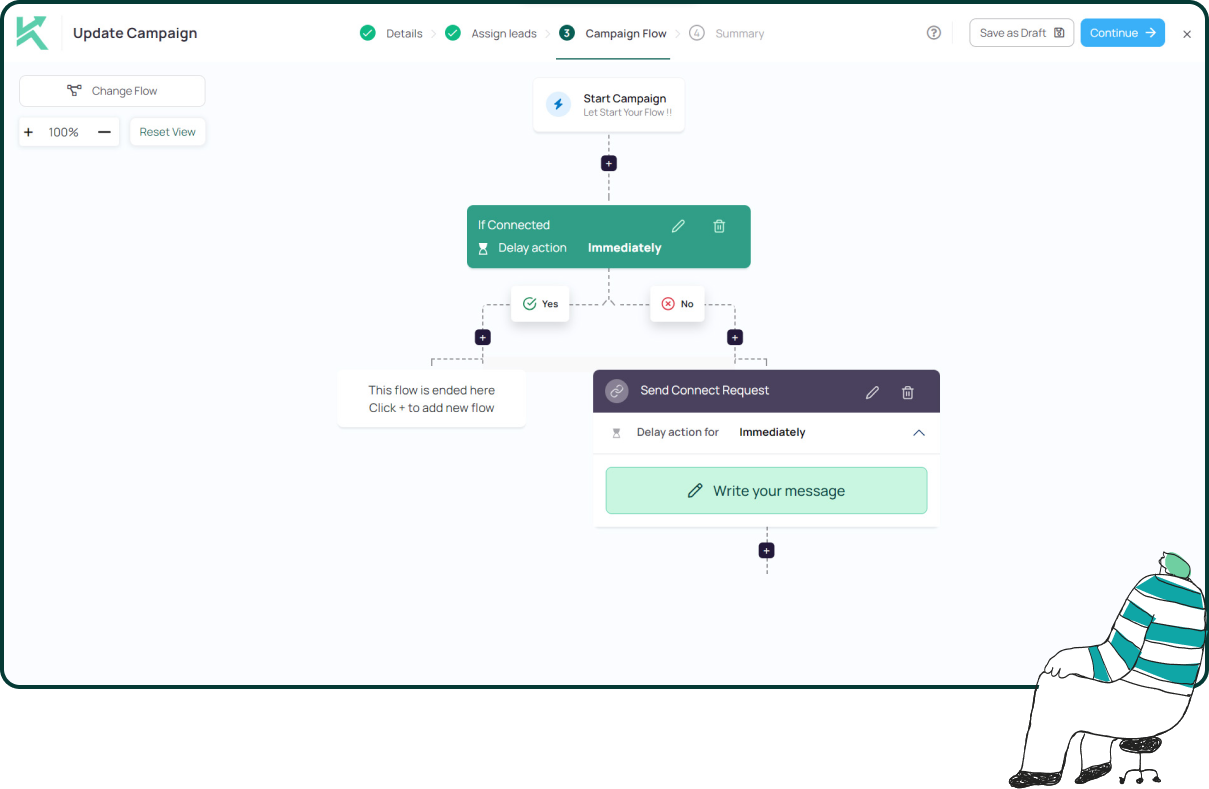
Harness the power of LinkedIn® Automation and Gen AI to amplify your reach like never before. Engage thousands of leads weekly with AI-driven comments and targeted campaigns—all from one lead-gen powerhouse platform.