Let’s get one thing straight before we get into tactics: LinkedIn impressions are not a vanity metric. They are a leading indicator — the first domino in a chain that ends in profile views, connection requests, outreach opportunities, and pipeline. If your impressions are flat or falling, the rest of that chain is quietly stalling too.
And right now, for most people, impressions are falling. Research analysing over 621,000 LinkedIn posts found that average reach is down 34% compared to the previous year for most users. Overall views dropped 50%, engagement declined 25%, and follower growth fell 59% for creators who did not adapt to LinkedIn’s 2026 algorithm overhaul.
But here is the thing about that stat: it is an average. Averages hide the full picture. While most accounts are seeing declining impressions, a specific cohort — the ones who understood what changed and adapted — are seeing their best numbers yet. This guide is about joining that cohort.
First: What LinkedIn Impressions Actually Tell You
An impression is recorded every time your content appears on someone’s screen. Unlike a “view” (which requires a minimum dwell time), impressions capture every appearance — whether or not the person stopped to read.
That distinction matters because impressions tell you about reach, not resonance. A post with 10,000 impressions and a weak hook generates almost no engagement. A post with 1,000 impressions and a strong hook can produce more qualified conversations. The goal is not simply more impressions — it is the right impressions, consistently delivered to the right audience, at a volume that compounds over time.
Think of impressions through four lenses:
- Goals: Are your impressions reaching the people who can actually buy from you, hire you, or partner with you? Vanity reach from outside your ICP is noise.
- Intent: High-impression posts from your ICP signal that your content is landing in the right feed at the right moment — which is why impression data is a proxy for how well your content strategy aligns with buyer intent.
- Reach: LinkedIn distributes content in waves. Understanding how that works — and how to influence it — is the mechanical foundation of impression growth.
- Unique insights: What you say matters as much as how you say it. The 2026 algorithm penalises generic content aggressively and rewards niche authority. The most reliable path to more impressions is becoming genuinely indispensable to a specific, relevant audience.
How LinkedIn Decides Who Sees Your Post
LinkedIn’s 360Brew algorithm (rebuilt in late 2024) does not distribute content to your full network at once. It runs a staged process:
| Stage | Time Window | What Happens | Key Metric | What to Do |
|---|---|---|---|---|
| Quality Check | 0–60 min | Spam detection and content classification | Content quality | Avoid links, write strong hooks |
| Engagement Test | 1–3 hrs | Shown to 2–5% of audience | Comments, dwell time | Reply quickly, drive interaction |
| Extended Distribution | 3+ hrs | Wider reach if engagement holds | Sustained interaction | Maintain replies and momentum |
Stage 1 — Quality check (0–60 minutes): LinkedIn scans your post for spam signals, assesses content quality, and categorises it by topic. This is where weak content dies before it ever gets distributed. External links in the post body reduce reach by approximately 60% at this stage — because LinkedIn treats them as an attempt to pull users off the platform.
Stage 2 — Engagement test (1–3 hours): Your post is shown to a small test audience — roughly 2–5% of your network. LinkedIn measures how quickly and deeply they engage. Comments carry 15x more algorithmic weight than likes. Saves and shares matter more than reactions. Dwell time — the seconds someone spends reading before scrolling — is now one of the highest-weighted signals in the entire system.
Stage 3 — Extended distribution (3+ hours): If the post passes the engagement test, LinkedIn expands reach based on topic relevance, network quality, and sustained interaction. Posts that earn real engagement in Stage 2 can continue circulating for days. This long-tail effect is new in 2026 — and it means your posting frequency strategy needs to change too.
The frequency insight most people miss: Posting 2–5 times per week delivers the highest impression-per-post ratio. Analysis of over two million LinkedIn posts confirms that this frequency produces an average of +1,182 more impressions per post versus lower-frequency posting. Posting more frequently than this actually cannibalises your own reach — each new post interrupts the distribution window of the previous one.
The Four Factors That Drive LinkedIn Impressions in 2026

1. Format: Documents Lead, Text Posts Follow
| Format | Avg Engagement | Trend (2026) | Strength | Use Case |
|---|---|---|---|---|
| Document (Carousel) | 6.6–7% | ↑ Growing | High dwell time | Frameworks, insights |
| Text Posts | 2–3% | ↓ Declining | Quick consumption | Opinions, commentary |
| Video | Variable | Mixed | High reach (top creators) | Personal branding |
| Image | Low | ↓ Declining | Visual | Announcements |
Format is the highest-impact decision you make before writing a word. Native document posts (carousels) lead all LinkedIn formats with an average 6.60–7.00% engagement rate, up 14% year-over-year. Carousels require swiping — each swipe is an engagement signal, and users spend 15–20 seconds on documents versus 8–10 on images or text posts. That extended dwell time directly triggers wider distribution.
Text posts average 2–3% engagement and are declining relatively. Video views grew 36% year-over-year but are concentrated among large pages — the average creator saw a 36% drop in video views as the platform’s architecture remains document-first.
The practical implication: build your highest-value insights into document carousels. Save text posts for commentary, reactions to news, and shorter perspective pieces. Use both, but weight your content calendar toward documents.
2. The Hook: You Have Three Seconds
The average LinkedIn user spends 3.7 seconds looking at a post before deciding whether to scroll. Your first line determines everything. If it does not create immediate curiosity, tension, or a specific knowledge gap, the post does not get read — and if it does not get read, dwell time collapses, engagement craters, and the algorithm treats it as low-quality content.
Hooks that consistently earn the “See more” click in 2026: a counterintuitive claim, a specific number that surprises, a direct challenge to conventional wisdom, or a precise question that the reader is already asking themselves. Vague hooks (“I want to share some thoughts on leadership”) are algorithmically death sentences.
3. Saves Over Likes: The Signal That Multiplies Reach
| Metric | Impact on Reach | Meaning | Strategy |
|---|---|---|---|
| Likes | Low | Quick reaction | Not a priority |
| Comments | High | Engagement depth | Encourage discussion |
| Saves | Very High (5x) | Value retention | Create reference content |
| Shares | High | Distribution boost | Make content shareable |
The metric most content creators are not tracking closely enough in 2026 is Saves. LinkedIn’s analytics now surface saves as a distinct metric — and the data is unambiguous: saves carry 5x more reach impact than a like, and posts that earn 200 saves regularly outperform posts with 1,000 reactions on total impressions.
A save signals to LinkedIn that your content is worth returning to — that it is reference-quality, not scroll-fodder. The content types that reliably earn saves: frameworks, checklists, step-by-step systems, data-backed analyses, and perspectives that make someone think “I need to share this with my team.”
If you want to grow LinkedIn impressions consistently, optimise every post you publish around one question: would someone save this?
4. Personal Profile vs. Company Page: The Gap Is a Chasm
If you are relying on your company’s LinkedIn page for impressions, the 2026 data is hard to ignore: personal profiles generate 561% more reach than company pages when sharing identical content. They drive 2.75x more impressions and 5x more engagement — even when the personal profile has a smaller follower base than the company page.
LinkedIn’s algorithm explicitly prioritises human-to-human content over brand broadcasts. This is not a temporary preference — it is a structural platform decision that has been reinforced across every 2025–2026 update. Your content strategy needs to flow through people: founders, executives, sales leads, and subject-matter experts publishing in their own voice, with the company page as an amplification layer, not the primary channel.
This is also where outreach and content intersect. A founder who is building genuine LinkedIn impressions through their personal profile is simultaneously building the warm audience that makes every connection request and DM they send more likely to convert. Content visibility and outreach performance are not separate strategies — they are the same flywheel at different stages.
That flywheel is exactly what Konnector.ai’s daily LinkedIn system for founders is built around. Your content creates impressions. Those impressions generate profile views. Profile views become warm leads. Warm leads become conversations. And Konnector handles the outreach layer — so you can focus on the content that drives everything upstream.
Ready to see how it works for your specific ICP? Book a free demo and we will walk through it live.
The Impression Traps That Are Killing Your Reach
| Mistake | Impact | Fix |
|---|---|---|
| External links in post | -60% reach | Move link to first comment |
| Engagement bait | Algorithm penalty | Use natural CTAs |
| Overposting | Cannibalised reach | Stick to 3–5 posts/week |
| No comment replies | -30% engagement | Reply within 2 hours |
As important as what to do is what to stop doing. These four patterns are actively suppressing impressions for most LinkedIn users in 2026:
- External links in post bodies. Carrying a link in the post body reduces reach by approximately 60% at LinkedIn’s quality check stage. If you need to share a URL, put it in the first comment after posting.
- Engagement bait. “Comment YES if you agree” and “Like if this resonates” are now algorithmically penalised. LinkedIn’s NLP layer detects explicit engagement requests and reduces distribution accordingly.
- Posting too frequently. More than five posts per week begins to cannibalise your own reach by interrupting the distribution window of previous high-performing posts.
- Publishing and disappearing. The 360Brew algorithm rewards accounts that reply to comments, maintain thread depth, and sustain engagement. Posts where the author responds to every comment within the first two hours achieve approximately 30% higher lifetime engagement.
How Impressions Connect to Outreach — and Why This Is the Part Most Teams Ignore
Here is the insight that most LinkedIn impression guides leave out entirely: LinkedIn impressions are not just a content metric. They are a pre-outreach warming system.
When your content reaches 5,000 people in your ICP consistently over several weeks, something measurable happens. Those people start recognising your name. They see your perspective in their feed before they ever see your connection request. And when your request does arrive, it does not feel cold — because to them, it is not.
This is the connection between social intent signals and impressions. Your impressions create the conditions for intent signals to emerge: profile views from your ICP, repeated post engagement from the same accounts, saves from decision-makers who are quietly researching your space. Those signals are the triggers for the most effective outreach — warm, timed, contextual, and far more likely to convert than anything sent cold.
The teams that understand this are not treating content and outreach as separate workstreams. They are running them as a single coordinated system: content builds impressions, impressions generate signals, signals trigger outreach, outreach opens conversations, conversations close pipeline.
Konnector.ai is built for exactly this motion. Our Social Signals Intelligence surfaces the ICP-matched impressions and engagement patterns that matter, while the outreach layer acts on them at the right moment — all within your account’s safe daily limits, all with your voice, all with human approval at every public-facing step.
If you want to see what this looks like running on your actual ICP, sign up free and run your first signal-triggered sequence today.
The LinkedIn Impressions Playbook: What to Do This Week
Pull up your LinkedIn analytics right now. Look at your last ten posts. Sort by impressions. Then ask three questions:
- Which formats produced the most impressions — and are those the formats you are posting most frequently?
- Which posts earned the most saves — and what did those posts have in common?
- How many of your top-impression posts came from your personal profile versus your company page?
The answers will tell you exactly what to do more of. Then run these principles for the next 30 days:
- Post 3–5 times per week, no more
- Weight your calendar toward native document carousels
- Write every hook with one goal: create a knowledge gap the reader cannot ignore
- Optimise every post around saves, not likes
- Reply to every comment within the first two hours of publishing
- Never put an external link in the post body — always in the first comment
- Track your LinkedIn analytics weekly — saves, dwell signals, SSI movement, and which topics your ICP is engaging with most
Thirty days of this, consistently executed, will compound your impressions faster than any hack, pod, or posting schedule you have tried before. And the impressions you build will not just be numbers — they will be the warm audience that makes every outreach sequence you run through Konnector.ai more likely to convert.
“Impressions are not the destination. They are the infrastructure. Build them intentionally, and everything downstream — profile views, warm signals, outreach replies, booked meetings — gets easier.”

📅 Book a Free Demo → See how Konnector.ai’s Social Signals Intelligence turns your LinkedIn impressions into qualified pipeline — automatically.
⚡ Sign Up Free → Start running signal-based LinkedIn outreach alongside your content strategy today.
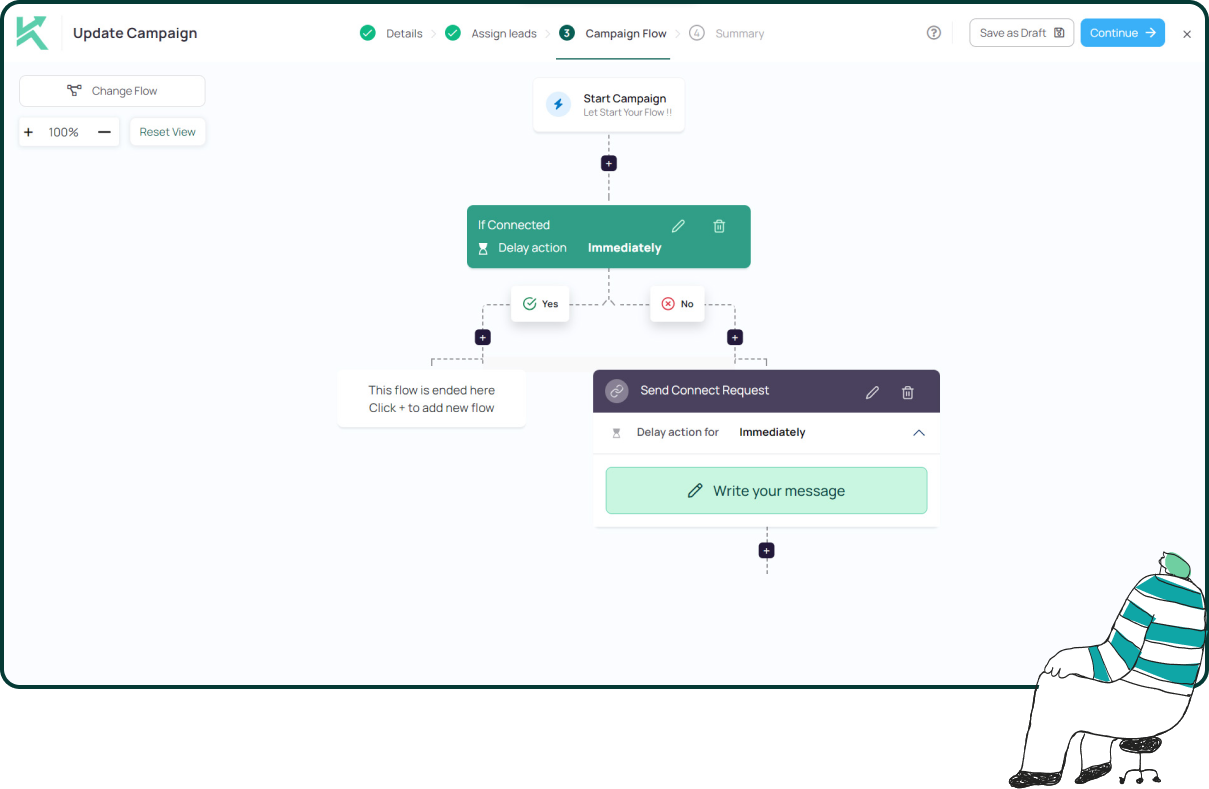
11x Your LinkedIn Outreach With
Automation and Gen AI
Harness the power of LinkedIn Automation and Gen AI to amplify your reach like never before. Engage thousands of leads weekly with AI-driven comments and targeted campaigns—all from one lead-gen powerhouse platform.
Frequently Asked Questions
LinkedIn impressions are the number of times your content appears on someone’s screen. They measure reach, not engagement, and indicate how widely your content is being distributed.
LinkedIn impressions are declining for many users due to algorithm updates that prioritise high-quality, relevant content and filter out low-value or generic posts.
LinkedIn uses a three-stage process: quality check, engagement test, and extended distribution. Posts that generate strong early engagement and dwell time are shown to a wider audience.
Document posts (carousels) currently generate the highest impressions due to higher dwell time and interaction signals like swipes and saves.
Yes, saves carry significantly more weight than likes. They signal that content is valuable and worth revisiting, which increases overall reach and distribution.
Posting 3–5 times per week delivers the best results. Posting more frequently can reduce reach by interrupting the distribution of previous posts.
LinkedIn prioritises human-to-human interactions, which is why personal profiles generate significantly more reach and engagement than company pages.
Yes, adding links in the post body can reduce reach significantly. It’s better to place links in the first comment after publishing.
Focus on strong hooks, high-value content, document posts, and early engagement. Optimising for saves and replying to comments quickly also improves reach.
Higher impressions increase visibility among your target audience, making your connection requests and messages feel warmer and more familiar, which improves response rates.