LinkedIn automation has entered a new era.
What once worked quietly in the background now sits under constant scrutiny. Accounts are monitored more closely. Behavioural signals are analysed more deeply. And tolerance for careless automation is lower than ever.
In 2025, LinkedIn automation is no longer about how much you can automate.
It is about how safely, how responsibly, and how sustainably you do it.
Have you checked out our best practices for safe and effective LinkedIn automation?
This guide breaks down what safe LinkedIn automation really means today, why bans happen, and how teams can automate outreach while protecting trust, credibility, and long-term results.
Why LinkedIn Automation Looks Very Different in 2025
LinkedIn has matured from a networking platform into a critical professional infrastructure.
With that shift has come a stronger focus on:
- User experience
- Platform integrity
- Spam reduction
- Behavioural trust signals
Automation is not banned.
Careless automation is.
LinkedIn automation that ignores timing, context, and human behaviour now stands out faster and more clearly than it did even a few years ago.
The Biggest Reason LinkedIn Automation Accounts Get Restricted
Most bans do not happen because of one aggressive day.
They happen because of patterns.
LinkedIn evaluates behaviour across:
- Days
- Weeks
- Sessions
- Devices
Consistency without variability is the fastest way to signal automation.
Perfectly timed actions.
Identical daily volumes.
Repeated sequences without adjustment.
These are not human behaviours, and LinkedIn’s systems are designed to detect them.
Save your account from restriction with these LinkedIn Automation Limits.
Understanding Trust as the Core Metric in LinkedIn Automation
In 2025, trust is the real currency of LinkedIn automation.
Trust is built when:
- Your behaviour looks natural over time
- Your outreach respects professional boundaries
- Your activity mirrors how real users operate
Trust is lost when:
- Automation feels mechanical
- Outreach ignores engagement signals
- Volume overrides relevance
Safe LinkedIn automation is trust-first automation.
Browser-Based LinkedIn Automation: Why Risk Increases at Scale?
Browser-based LinkedIn automation tools operate inside your live browser session.
They:
- Simulate clicks and typing
- Run in real time
- Expose device and browser fingerprints
While this may feel familiar and controllable, it creates visibility.
Over time, repeated actions tied to the same browser environment make behavioural patterns easier to identify.
At small scale, browser automation may appear safe.
At consistent scale, it becomes fragile.
Cloud-Based LinkedIn Automation: Designed for Longevity
Cloud-based LinkedIn automation takes a fundamentally different approach.
Instead of imitating clicks, it focuses on orchestration.
Actions are:
- Queued instead of executed instantly
- Distributed over time
- Paced to reflect real professional behaviour
From LinkedIn’s perspective, this creates:
- Natural spacing
- Behavioural variability
- Lower pattern predictability
Cloud-based LinkedIn automation is built for endurance, not bursts.
The Role of Timing in Safe LinkedIn Automation
Timing consistency is one of the strongest automation signals LinkedIn evaluates.
Humans do not operate on fixed schedules.
They pause.
They multitask.
They abandon actions mid-flow.
Automation that acts every few minutes with clock-like precision creates an artificial rhythm.
Safe LinkedIn automation introduces variability by design.
Why Volume Is No Longer a Performance Metric
For years, teams equated performance with output.
More messages sent.
More profiles visited.
More connections requested.
In 2025, volume without trust creates diminishing returns.
- Response rates drop
- Inbox credibility erodes
- Restrictions become more likely
Sustainable LinkedIn automation focuses on continuity, not intensity.
Context-Aware Automation Is the New Standard
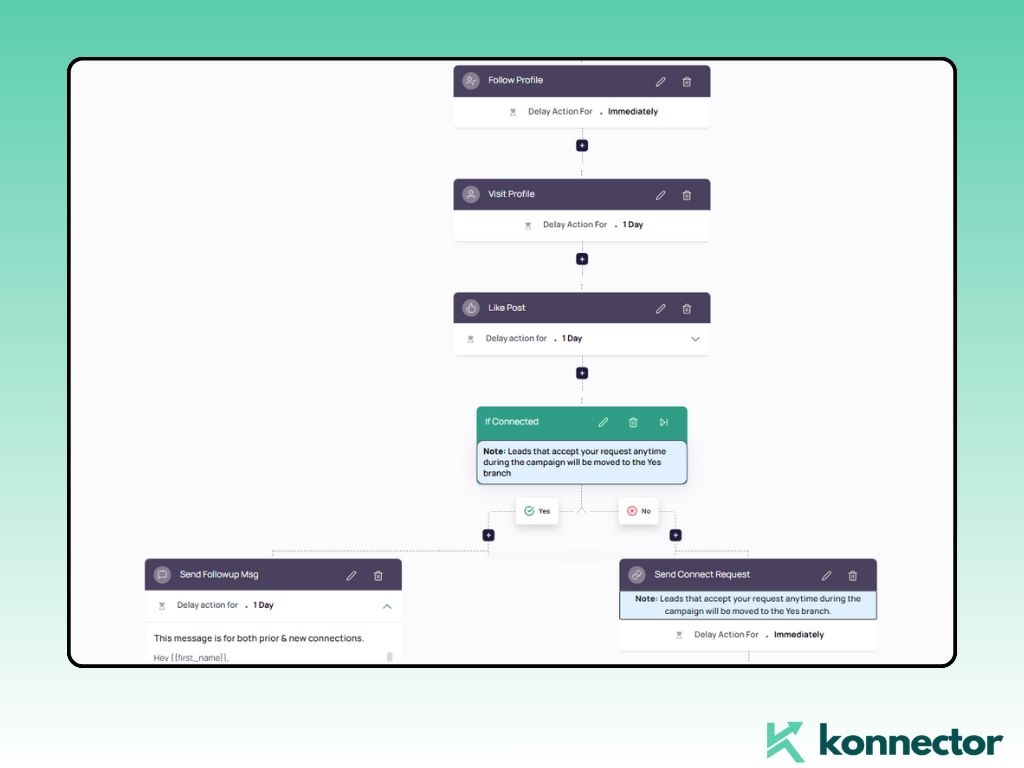
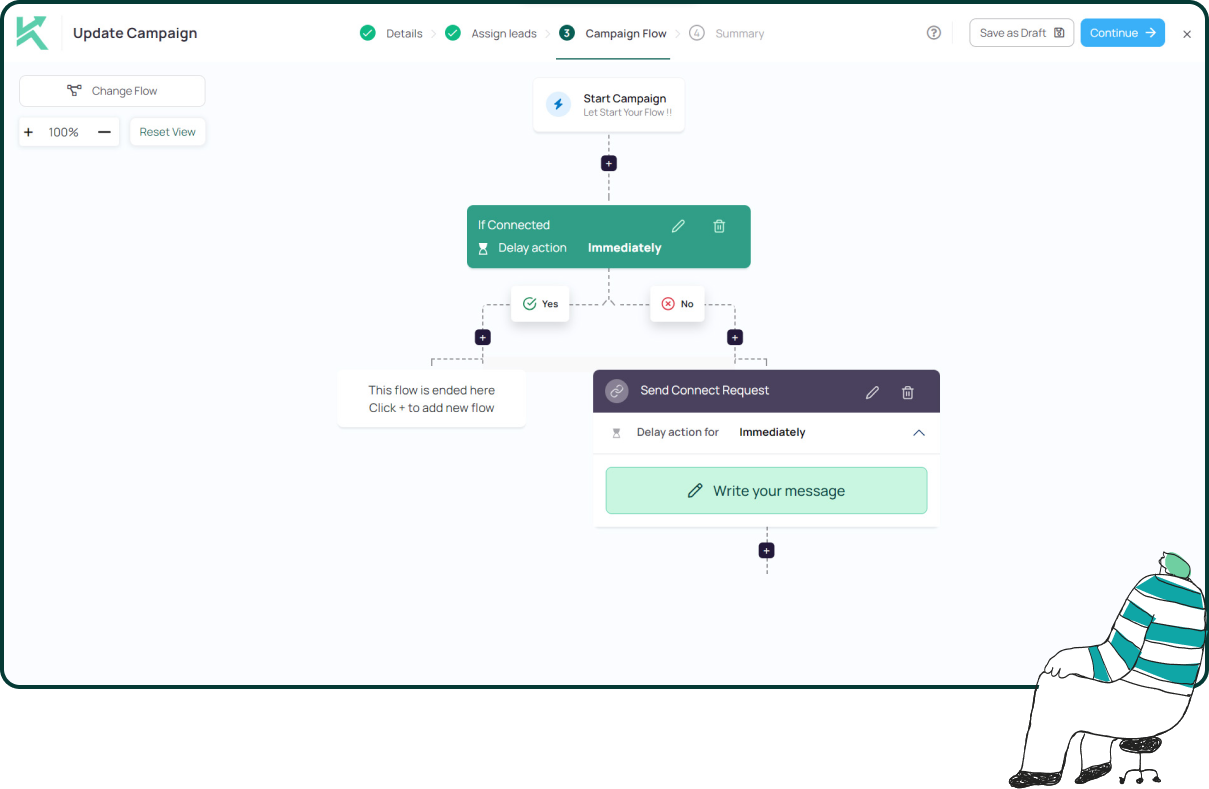
Safe LinkedIn automation adapts to context.
It understands:
- Whether a lead is already connected
- Whether previous messages were opened or ignored
- Whether engagement signals exist
Blind sequences that push forward regardless of response are no longer viable.
Automation must respond to people, not push past them.
Here is a snap shot of how Konnector runs LinkedIn automation:
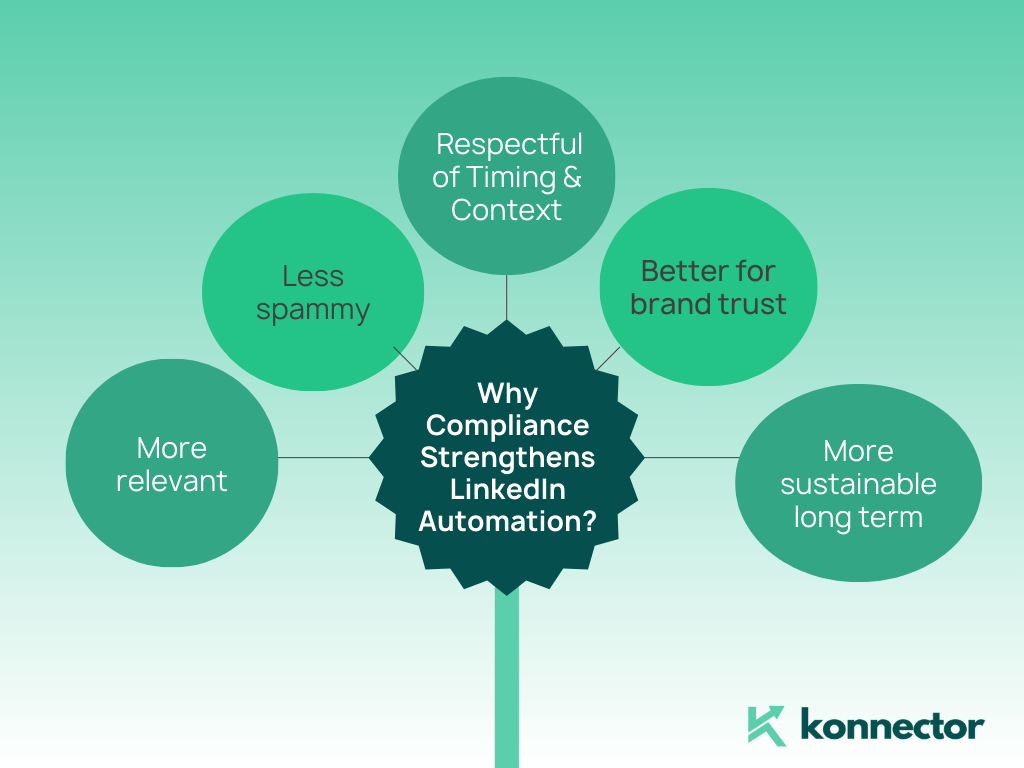
Why Compliance Strengthens LinkedIn Automation?
Many teams assume compliance slows them down.
In reality, compliance improves outreach quality.
GDPR-aligned LinkedIn automation tends to be:
-
More relevant:
When LinkedIn automation is done thoughtfully, outreach is based on real context — role, industry, recent activity, or shared interests. Messages are sent with a reason, not just because someone matched a filter. This makes recipients more likely to read, respond, and engage meaningfully.
-
Less spammy:
GDPR-aligned and safety-first automation avoids mass, repetitive messaging. Volumes are controlled, content is varied, and follow-ups are limited. The result is outreach that feels like a conversation starter, not inbox noise.
-
More respectful of timing and context:
Good automation respects when to reach out and when to pause. Messages are spaced naturally, follow-ups are not rushed, and silence is treated as a signal. This mirrors how real professionals communicate on LinkedIn.
-
Better for brand trust:
When outreach feels relevant and respectful, it reflects positively on your brand. Prospects associate your name with professionalism instead of pressure, which builds credibility even if they do not respond immediately.
-
More sustainable long term:
Safe, compliant LinkedIn automation runs consistently without interruptions, restrictions, or resets. Instead of short bursts followed by blocks, teams build steady visibility and momentum that compounds over time.
Compliance forces clarity.
Clarity improves messaging.
Compliance is not just legal protection. It is message quality protection.
The Hidden Cost of Unsafe LinkedIn Automation
Unsafe LinkedIn automation creates invisible costs.
- Lost momentum after restrictions
- Damaged brand perception
- Lower reply quality
- Time spent recovering accounts
Each reset breaks compounding growth.
Safe LinkedIn automation compounds. Unsafe automation resets.
What the Safest LinkedIn Automation Systems Do Differently
The safest systems share common principles.
- Controlled activity pacing
- Built-in cooldowns
- Behavioural variability
- Context-aware campaign flows
- Respect for engagement signals
They are designed around how LinkedIn expects users to behave.
They do not try to outsmart the platform. They align with it.
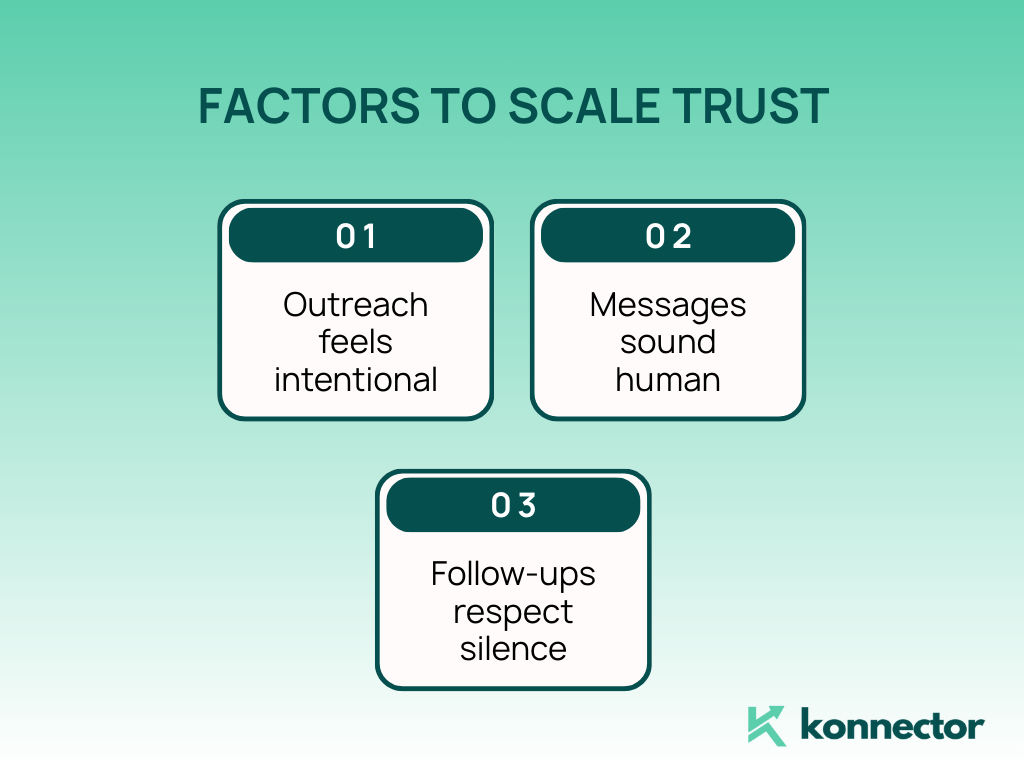
Building Trust While Scaling LinkedIn Automation
Trust scales differently than volume.
Trust scales when:
- Outreach feels intentional:
Intentional outreach is immediately noticeable. The message has a reason to exist. It references context, role, timing, or relevance instead of feeling like a broadcast sent to everyone with a LinkedIn profile. When LinkedIn automation is designed intentionally, each outreach step answers a silent question in the recipient’s mind: “Why me, and why now?” This reduces friction, builds credibility, and makes the outreach feel like a professional introduction rather than an interruption. - Messages sound human:
Human-sounding messages are not about adding emojis or casual language. They are about rhythm, tone, and restraint. The wording feels natural, imperfect in a good way, and free from exaggerated claims or forced enthusiasm. GDPR-aligned and safety-first LinkedIn automation avoids scripted pressure and instead mirrors how real professionals write when they reach out manually. The result is messaging that feels personal without pretending to be personal. - Follow-ups respect silence:
Silence is information, not an error. Respectful LinkedIn automation treats non-response as a signal, not something to override with more volume. Follow-ups are spaced thoughtfully, limited in number, and never designed to corner the recipient into replying. When silence is respected, outreach maintains dignity, avoids irritation, and protects brand perception. Often, this restraint is exactly what leads to better replies later.
LinkedIn automation should support relationship building, not replace it.
Automation sets the stage. Humans close the loop.
The Future of LinkedIn Automation Beyond 2025
LinkedIn automation will continue to evolve.
Detection systems will become more behavioural.
Expectations around professionalism will rise.
Tolerance for spam will shrink further.
The teams that succeed will be the ones who:
- Automate carefully
- Respect trust signals
- Prioritise long-term visibility
Final Perspective
LinkedIn automation is not disappearing.
But reckless automation is.
In 2025, the safest LinkedIn automation strategies are built around trust, compliance, and behavioural intelligence.
Safety is no longer a limitation.
Safety is the foundation of scalable LinkedIn automation.
Konnector.ai is built for teams who want LinkedIn automation that lasts — without bans, without fear, and without sacrificing credibility. Book a demo today to leverage safe automation and up your outreach game.
11x Your LinkedIn Outreach With
Automation and Gen AI
Harness the power of LinkedIn Automation and Gen AI to amplify your reach like never before. Engage thousands of leads weekly with AI-driven comments and targeted campaigns—all from one lead-gen powerhouse platform.
Frequently Asked Questions
LinkedIn automation can be safe in 2025 if it follows platform limits, uses controlled pacing, avoids aggressive behaviour, and prioritises long-term account health over short-term volume.
Accounts are typically flagged due to timing consistency, repetitive behaviour, excessive daily actions, browser-based automation patterns, and ignoring LinkedIn’s connection and messaging limits.
Yes. Cloud-based LinkedIn automation is generally safer because it distributes actions over time, reduces device-level exposure, and avoids repetitive browser session patterns.
There is no fixed universal number. Safe LinkedIn automation focuses on variable pacing, realistic daily activity, and natural fluctuations rather than hitting maximum limits every day.
LinkedIn discourages aggressive automation and misuse of the platform. Tools that prioritise safety, realistic behaviour, and respectful outreach are less likely to trigger enforcement actions.
Yes. Consistent, well-paced LinkedIn automation often outperforms aggressive automation because it maintains inbox access, account credibility, and response quality over time.
Perfectly predictable timing is a strong automation signal. Safe LinkedIn automation introduces variability, pauses, and natural gaps to reflect real human behaviour.
Yes, when used responsibly. Recruiters and founders benefit most from LinkedIn automation that prioritises trust, relevance, and long-term relationship building.
The biggest mistake is prioritising speed and volume over safety, leading to account restrictions, poor response rates, and damaged brand trust.
Safe LinkedIn automation means running outreach that protects your account, respects recipients, adapts to engagement signals, and compounds results without risking bans or interruptions.