Direct answer: Automate connection requests first. Use InMails second. Connection requests deliver higher reply rates, grow your network permanently, and cost nothing. InMails are a finite, paid resource best reserved for prospects who do not respond to connection requests — or for senior titles where cold acceptance rates are too low to rely on invitations alone.
The Data: InMails vs Connection Requests in 2026
| Metric | Connection Requests | InMails |
|---|---|---|
| Average acceptance / open rate | 30–45% acceptance | Not applicable (no acceptance step) |
| Reply rate | 39% positive reply rate | 18–25% reply rate |
| Cost | Free (within weekly limits) | Credits required (15–50/month depending on plan) |
| Network benefit | Permanent 1st-degree access on acceptance | None — one-off transaction, no network growth |
| Automation safety | Moderate — requires pacing and variation | Lower risk — platform-native paid feature |
| Weekly / monthly capacity | 100–200 requests/week | 15–50 credits/month |
Connection requests win on every measurable output metric. A real-world analysis of over 500,000 LinkedIn outreach attempts confirms a 39% positive reply rate for personalised connection-based sequences vs 18–25% for InMails. InMails do significantly outperform cold email (which averages just 3% reply rate), but within LinkedIn, they are the weaker primary channel.
Want to run both channels in one coordinated sequence? Book a Konnector.ai demo and see how smart sequencing handles connection requests and InMails automatically.
The Right Way to Combine Both in a LinkedIn Automation Sequence

The most effective LinkedIn automation strategy is not either/or — it is sequential. Here is the proven structure:
Step 1: Automated Connection Request (Day 1)
Send a personalised connection request. Free, scalable, and the highest-converting first touch. Include a short note referencing a specific reason for connecting — a shared group, a recent post, a relevant role. Personalised requests achieve 30–40% higher acceptance than generic invitations.
Step 2: Follow-up Message (Day 3–4 after acceptance)
Once accepted, send a value-driven first message. Do not pitch immediately. Add context, share a relevant insight, or reference what prompted the connection. This is where the 39% reply rate is generated.
Step 3: InMail for Non-Responders (Day 7+)
If the connection request is not accepted after 5–7 days, withdraw it (to protect your pending invite ratio) and deploy an InMail. Keep InMails under 400 characters — shorter InMails consistently produce higher response rates. Use your monthly credits here, not at step one.
This sequencing conserves InMail credits for where they are genuinely needed, maximises network growth from accepted requests, and ensures no high-value prospect falls through without a second attempt.
Running this manually across hundreds of prospects is operationally impossible. Sign up to Konnector.ai and automate the entire sequence — request, follow-up, and InMail fallback — in one workflow.
When InMails Should Lead the Sequence
There are three specific scenarios where leading with an automated InMail makes more sense than a connection request:
- C-suite and VP-level prospects with acceptance rates consistently below 15%. Senior titles receive high volumes of cold invitations and frequently ignore them. An InMail with a sharp subject line and a direct, concise value proposition stands out differently.
- Very small, high-value target lists where each prospect justifies the credit spend and a premium-feeling first touch is part of the strategy.
- Open Profiles — LinkedIn members who have enabled open messaging. These can receive InMail for free, without using credits. Automation tools can identify Open Profiles automatically and route them into a free InMail sequence, bypassing credit limits entirely.

Run Both Channels in One Automated Sequence
📅 Book a Free Demo → See the full InMail and connection request automation workflow live.
⚡ Sign Up Free → Start your first multi-channel LinkedIn sequence today.
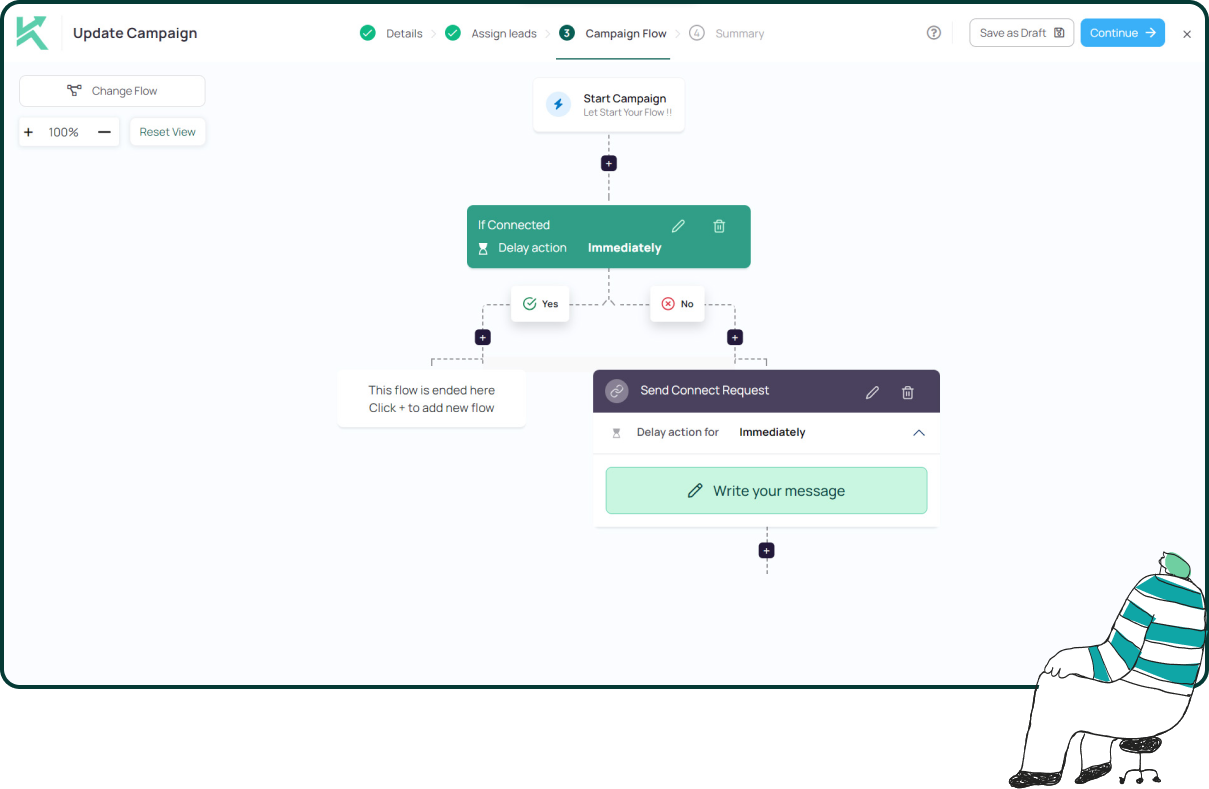
11x Your LinkedIn Outreach With
Automation and Gen AI
Harness the power of LinkedIn Automation and Gen AI to amplify your reach like never before. Engage thousands of leads weekly with AI-driven comments and targeted campaigns—all from one lead-gen powerhouse platform.
Frequently Asked Questions
Automate connection requests first. They outperform InMails on reply rate, are free, and build permanent network access. Use automated InMails as a fallback for non-responders or for senior titles unlikely to accept cold invitations.
No. Personalised connection requests with follow-up messages achieve around a 39% positive reply rate, compared to 18–25% for InMails. InMails outperform cold email but are less effective than connection-based outreach within LinkedIn.
Use them after a connection request goes unanswered for 5–7 days, for C-level prospects with low acceptance rates, or for Open Profiles where InMails are free. Treat InMails as a secondary channel, not the starting point.
LinkedIn Premium Business offers around 15 credits per month, while Sales Navigator provides approximately 50. Credits are refunded if the recipient replies within 90 days.
Yes. InMail automation carries lower platform risk since it is a native paid feature. However, sending identical templates at scale can still reduce reply rates and trigger detection. Personalisation is still critical.
Yes. Senior executives are less likely to accept connection requests but are more responsive to well-crafted InMails. This makes InMails particularly effective for targeting C-level or highly selective profiles.
A strong InMail reply rate is typically between 18–25%. Rates above 25% indicate highly targeted messaging and strong personalisation.
Yes, but only up to a limit. LinkedIn allows unused credits to accumulate for up to 3 months depending on your subscription plan.
They should always be personalised. Even when automated, adding context such as the recipient’s role, company, or recent activity significantly improves response rates and reduces spam signals.
Overusing it as a primary outreach channel. Many users burn through credits on cold, untargeted outreach. The most effective strategy is to use InMails selectively after connection-based outreach or for high-value prospects.