If you have ever tried to grow your LinkedIn network quickly, you already know the problem: generic connection requests get ignored, but writing a thoughtful, personalized note for every single person you want to connect with is painfully time-consuming. This is exactly where AI tools like ChatGPT and Claude change the equation. Used correctly, they let you personalize LinkedIn connection notes at scale — without sacrificing the human touch that actually gets people to accept and respond. This guide shows you the exact workflows, prompts, and principles to make it work.
Why Personalization Is the Only Thing That Works
LinkedIn’s own data has consistently shown that connection requests with personalized notes have significantly higher acceptance rates than blank requests. The gap is not small. Depending on the audience and context, personalized notes can outperform blank requests by two to five times.
The reason is simple: people are busy, skeptical, and drowning in generic outreach. When someone lands in their inbox with a note that references their specific work, a post they wrote, a mutual connection, or a shared experience, it signals that you actually looked at them as a person — not just a name on a list. That signal is what earns the connection.The challenge has always been time. Writing twenty truly personalized notes in a day is exhausting. Writing one hundred is impossible without a system.
AI does not replace the personalization — it accelerates the process of creating it, so you can operate at volume without sounding like a mass mailer.
ChatGPT vs Claude: Which Tool for Which Job
| Feature | ChatGPT (OpenAI) | Claude (Anthropic) |
|---|---|---|
| Availability & Ecosystem | Widely available with a large user base and strong third-party integrations. | Growing ecosystem, but fewer automation integrations compared to ChatGPT. |
| Automation Integration | Integrates easily with Zapier, Make (formerly Integromat), Clay, and API-based workflows. | More limited no-code automation support at scale. |
| Batch Output Consistency | Excellent at following structured templates and producing consistent results across large batches. | Strong output quality, but optimized more for nuance than high-volume uniform generation. |
| Tone & Conversational Flow | Clear and structured, but can sometimes feel slightly formulaic if not prompted carefully. | Highly natural, nuanced, and conversational — often less robotic in cadence. |
| Best Use Case | Building automated LinkedIn outreach pipelines and large-scale connection note generation. | Crafting personalized notes for high-value prospects where tone and subtlety matter most. |
For most people, the tool that produces the best output is the one you are already comfortable with. The prompts and principles in this guide work equally well in both. Many practitioners use ChatGPT for bulk generation and Claude for high-value individual notes — but the workflow is identical.
What to Gather Before You Write a Single Note
The quality of your AI-generated LinkedIn notes is directly proportional to the quality of the information you feed the AI. Garbage in, generic out. Before you open ChatGPT or Claude, you need to gather personalization data for each person you plan to reach out to.
The Essential Data Points
At minimum, you want the person’s first name, their current job title and company, and one specific, genuine reason you are reaching out to them. That reason is the engine of personalization.
The High-Value Data Points
If you want notes that feel genuinely tailored rather than template-filled, go deeper. Look for a recent post or article they published and note the topic or a specific point that resonated. Check whether you have any mutual connections and, if so, who they are. Look for shared professional experiences — did you both work in the same industry, attend the same conference, or navigate the same career transition? Note any relevant awards, milestones, or company news that is recent enough to feel timely. These data points become the raw material your AI prompt will transform into a personal, relevant note.
Where to Find This Information
Their LinkedIn profile is your primary source. Go beyond the headline — read their About section, check their recent activity (posts and comments), look at the companies they have worked for, and scan their featured section. If they have a newsletter, podcast, or published content linked from their profile, even a brief skim gives you material that almost no one else reaching out to them will have bothered to find.
Organizing Your Research
For scaling this process, keep your research in a simple spreadsheet. Columns should include: First Name, Current Title, Company, Industry, Personalization Hook (the one specific thing you will reference), Your Reason for Reaching Out, and any Additional Context. This spreadsheet becomes the input for your AI prompts at scale.
Read more—> The Role of AI in Modern LinkedIn Networking

The Core Prompt Framework for LinkedIn Notes
A well-structured prompt is the difference between AI output you can send immediately and AI output that needs a complete rewrite. Here is the framework that consistently produces the best LinkedIn connection notes across different use cases.
The Six Elements of a High-Converting AI Prompt
1. Role
Tell the AI who it is writing as. Include your name, your current role, and any relevant context about your professional focus. The AI needs to know whose voice it is writing in. Example: “You are writing on behalf of [Your Name], a B2B SaaS marketing consultant who helps early-stage startups build their first growth engine.”
2. Recipient Context
Give the AI the key facts about the person you are reaching out to. Include their name, role, company, and the specific personalization hook you identified in your research. Example: “The recipient is [First Name], VP of Product at [Company]. They recently posted about the challenge of aligning product and sales teams in a PLG motion.”
3. Goal of the Message
Be explicit about what you want the note to accomplish. LinkedIn connection notes have a 300-character limit, so the goal is almost never to close a deal — it is to earn the connection and signal genuine relevance. State this clearly in the prompt: “The goal is to earn the connection by showing genuine relevance, not to pitch a product or service.”
4. Tone and Voice
Specify the tone explicitly. Options include: warm and conversational, direct and professional, curious and peer-to-peer, enthusiastic but respectful. Match the tone to your personal brand and to the likely preference of the recipient. A startup founder will respond differently to a note than a corporate VP.
5. Constraints
LinkedIn connection notes are limited to 300 characters. Specify this as a hard constraint in your prompt. Also specify any phrases or approaches to avoid — for example, “do not mention any services or products,” “do not use the word synergy,” or “avoid starting with I.”
6. Output Format
Ask for two or three variations so you have options to choose from. Request that each variation stay under 300 characters and be written in plain text with no special formatting or emoji.
Read more—-> Can AI Agents Handle Replies Without Sounding Like Robots?

The Master Prompt Template
Here is a reusable master prompt that incorporates all six elements. Copy it into ChatGPT or Claude and fill in the bracketed fields:
You are writing a LinkedIn connection request note on behalf of [YOUR NAME], a [YOUR ROLE] who [BRIEF DESCRIPTION OF WHAT YOU DO AND FOR WHOM].
The recipient is [FIRST NAME], [THEIR TITLE] at [THEIR COMPANY]. [ONE SENTENCE OF SPECIFIC CONTEXT — e.g., “They recently wrote about X” or “They just joined Y company after Z years at W.”]
My reason for connecting: [YOUR GENUINE REASON — shared interest, admiration for their work, potential collaboration, same community, etc.]
Tone: [TONE — e.g., warm and peer-to-peer, direct and professional, curious and low-pressure]
Constraints: Under 300 characters. Plain text. No pitching. No jargon. Do not start with “I.” Do not use the word “synergy,” “leverage,” or “touch base.”
Write three variations.
Ready-to-Use Prompt Examples by Use Case
Different outreach goals require different prompts. Here are fully written prompt examples for the most common LinkedIn connection scenarios.
Use Case 1: Reaching Out After Reading Their Content
You are writing a LinkedIn connection request on behalf of Maya Chen, a UX researcher at a mid-size fintech company. The recipient is David Park, a product designer who recently published a post about why dark patterns are eroding trust in financial apps. Maya found the post insightful and wants to connect with David as a peer in the product and design space. Tone: genuine, peer-to-peer, intellectually engaged. Under 300 characters. No pitch. Three variations.
Use Case 2: Connecting With a Potential Client
You are writing a LinkedIn connection request on behalf of James Okafor, a freelance brand strategist. The recipient is Priya Mehta, Head of Marketing at a Series A health tech startup called NovaCare. James has been following NovaCare’s growth and admires how they are positioning in a crowded market. He wants to connect without pitching — just open a door. Tone: respectful, knowledgeable, low-pressure. Under 300 characters. Do not mention his services. Three variations.
Use Case 3: Reaching Out to a Potential Employer or Hiring Manager
You are writing a LinkedIn connection request on behalf of Leila Santos, a data analyst with five years of experience in e-commerce and retail. The recipient is Tom Briggs, Director of Analytics at Shopify. Leila is actively exploring new roles and genuinely admires Shopify’s approach to merchant analytics. She wants to connect authentically, not just because she is job-hunting. Tone: professional, enthusiastic, genuine. Under 300 characters. No mention of job applications. Three variations.
Use Case 4: Reconnecting With a Former Colleague or Contact
You are writing a LinkedIn connection request on behalf of Raj Patel, a sales director. The recipient is Sarah Kim, who worked with Raj at the same company four years ago. They were not close colleagues but crossed paths on a few projects. Raj wants to reconnect without it feeling forced or transactional. Tone: warm, casual, no agenda. Under 300 characters. Three variations.
Use Case 5: Connecting After a Conference or Event
You are writing a LinkedIn connection request on behalf of Anna Kowalski, a startup founder. The recipient is Ben Torres, a VC partner she met briefly at SaaStr last week. They had a short conversation about AI in vertical SaaS. Anna wants to continue the conversation. Tone: warm, energetic, specific to the meeting. Under 300 characters. No ask. Three variations.
Read more—-> Safely Automate LinkedIn Outreach with Konnector.ai
The Personalization Variables That Actually Move the Needle
Not all personalization is created equal. Mentioning someone’s name is table stakes — it is the baseline expectation, not a differentiator. The personalization variables that actually increase acceptance and reply rates are the ones that demonstrate you looked past the surface of someone’s profile.
High-Impact Personalization Variables
A Specific Post or Article They Wrote
Referencing a specific argument, observation, or piece of advice from something they published is the single most powerful personalization trigger. It proves you read their work, and most people deeply appreciate having their thinking acknowledged. Do not just name the post — reference something specific from it to show you actually engaged with the content.
A Recent Career Transition or Milestone
Starting a new role, getting promoted, launching a product, or hitting a company milestone are all powerful hooks. People are proud of these moments and receptive to acknowledgment when it feels genuine rather than opportunistic. Keep the tone congratulatory and curious, not sycophantic.
A Shared Community or Experience
Did you both attend the same university? Both work in the same niche industry? Both navigate the same career transition from, say, consulting to startups? Shared experiences create an immediate sense of kinship, and AI can help you frame this connection in a natural, unstuffy way.
A Mutual Connection
Mentioning a mutual connection — especially if that person is well-regarded — adds instant social proof and trust. Only do this if the mutual connection is someone you actually know and who knows you. Never drop a name you cannot back up.
Their Company’s Recent News
A funding round, product launch, press feature, or notable hire is all fair game. This signals you follow the space and care about what is happening in their world — not just what they can do for you.
Low-Impact (But Still Worth Using) Variables
Their job title, the industry they work in, and their company name are better than nothing but are not strong personalization signals on their own. These are “basic relevance” indicators. Use them as supporting context in your prompt, but do not rely on them as the primary hook.
Read more—-> LinkedIn First Messages Examples & Templates
The Scaling Workflow: From One Note to One Hundred
Once you have validated that your prompt produces great individual notes, it is time to build the workflow that lets you generate personalized notes at volume without sacrificing quality.
Step 1: Build Your Research Spreadsheet
Create a spreadsheet with one row per person you plan to reach out to. Your columns should include: First Name, Title, Company, Industry, Personalization Hook, Your Reason for Connecting, Tone (if it varies by segment), and a column for the Generated Note and another for the Reviewed/Final Note.
Step 2: Batch Your Prompts by Segment
Do not write a unique prompt for every single person. Instead, group your list into segments — for example, potential clients, potential collaborators, admired thought leaders, and former colleagues. Write one master prompt template for each segment. Then fill in the personalization variables for each individual within that segment. This approach gives you personalized output without requiring you to reinvent the prompt from scratch each time.
Step 3: Generate in Batches
For moderate volume (ten to thirty notes), you can do this manually by pasting individual filled-in prompts into ChatGPT or Claude one at a time. For higher volume, use the API (ChatGPT’s OpenAI API or Claude’s Anthropic API) combined with a spreadsheet tool like Google Sheets with an AI add-on, or a no-code automation tool like Clay, Make, or Zapier. These platforms allow you to pass each row of your spreadsheet as a prompt and receive the generated note back into a new column automatically.
Step 4: Review, Edit, and Approve
Every AI-generated note must pass through a human review step before it gets sent. This is not optional — more on why in the next section. Mark each note as Approved, Needs Edit, or Regenerate before you begin sending.
Step 5: Send With Intention
LinkedIn does not have a bulk send feature for connection notes — each request must be sent individually. This is actually a feature, not a bug: it forces a natural pacing that keeps your outreach from triggering LinkedIn’s spam filters. A reasonable daily volume for manual sending is twenty to fifty connection requests per day. Spread them throughout the day rather than sending them all at once.

The Human Review Layer You Cannot Skip
AI-generated LinkedIn notes are a first draft, not a final product. Treating them as finished output is the most common and most costly mistake people make when trying to personalize LinkedIn connection notes at scale.
What to Check in Every Note
Accuracy
AI models can hallucinate or misinterpret context you provide. If you told the AI that someone “recently posted about remote team management,” verify that the note’s reference to that post is accurate and specific — not a vague paraphrase that could apply to anyone. A note that gets the details wrong is worse than a generic note because it signals carelessness rather than genuine interest.
Character Count
LinkedIn’s 300-character limit is strict. Paste every note into a character counter before sending. Even if you specified the constraint in your prompt, AI occasionally goes over. A note that gets truncated mid-sentence is embarrassing and ineffective.
Tone Fit
Read each note out loud. Does it sound like you? Does it fit the recipient’s likely communication style? A note written in a highly formal register for someone who writes casual, humor-filled LinkedIn posts will feel off. Adjust tone as needed during review.
The “Is This Creepy?” Test
There is a fine line between impressively researched and uncomfortably surveilled. If your note references something very obscure — a comment they left on someone else’s post two years ago, for example — it may feel intrusive rather than personalized. Stick to publicly visible, recent, and professional context.
Grammar and Flow
AI output is usually grammatically clean, but not always. Read for flow as well as correctness. Short, punchy sentences work best in LinkedIn notes. Anything that requires re-reading to understand needs to be simplified.
What to do and What Not: The Mistakes That Make AI Notes Feel Like Spam
The goal of using AI to personalize LinkedIn connection notes at scale is to create connection, not to automate mass communication. There are several patterns that immediately reveal an AI-generated note as inauthentic — avoid all of them.
LinkedIn Connection Notes: What to Do vs What to Avoid
| Area | ✅ Do | ❌ Don’t |
|---|---|---|
| Personalization | Reference something truly specific — a post title, argument, example, or insight that genuinely stood out. | Write vague lines like “I loved your recent post about leadership.” Fake specificity signals templated outreach. |
| Tone & Compliments | Keep appreciation grounded and natural. Make praise specific and relevant. | Overuse flattery like “incredible journey” or “exceptional thought leadership.” Excessive praise feels robotic. |
| Sales Intent | Earn the connection first. Focus on shared relevance or curiosity. | Insert a stealth pitch or soft CTA in the connection note. The pitch belongs in follow-ups. |
| Language Style | Write conversationally and clearly. Use simple, human language. | Use corporate jargon like “synergy,” “leverage,” “value-add,” or “circle back.” It feels generated. |
| Batch Outreach Quality | Vary structure, personalization angle, and flow across notes. Review side-by-side for sameness. | Send structurally identical notes to similar profiles. Changing a few words isn’t real variation. |
What Happens After They Accept: AI-Assisted Follow-Up
The connection note gets your foot in the door. The follow-up message is where real conversion happens. AI can help you personalize this step as well, using the same principles with a few important differences.
The First Follow-Up Message
Send a follow-up within twenty-four to forty-eight hours of acceptance, while you are still fresh in their mind. This message should be slightly longer than the connection note — two to four sentences — but still casual and non-transactional. Thank them for connecting, reinforce the relevance of the connection, and open a conversational thread with a genuine question or observation.
Prompting AI for Follow-Up Messages
Use the same master prompt framework but update the goal. Instead of “earn the connection,” the goal is now “open a genuine conversation.” Give the AI the context of why they accepted (if you know), the original hook from your connection note, and one conversational question you genuinely want answered. Ask for a message that ends with a single, easy-to-answer question. Multiple questions kill reply rates — one question is always the right number.
The Long-Game Approach
Not everyone you connect with will convert immediately into a client, employer, collaborator, or opportunity. The most valuable connections often develop over months through consistent, value-adding interactions — commenting on their posts, sharing their work, responding to their content. AI can help you draft thoughtful comments at scale as well. Treat your LinkedIn network as a garden, not a vending machine.
Tools and Integrations That Automate the Pipeline
If you want to personalize LinkedIn connection notes at scale beyond what manual copy-paste allows, these tools and platforms can help you build an integrated pipeline.
Clay
Clay is a data enrichment and outreach automation platform that integrates directly with AI APIs. You can pull LinkedIn profile data, enrich it with additional context from the web, and run AI prompts to generate personalized notes — all within a single workflow. It is one of the most purpose-built tools for exactly this use case and is widely used by sales teams and recruiters for AI-personalized outreach at scale.
Make (formerly Integromat) and Zapier
Both platforms allow you to connect Google Sheets (where your research lives) to the OpenAI or Anthropic API. You can build a workflow where adding a row to your spreadsheet automatically triggers a prompt, generates a note, and writes it back into the sheet. No coding required for basic workflows.
Phantombuster and Dux-Soup
These LinkedIn automation tools can help you gather profile data at scale, which then feeds into your AI prompting workflow. Use them carefully and within LinkedIn’s terms of service — excessive automation can result in account restrictions.
Google Sheets with GPT or Claude Add-Ons
Several Google Workspace add-ons bring AI directly into Google Sheets, allowing you to write a prompt formula in a cell and have it generate output based on data from other cells in the same row. This is the most accessible entry point for non-technical users who want to automate batch generation without building a full integration.
A Note on LinkedIn’s Terms of Service
LinkedIn restricts automated or bulk messaging and connection requests that violate its User Agreement. Using AI to write notes is not a violation — the content is still human-reviewed and manually sent. However, using bots to automatically send connection requests at high volume is against the platform’s rules and risks account restrictions. The safest approach is always AI-assisted writing combined with manual sending.
Quick-Start Checklist: Personalize LinkedIn Connection Notes at Scale
Use this checklist to launch your first AI-personalized outreach campaign from scratch.
Research and Setup
Build a research spreadsheet with columns for name, title, company, personalization hook, reason for connecting, and tone. Identify at least one genuine, specific personalization hook for each person. Group your list into two or three segments with shared outreach goals.
Prompt Building
Write one master prompt template per segment using the six-element framework. Include the 300-character constraint, banned word list, and tone specification. Test each template with three to five individuals before running the full batch. Review outputs and refine the prompt until results are consistently strong.
Batch Generation
Generate notes in batches by segment. For volume above thirty per day, use an AI API integration with your spreadsheet. Save all generated notes back into the spreadsheet in a dedicated column.
Human Review
Read every note before sending. Verify accuracy, check character count, assess tone fit, and apply the “is this creepy?” test. Mark each note as approved, edit needed, or regenerate.
Sending and Follow-Up
Send twenty to fifty requests per day manually, spread throughout the day. Follow up within twenty-four to forty-eight hours of acceptance with a short, conversational message ending in one question. Track acceptance rates and reply rates by segment to refine your approach over time.

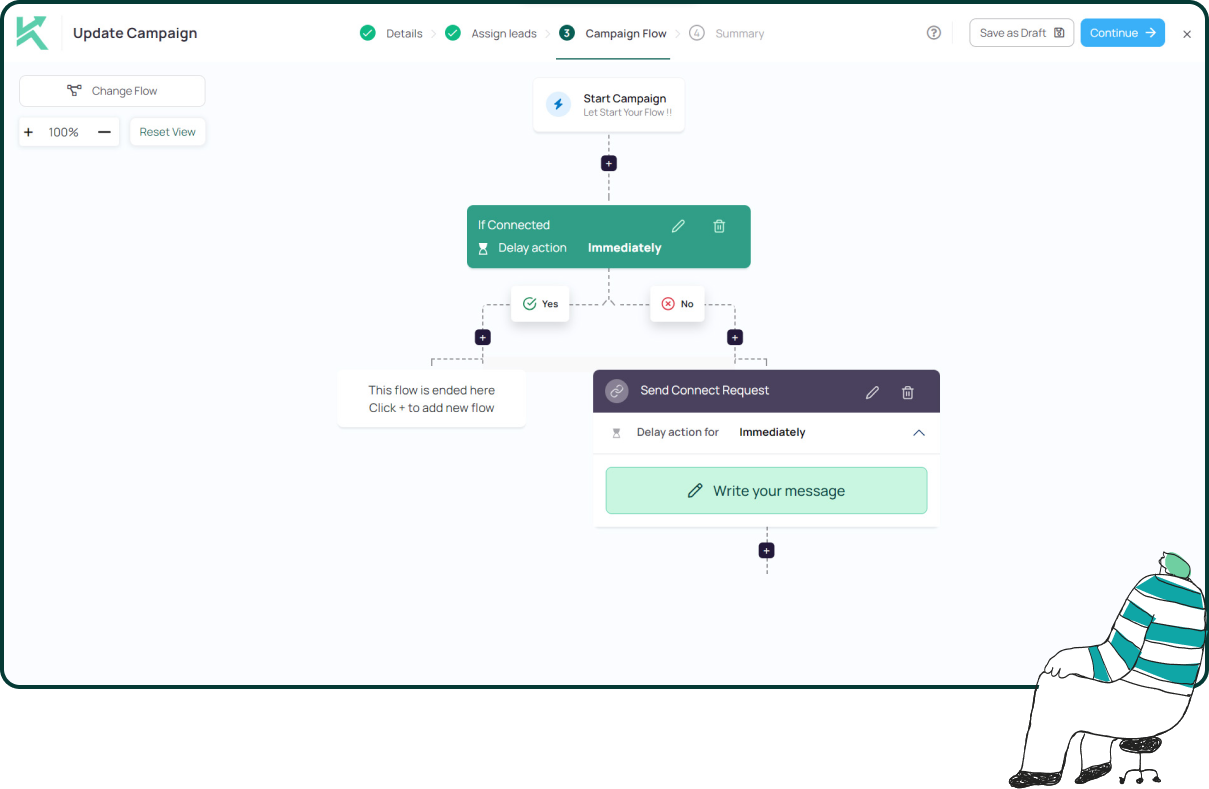
11x Your LinkedIn Outreach With
Automation and Gen AI
Harness the power of LinkedIn Automation and Gen AI to amplify your reach like never before. Engage thousands of leads weekly with AI-driven comments and targeted campaigns—all from one lead-gen powerhouse platform.
Frequently Asked Questions
You can personalize LinkedIn outreach at scale by gathering structured personalization data (posts, milestones, shared experiences) and using AI tools like ChatGPT or Claude to generate tailored connection notes based on that context. Always include human review before sending.
Yes. Personalized LinkedIn connection notes consistently outperform blank requests — often by two to five times — because they signal relevance and genuine interest rather than mass outreach.
Both ChatGPT and Claude work well. ChatGPT integrates more easily into automation workflows, while Claude often produces more naturally conversational tone. The best choice depends on whether you prioritize scale or nuance.
At minimum:
First name
Current role and company
One specific personalization hook
High-impact data includes recent posts, milestones, mutual connections, or shared professional experiences.
LinkedIn connection notes have a strict 300-character limit. The ideal note is concise, relevant, and focused solely on earning the connection — not pitching.
Using AI to write connection notes is safe when you manually review and send them. However, fully automated sending tools that violate LinkedIn’s terms of service can lead to account restrictions.
Common mistakes include:
Fake specificity
Over-the-top compliments
Stealth pitching
Corporate jargon
Structurally identical notes sent in batches
These patterns reduce trust and acceptance rates.
A safe manual range is 20–50 connection requests per day, spread throughout the day. Sending too many at once may trigger LinkedIn restrictions.
Send a short follow-up within 24–48 hours. Thank them for connecting, reinforce relevance, and ask one simple, easy-to-answer question to start a conversation.
Yes — when used responsibly. LinkedIn Automation helps scale research and message drafting, but conversion depends on strong personalization and human oversight.