The Risk: Why Managing Multiple Profiles Triggers LinkedIn Flags
Managing several LinkedIn accounts from a single location is one of the fastest ways to get accounts restricted. It is also one of the most common mistakes agencies make when onboarding new clients.
LinkedIn’s security algorithms are designed to detect suspicious patterns that suggest automated behavior, coordinated inauthentic activity, or credential sharing. When an agency logs into 50 or more client accounts from the same IP address, it creates a digital fingerprint that resembles a single entity operating many profiles from one environment.
If LinkedIn’s systems believe one person is controlling many accounts simultaneously, they may restrict the entire cluster of profiles to protect platform integrity.
Konnector Insight: Konnector.AI uses dedicated, residential-grade IPs that are procured from real-world providers and carefully maintained. Think of it as the difference between staying at a 5-star hotel versus a hostel where the address is already on LinkedIn’s spam watchlist.
Additionally, Konnector uses non-linear delays—random intervals between actions that mimic human behavior. No two sessions look the same, which is exactly what you need to stay under the radar.
Common Triggers That Flag Your Accounts
| Trigger | Why It Flags Your Account |
|---|---|
| Shared IP addresses | Logging into multiple profiles from one office Wi-Fi signals coordinated inauthentic behavior to LinkedIn’s detection systems. |
| Device fingerprint conflicts | Using the same browser profile for different accounts reuses session cookies (such as li_at), which can link profiles together. |
| Impossible travel | A client logs in from London on mobile while your agency logs in from New York on desktop five minutes later. This geographic mismatch is a strong red flag. |
| Aggressive volume spikes | Sending 50 invites on day one of a dormant or newly acquired account triggers rate-limit warnings and can lead to immediate restriction. |

Step 1: Technical Isolation — Device and IP Hygiene
The foundation of safe multi-account management is session isolation. Every client account must exist in its own digital environment so that cookies, login sessions, and IP addresses never overlap.
Use Separate Browser Sessions per Client
Create a unique browser environment for each client account. If you are using Chrome, open the profile manager, click “Add,” and name the profile after your client (for example, “Client A — LinkedIn”). This ensures that cookies, browsing history, and cache are strictly separated across accounts.
With Konnector, this is handled automatically. Konnector’s cloud-based architecture runs each LinkedIn account in its own isolated session. You do not need to manage multiple Chrome profiles manually. Each account’s cookies and session data are kept completely separate within the platform, eliminating cross-session leakage.
Stay away from LinkedIn radar and get a proven system to handle your accounts. Book a demo now with our experts.
Assign a Stable, Client-Matched IP Address
Use a stable, dedicated IP per client to avoid mixing digital footprints. Avoid data center IPs, as these are inexpensive but frequently flagged as automation indicators. Instead, prefer ISP-issued static IPs that reflect the client’s actual geographic location.
Geo-matching matters. If your client is based in Paris, their outreach should originate from a French IP. If they travel, pause automations or gradually shift location rather than making sudden jumps.
Konnector provides cloud-based dedicated IPs for each connected LinkedIn account. This means every client’s activity runs from a consistent, isolated location, reducing the risk of “impossible travel” flags and coordinated-behavior detection.
Step 2: The 4-Week Warm-Up Strategy
New connections must be built gradually. If you take over a dormant LinkedIn account and immediately send 50 connection requests, the account will almost certainly get flagged. LinkedIn’s systems monitor for sudden behavioral changes, and a sharp spike in activity on a previously quiet profile is one of the strongest restriction triggers.
Follow this progressive ramp-up schedule to build trust with LinkedIn’s algorithm. Gradual activity increases reduce sudden-behavior flags and help maintain healthy acceptance rates.
| Timeline | Daily Limit | Focus |
|---|---|---|
| Week 1 | 10–15 actions | Profile hygiene: Update the profile picture, headline, and about section. Create and share original content. View profiles organically. Send zero connection requests. |
| Week 2 | 20–25 actions | Soft outreach: Send manual connection requests to people the client already knows. Start engaging with industry posts through likes and thoughtful comments. |
| Week 3 | 30–40 actions | Lead generation: Begin targeted outreach campaigns using Konnector’s smart sequences. Include personalized messages based on prospect activity and profile data. |
| Week 4 | 50–60 actions | Cruising altitude: Reach sustainable scale. Monitor acceptance rates and reply rates closely. Maintain this pace only if metrics remain healthy and no warnings appear. |
Pro Tip: Stagger actions throughout the workday to avoid bursty patterns. With Konnector’s built-in scheduler, you can set each account to operate within the client’s local business hours (e.g., 9 AM–5 PM in their time zone), with randomized delays between actions to simulate natural human behavior.
Step 3: Identity, Consent, and the LinkedIn User Agreement
Managing someone else’s LinkedIn account requires strict legal and ethical compliance. The LinkedIn User Agreement states that accounts should not be shared. If a client authorizes access, proceed with caution and ensure full transparency.
Consent and Liability Framework
- Written authorization: Obtain a signed agreement stating you have explicit permission to access the client’s LinkedIn account for content creation and outreach.
- Privacy boundaries: Agree in writing on what you will and will not access (for example, private messages with personal contacts or specific competitor profiles).
- Security protocols: Use a password manager with item-level sharing and limit credential visibility to designated team members. Credential sharing can violate platform terms, so minimize access points and obtain written consent.

Brand Voice Protection
You are managing a personal brand, not just a company page. Every message, comment, and connection request must sound like it came from the client, not from an agency template.
- Tone matching: Audit the client’s previous posts, messages, and comments. Note whether they use emojis, industry jargon, formal or casual language. Match their style precisely.
- Content approval workflow: Use a shared content calendar where clients can review and approve posts before they go live. Konnector’s AI comment feature generates draft comments that require your explicit approval before posting, ensuring brand safety on every interaction.
Read more—-> Automated LinkedIn Leads with Social Signals
Step 4: Scale Safely with Konnector’s Cloud Automation
At 50 or more accounts, cloud-based automation is significantly more reliable and safer than local browser extensions. Browser extensions run inside your local Chrome instance, often leak data, share your local IP address across all managed accounts, and create the exact patterns that trigger LinkedIn’s detection systems.
Why Cloud Automation Reduces Risk
- Isolated environments: Konnector runs each account in a separate cloud environment. Sessions, cookies, and IP addresses are completely isolated, so activity on one client’s account never bleeds into another’s.
- Device consistency: Cloud automations run from a consistent server location on a predictable schedule, which helps avoid “impossible travel” patterns that occur when a client is in one city while the agency operates from another.
- Role-based team access: Konnector offers unlimited team members with role-based permissions. Assign access at the workspace or campaign level rather than sharing a single login, giving each team member visibility only into the accounts they manage.
- Social signals intelligence: Unlike tools that only automate outbound actions, Konnector identifies prospects who are actively engaging on LinkedIn through posts, comments, profile views, and follows. These signals indicate buying intent, letting your team reach out at the moment a prospect is most receptive.

Manage your LinkedIn outreach with Konnector.AI – the best LinkedIn automation tool for all your needs.
Book a demo now.
Safety Guardrails to Configure in Konnector
| Guardrail | How to Configure in Konnector |
|---|---|
| Daily caps | Start with 10–20 connection requests per day and increase gradually based on acceptance rate and account age. Set per-account daily caps in Konnector’s campaign scheduler. |
| Working hours | Set each account’s scheduler to operate within the client’s local business hours (e.g., 9 AM–5 PM in their time zone) with randomized delays between actions. |
| Auto-withdrawal | Enable auto-withdrawal for pending connection invites after 30–45 days to keep the prospect network healthy and prevent stale requests from accumulating. |
| Human-in-the-loop AI | Konnector’s AI comment generator drafts contextual comments on your leads’ posts. Every comment requires your explicit approval before posting, ensuring brand safety and compliance. |
| Native CRM sync | Connect Konnector natively to HubSpot or Salesforce so all outreach activity, lead attributes, and engagement data sync automatically — no Zapier workaround required. |
Step 5: Advanced Outreach Segmentation and AI Personalization
Low-relevance outreach is the fastest path to restrictions and client churn. LinkedIn penalizes accounts that receive high volumes of ignored or declined connection requests. To keep accounts safe and drive real pipeline, focus on relevance over volume.
Target Audience Segmentation
Split your outreach lists by relevance and intent. For example, an agency running campaigns for a B2B SaaS client might segment like this:
- List A — CEOs and founders of SaaS companies: Focus on growth and partnership opportunities.
- List B — VP-level marketing leaders: Focus on the specific problem the client solves.
- List C — Shared connections and alumni networks: Focus on warm introductions and credibility.
AI-Assisted Personalization with Konnector
Konnector’s AI message writer drafts tailored openers that flow directly into your outreach sequences. Rather than sending a generic template, the AI analyzes each prospect’s profile, recent activity, and shared context to generate a relevant first line.
Acceptance Rate Benchmark: A sustained acceptance rate well below 20% is a red flag. If you see declining rates, slow down, improve targeting, and increase message relevance before scaling volume. Konnector’s analytics dashboard tracks acceptance and reply rates per campaign in real time, making it easy to spot and fix issues early.
Social Signals: Engage Before You Outreach
One of the most effective ways to improve acceptance rates is to create familiarity before sending a connection request. Konnector automates warm-up actions such as profile views, post likes, and follows as the first steps in your outreach sequence. This means your prospect has already seen your client’s name in their notifications before any message arrives, making the eventual request feel natural rather than cold.
Konnector’s social signals engine goes further. It monitors up to 6 live keyword signals and 4 static keyword signals per LinkedIn sender, surfacing prospects who are actively discussing topics relevant to your client’s offer. When a prospect posts about a pain point your client solves, that’s the optimal moment to engage — and Konnector flags it automatically.
Conclusion: Precision, Not Shortcuts
Running multiple LinkedIn accounts safely is a discipline, not a hack. Each client deserves a dedicated technical setup, a gradual warm-up, a transparent consent process, and outreach that earns replies rather than generating spam reports.
When scale demands efficiency, the answer is not to cut corners on safety — it is to use cloud-based automation that isolates every account, enforces rate limits, and gives your team the intelligence to reach the right people at the right time.
Konnector is purpose-built for this. With cloud-based dedicated IPs, isolated sessions per account, unlimited team members, AI-powered engagement with human-in-the-loop approval, native CRM integration, and a social signals engine that identifies high-intent prospects in real time, Konnector gives agencies the infrastructure to scale LinkedIn outreach without risking the accounts they manage.
Start your 14-day free trial at konnector.ai — no credit card required. Link unlimited LinkedIn accounts, configure isolated sessions and dedicated IPs, and launch your first safe outreach campaign in minutes.
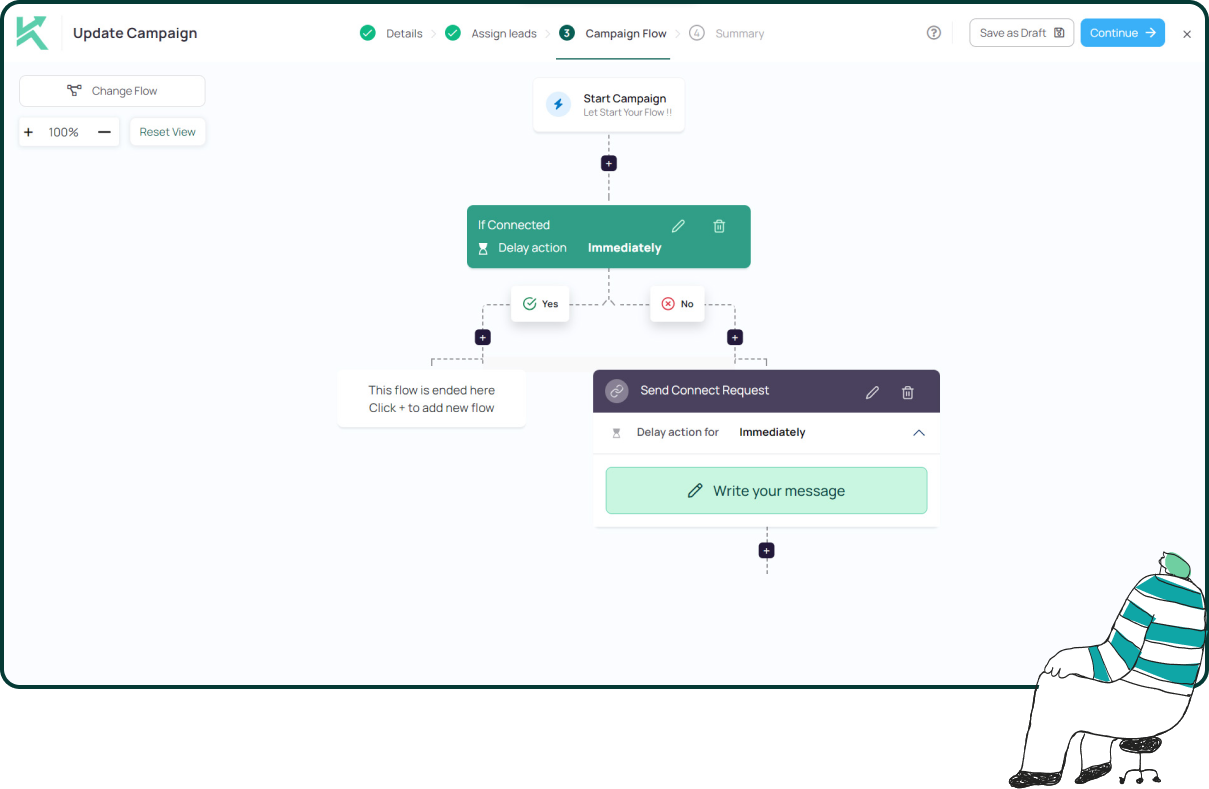
11x Your LinkedIn Outreach With
Automation and Gen AI
Harness the power of LinkedIn Automation and Gen AI to amplify your reach like never before. Engage thousands of leads weekly with AI-driven comments and targeted campaigns—all from one lead-gen powerhouse platform.
Frequently Asked Questions
LinkedIn restrictions often occur when several accounts are operated from the same IP address or browser session. LinkedIn’s detection systems interpret this pattern as coordinated inauthentic behavior or automation abuse. Using separate sessions, dedicated IPs, and isolated environments helps reduce this risk.
Agencies should isolate each account technically and operationally. This includes assigning a dedicated IP per client, using separate browser sessions, following a gradual warm-up schedule, and limiting daily activity. Cloud-based platforms like Konnector automate these safeguards by running each account in its own isolated environment.
The safest approach is to use cloud-based automation that mimics natural behavior. Platforms like Konnector run each LinkedIn account in a separate cloud session with dedicated IPs, built-in rate limits, and randomized activity timing to avoid suspicious automation patterns.
LinkedIn monitors sudden spikes in activity. If a dormant account suddenly sends dozens of connection requests, it may trigger rate-limit warnings or restrictions. A gradual warm-up over 3–4 weeks allows the account to build trust with LinkedIn’s algorithm before scaling outreach.
After an account is properly warmed up, most professionals operate safely within a range of 20–30 connection requests per day. New accounts should begin with fewer actions and increase gradually while monitoring acceptance rates and engagement signals.
LinkedIn discourages credential sharing in its User Agreement. Agencies managing accounts should always obtain written authorization from clients, maintain clear privacy boundaries, and follow security best practices such as password managers and limited access permissions.
Browser extensions run locally in a single browser environment and may expose multiple accounts to the same IP address, device fingerprint, or cookies. Cloud automation platforms isolate each account in separate environments with dedicated IPs, which significantly reduces the risk of LinkedIn detecting coordinated activity.
Konnector provides isolated cloud sessions, dedicated IPs, role-based team access, built-in rate limits, and social signal intelligence. These features allow agencies to manage multiple client accounts while reducing restriction risks and maintaining consistent outreach performance.