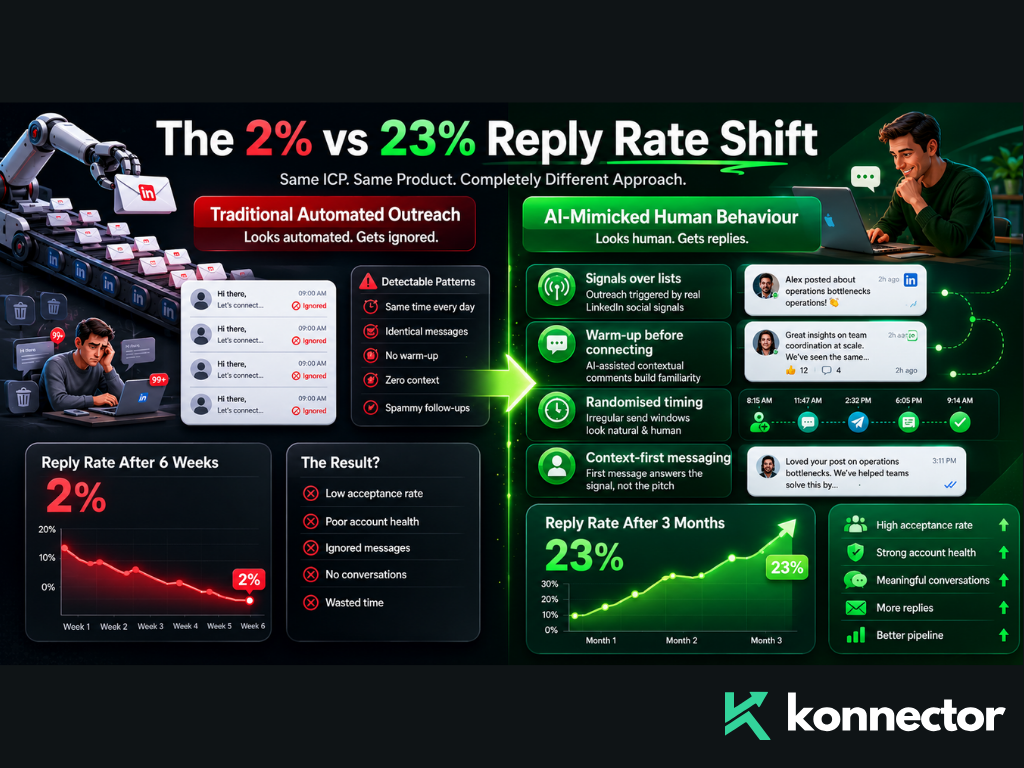
James ran a B2B SaaS product for operations teams. Smart ICP. Real problem. Clear value proposition. And a LinkedIn® outreach campaign that was generating a 2% reply rate after six weeks of consistent sending.
He was doing what most founders do. Exporting a Sales Navigator list. Writing a decent connection note. Following up twice. Watching the silence pile up.
Three months later, his reply rate sat at 23%.
Same ICP. Same product. Completely different approach. Here is what changed — and why the mechanics behind it matter more than the number.
What was broken in the original campaign
The 2% reply rate was not a writing problem. It was not a product problem. It was a behaviour problem.
James’s outreach looked automated. Because it was.
Connection requests arriving without prior engagement. Messages timed to the same window every day. First messages structured identically across every prospect. No warm-up. No context. No signal that James had paid any attention to the person on the other side.
LinkedIn®’s algorithm had flagged the pattern. Prospects had learned to recognise it. And the inbox, already crowded with outreach that looked exactly the same, had developed immunity to all of it.
A reply rate below 5% is almost never a wording problem. It is an audience and timing problem. The message arrives, but the conditions for a reply do not exist yet.
What is AI-mimicked human behavior in LinkedIn® outreach?
AI-mimicked human behavior means designing your outreach to move, feel, and pattern-match like a real human professional — not a scheduled automation sequence.
In practice, this covers four things.
| Behaviour | What humans do | What AI-mimicked outreach replicates |
|---|---|---|
| Timing | Send messages at irregular intervals across the day | Randomised send windows, no fixed patterns |
| Warm-up | Engage with content before reaching out directly | AI-assisted comments on prospects’ posts before connection requests |
| Context | Reference something specific the prospect has done or said | Signal-based personalisation drawn from real LinkedIn® activity |
| Pacing | Do not send five messages in a week to a stranger | Sequence pacing that respects natural relationship timelines |
None of this is deceptive. It is the opposite of deceptive. It is outreach designed to behave the way a thoughtful professional actually would — rather than the way a bulk-sending tool does when left to its own defaults.
The four changes James made

1. He started with signals, not lists
James stopped pulling static exports and started working LinkedIn® social signals. When a prospect in his ICP posted about an operations bottleneck, commented on content related to workflow automation, or announced a new role in a relevant position — that became the trigger for outreach.
Signals change the entire premise of a cold message. You are not guessing whether this is a good time. The prospect has told you it is.

2. He warmed prospects before connecting
Before any connection request went out, James’s account engaged with the prospect’s recent content. A specific, contextual comment. Something that added to the conversation rather than just acknowledging it.
By the time the connection request arrived, James was already a familiar name. Not a stranger. Not a pitch waiting to happen. Someone who had shown up in the prospect’s notifications once or twice with something worth reading.
Konnector’s AI-assisted comment workflow made this possible at scale. The platform drafts contextual comments based on the actual post content, randomises engagement timing to avoid detectable patterns, and holds every draft for human approval before anything posts. James read every comment before it went live. His voice stayed consistent. The volume scaled.

3. He let AI randomise his activity timing
The original campaign sent messages in tight, predictable windows. Same time of day. Same day-gap between follow-ups. LinkedIn®’s systems — and experienced prospects — can read that pattern in seconds.
Konnector randomises activity timing across all outreach. Connection requests go out at varied intervals. Follow-ups land at different points in the day. The pattern looks human because the pattern is irregular. No two touchpoints arrive with the same mechanical rhythm.
This alone improved his account health score within two weeks. Acceptance rate started climbing before the message copy had changed at all.
4. His first message answered the signal, not the pitch
James rewrote every first message to open with the signal that triggered the outreach. If a prospect had posted about team coordination breaking down at scale, the message opened there. One sentence acknowledging what they had raised. One specific question that built on it. Nothing else.
No product mention. No deck. No request for fifteen minutes.
The goal of the first message became a reply. Not a meeting. Not a conversion. Just a reply — because a prospect who replies once is in a completely different pipeline position to a prospect who has been silently auto-sequenced three times.
Why does AI-mimicked human behavior improve reply rates so dramatically?
The mechanism is straightforward once you see it.
LinkedIn® inboxes in 2026 are pre-filtered by the people receiving messages. Early automation tools trained professionals to spot templated outreach in seconds — and to close it in the same amount of time. The pattern recognition is now instinctive.
Outreach that does not trigger that pattern recognition gets read. Outreach that references something real — a post, a signal, a specific professional moment — gets considered. And outreach that arrives after a name has already appeared once in a comment gets replied to at a rate that generic cold messages cannot touch.
The 11x improvement was not a copywriting miracle. It was the result of removing every signal that said “this is automated” and replacing it with signals that said “this person actually paid attention.”

What does a healthy reply rate look like on LinkedIn®?
For cold LinkedIn® outreach, a reply rate between 10 and 25% is strong. Above 25% indicates excellent signal-based targeting and warm-up. Below 5% — sustained over two or more weeks — points to an audience, timing, or behavioural pattern problem that message copy alone will not fix.
| Reply rate | What it signals | Where to look first |
|---|---|---|
| Below 5% | Audience or timing problem | ICP targeting and signal quality |
| 5 to 10% | Warm-up or messaging gap | Pre-outreach engagement and first message structure |
| 10 to 20% | Healthy — room to optimise | Follow-up pacing and sequence depth |
| 20% and above | Strong signal-based campaign | Scale and protect account health |

The system behind the number
James is not exceptional. He is running a better system. Signal detection. Warm-up comments. Randomised timing. First messages built around real context rather than assumptions about the prospect’s pain.
That system is exactly what Konnector is built to support — signal-based targeting, AI-assisted engagement with human approval at every touchpoint, and outreach that behaves like a professional paying attention rather than a tool running a sequence.
Book a demo to see how it applies to your ICP and current outreach setup. Or sign up and run your first signal-based campaign today.
Further reading
- What Is a Good LinkedIn® Reply Rate in 2026?
- Understanding LinkedIn® Social Signals with Konnector
- LinkedIn® Outreach at Scale: Automate Without Losing Engagement
- AI LinkedIn® Replies: Can AI Respond Like a Human in Outreach?
- LinkedIn® Outreach: 5 DM Templates and Strategy for Replies
11x Your LinkedIn® Outreach With
Automation and Gen AI
Harness the power of LinkedIn® Automation and Gen AI to amplify your reach like never before. Engage thousands of leads weekly with AI-driven comments and targeted campaigns—all from one lead-gen powerhouse platform.
Frequently Asked Questions
AI-mimicked human behavior refers to outreach designed to behave like a real professional rather than a rigid automation sequence. It includes irregular timing, contextual engagement, warm-up interactions, and personalised messaging based on LinkedIn® activity.
Reply rates below 5% usually indicate issues with targeting, timing, or behavioural patterns rather than poor copywriting. Generic automated outreach often gets ignored because prospects instantly recognise repetitive messaging patterns.
A healthy LinkedIn® reply rate for cold outreach typically falls between 10% and 25%. Campaigns above 25% usually indicate strong signal-based targeting and effective warm-up engagement.
LinkedIn® social signals help identify prospects already discussing relevant pain points, role changes, or business challenges. This makes outreach more timely and relevant, increasing the chances of receiving a reply.
Warm-up engagement helps prospects recognise your name before receiving a connection request. Thoughtful comments and interactions create familiarity and reduce the chances of appearing like spam outreach.
Yes. Randomised timing helps outreach appear more natural and avoids predictable automation patterns that LinkedIn® systems and experienced users can easily detect.
The first message should focus on the signal that triggered the outreach, such as a recent post or business update. The goal should be starting a conversation rather than pitching a product immediately.
Yes. AI can support outreach by assisting with contextual comments, timing randomisation, and signal detection while still keeping humans involved in approval and personalisation.