You have seen it. You have probably received one. A connection request lands, you accept it, and within 48 hours there is a pitch in your inbox from someone who knows nothing about you, your company, or whether you actually need what they are selling.
That is pitch-slapping. And in 2026, it is not just ineffective — it is actively working against you.
The accounts generating real pipeline on LinkedIn® are not the ones sending the most messages. They are the ones sending the right messages, to the right people, at the right moment. That shift — from volume-based automation to intent-based selling — is what this article is about.
What is pitch-slapping, and why does it fail?
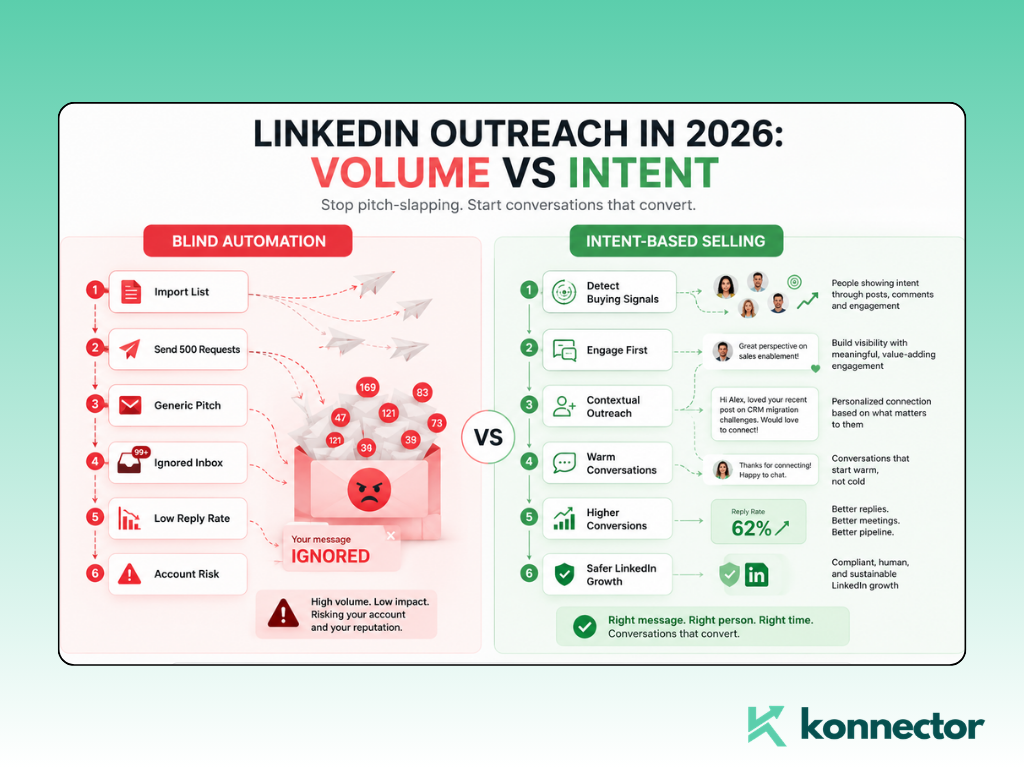
Pitch-slapping is what happens when outreach is built around the sender’s schedule rather than the buyer’s readiness. You import a list, set up an automation sequence, and fire it at everyone who matches your ICP filters — regardless of whether any of them have shown the faintest signal of interest.
The logic seems reasonable on paper. More outreach should mean more responses. But it does not work that way, and the numbers bear this out. LinkedIn®’s own data consistently shows that personalised, contextual messages outperform generic automated ones by a significant margin when it comes to reply rate. And as inboxes have become noisier, the gap has widened.
The reason is simple. People on LinkedIn® are not passive recipients. They are professionals with a limited tolerance for irrelevant interruptions. When an unsolicited pitch hits their inbox from someone they have never encountered before, the default response is to ignore it — or worse, report it.
Blind automation treats your prospect list like a broadcast channel. Intent-based outreach treats it like a set of individual conversations waiting for the right moment to start.
What is intent-based selling on LinkedIn®?
Intent-based selling means reaching out to people based on signals they have already given you — signals that indicate they are thinking about a problem you can solve, or actively evaluating options in your space.
On LinkedIn®, those signals are hiding in plain sight. Every time a prospect publishes a post about a strategic challenge, comments on content related to your category, shares an article from a competitor, or starts engaging with topics they were not engaging with three months ago — they are broadcasting intent. Most outreach teams are not listening.
LinkedIn® social selling at its best is the practice of detecting those signals and acting on them with precision and relevance. You are not interrupting someone’s day with a pitch they did not ask for. You are showing up at a moment when your message is genuinely useful.
The role of LinkedIn® social signals in modern outreach
So what exactly counts as a LinkedIn® social signal? In practical terms, it is any observable behaviour on the platform that suggests a prospect is in motion — thinking, researching, evaluating, or about to make a decision.
Some signals are explicit:
- A prospect posts about a problem your product solves
- A prospect comments on a competitor’s content
- A prospect shares an article about a challenge relevant to your category
- A prospect’s company announces a new hire in a relevant role
Some signals are contextual:
- A sudden increase in posting frequency about a particular topic
- Engagement patterns shifting toward content in your space
- Comments that reveal a strategic priority or a frustration
Individually, each signal is a data point. Together, they paint a picture of where a prospect is in their decision-making process — which is information that a static contact list simply cannot give you.
Konnector tracks these signals automatically across your target accounts, surfacing the prospects who are showing active intent so your outreach team can act on them before the moment passes. You can read more about how this works in our piece on LinkedIn® social signals.

Why tracking LinkedIn® engagement changes everything
There is a meaningful difference between knowing who your prospects are and knowing what your prospects are doing right now. Static ICP lists give you the former. Tracking LinkedIn® engagement gives you the latter.
When you can see that a VP of Sales at a target account has spent the last two weeks posting about CRM migration challenges, you do not need to guess whether your timing is right. You already know it is. Your outreach is not a cold interruption — it is a relevant response to something they have publicly expressed.
That context changes everything about how a message lands. It changes your opening line. It changes the problem you reference. It changes the reason they have for replying. And it changes your conversion rate at every stage that follows.
Konnector’s engagement tracking pulls this signal data into your prospecting workflow so that by the time you reach out, you are not introducing yourself to a stranger — you are continuing a conversation they have already started in public.
The anatomy of an intent-based outreach sequence
Intent-based selling is not just about better targeting. It changes the entire structure of how you engage with a prospect before, during, and after a connection request.

Phase 1: Signal detection
Before anything else, identify which prospects in your ICP are showing active signals. Who is posting about relevant challenges? Who is engaging with content in your space? Konnector surfaces this automatically, so your team is not manually scrolling feeds to find the right moment.
Phase 2: Warm engagement
Before you connect, engage. Leave a thoughtful comment on a post where you have something genuine to add. Not a “Great post!” — an actual perspective that extends the conversation. Done consistently over one to two weeks, this establishes name recognition and signals that you are a credible voice in the space, not a cold bot.
Konnector’s AI-assisted comment workflow drafts contextual comments based on the post content and your professional tone. You review every draft before it posts. Nothing goes live without your approval — which means your engagement stays authentic and your voice stays consistent, even at scale.
Phase 3: The connection request
Now you connect. Your request note references something specific — a post they wrote, a topic they have been exploring, a challenge they mentioned. Because they have already seen your name, this does not feel cold. It feels like a natural next step.
Phase 4: The first message
This is where most outreach fails. The first message after a connection is accepted is not the place for a pitch. It is the place for a conversation opener that acknowledges what you already know about them and asks something worth answering.
Reference the signal that triggered your outreach. Make it clear you have been paying attention. One question. No attachments. No deck. No pitch.
Phase 5: The follow-up
If they do not reply, follow up once — briefly and without pressure. If there is a piece of content genuinely relevant to what they have been posting about, share it. Make the follow-up easy to respond to and easy to ignore without feeling harassed.
This sequence is what LinkedIn® social selling looks like in practice. It is slower than blasting a list. It is also significantly more effective — and it does not damage your account or your reputation in the process.
Watch: Intent-based outreach with Konnector
Here is a closer look at how Konnector approaches LinkedIn® social selling — from signal detection through to the human-in-the-loop approval workflow.
Blind automation vs. intent-based selling: the real difference
| Dimension | Blind automation | Intent-based selling |
|---|---|---|
| Targeting | Static ICP filters | ICP filters plus live engagement signals |
| Outreach timing | Sequence-driven, calendar-based | Signal-triggered, prospect-led |
| Message personalisation | Variable field swaps | Context-specific, signal-referenced |
| Pre-outreach engagement | None | Targeted comment warm-up |
| Human involvement | Set and forget | Human review at every touchpoint |
| LinkedIn® account risk | High at volume | Low — compliant by design |
| Pipeline quality | High volume, low conversion | Lower volume, higher conversion |
Why this matters more now than it did two years ago
LinkedIn®’s algorithm has become considerably better at identifying and suppressing automated behaviour. Accounts that send high volumes of templated messages, connect with people indiscriminately, or engage with content in patterns that look non-human are being flagged, restricted, and warned at a higher rate than ever before.
At the same time, LinkedIn® users have become more discerning. The average professional on the platform today has received enough generic pitches to immediately recognise one — and immediately ignore it.
The window for blind automation producing results has closed. The teams still using it are burning through their outreach quotas to generate diminishing returns, while the teams that have shifted to intent-based approaches are building pipeline with a fraction of the volume.
This is not a minor tactical adjustment. It is a fundamental rethink of what LinkedIn® outreach is for — and how you measure whether it is working.
How Konnector is built for intent-based selling
Konnector was designed around the assumption that quality of signal matters more than quantity of sends. The entire platform — from the targeting filters to the comment workflow to the approval queue — reflects that philosophy.
Here is what that looks like in practice:
- Social signal tracking surfaces which prospects in your ICP are showing active engagement on relevant topics, so your outreach team is always working the highest-intent accounts first.
- AI-assisted comment drafts let you engage at scale without losing the contextual relevance that makes comments worth leaving.
- Human approval queues for comments and messages mean every piece of outreach has been read and approved by a human before it posts — keeping your voice authentic and your account compliant.
- Campaign analytics track which signals are producing the strongest outcomes, so you can refine your targeting criteria over time based on what is actually converting.
The result is a lead generation workflow that LinkedIn®’s systems read as human, intentional, and relationship-driven — because it is.
Ready to stop pitch-slapping and start selling with intent?
If you want to see how Konnector maps intent-based selling to your specific ICP and market, book a demo and we will walk through it together. Or if you want to get started directly, sign up here.
Further reading
- Understanding LinkedIn® Social Signals with Konnector
- LinkedIn® Lead Generation: The Konnector Approach
- Lead Generation Hacks That Actually Work on LinkedIn®
- How to Automate LinkedIn® Without Getting Restricted
- LinkedIn® Lead Generation in Europe: What Works in 2026
11x Your LinkedIn® Outreach With
Automation and Gen AI
Harness the power of LinkedIn® Automation and Gen AI to amplify your reach like never before. Engage thousands of leads weekly with AI-driven comments and targeted campaigns—all from one lead-gen powerhouse platform.
Frequently Asked Questions
LinkedIn®'s systems have become significantly better at detecting automated behaviour and restricting accounts that exhibit it. At the same time, the volume of generic outreach on the platform has trained professionals to ignore it quickly. Intent-based approaches that show genuine relevance and contextual awareness consistently produce higher reply rates and lower account risk.
Intent-based selling on LinkedIn® means reaching out to prospects based on observable signals of interest — posts they have published, content they are engaging with, or topics they are actively exploring — rather than relying solely on static ICP criteria. The goal is to make outreach relevant to where the prospect actually is, not just who they are on paper.
LinkedIn® social signals are behavioural data points that indicate a prospect is in motion. This includes posts they publish about relevant challenges, comments they leave on competitor or category content, articles they share, and shifts in their engagement patterns. These signals reveal buying intent in real time and are the foundation of effective intent-based outreach.
Tracking LinkedIn® engagement for outreach means monitoring target accounts for activity signals — what they are posting, commenting on, and engaging with — and using that data to time and personalise your outreach. Konnector does this automatically, surfacing high-intent prospects from your ICP based on their live activity so your team can act on signals before the moment passes.
LinkedIn® social selling is a human-led, signal-driven approach to building relationships and generating pipeline on the platform. Automation, in the broad sense, refers to tools that execute outreach at scale without human review or signal-based targeting. The two are not mutually exclusive — Konnector uses automation to support the social selling process, but keeps a human in the loop at every point of contact.