Most LinkedIn® automation advice focuses on volume. Send more requests. Follow up faster. Push the daily limit. And most LinkedIn® automation advice produces the same result: a 15 to 20% acceptance rate, a steady stream of ignored follow-ups, and an account that LinkedIn®’s systems are quietly flagging as suspicious.
Warm automation is the alternative. It is not a softer version of the same approach. It is a fundamentally different philosophy — one that consistently produces acceptance rates of 50%, 60%, sometimes higher. And it is the approach that separates outreach that builds pipeline from outreach that burns accounts.
What is warm automation on LinkedIn®?
Warm automation is the practice of using automated tools to build genuine familiarity with a prospect before any direct outreach begins — then layering in connection requests and messages only after that context exists.
The name captures the core idea. Traditional automation is cold by default: it sends requests at volume to people who have never seen your name. Warm automation engineers the conditions — profile views, content engagement, AI-assisted comments — that make a prospect recognise you before your connection request arrives.
By the time the invite lands, you are not a stranger. You are a name they have seen in their notifications. Someone who left a thoughtful comment on their post. A professional who has shown up in their feed with something worth reading. That shift in perception is what the acceptance rate reflects.
Why cold automation produces diminishing returns in 2026
Cold LinkedIn® automation — bulk requests, zero prior engagement, templated notes — worked well enough in 2022. In 2026, it has two problems that compound each other.
First: LinkedIn®’s Trust Score system. LinkedIn® now assigns every account a dynamic Trust Score based on engagement-to-outreach ratio, acceptance rates, and spam reports. Accounts with low acceptance rates do not just get fewer responses — they get throttled. Your daily limits shrink. Your requests get deprioritised in notification feeds. Your outreach becomes progressively less visible even when you are technically within the rules.
Second: prospects have learned the pattern. A connection request from someone they have never encountered, with a note that could have been written for anyone, is now a recognisable format. It gets ignored — not out of rudeness, but out of trained pattern recognition built from years of receiving identical messages.
| Approach | Typical acceptance rate | Trust Score impact | Account risk |
|---|---|---|---|
| Cold request, no prior engagement | 20 to 30% | Neutral to negative over time | Medium to high at volume |
| Personalised note, no prior engagement | 25 to 35% | Neutral | Medium |
| Warm automation (engagement before request) | 50 to 70% | Positive — improves Trust Score | Low — compliant by design |
Sending connection requests after engaging with a prospect’s content can push acceptance rates above 60%. Cold, context-free requests average 20 to 30% even with strong targeting. The gap is not a small optimisation. It is a structural advantage.

What does warm automation actually look like in practice?
Warm automation runs in three layers before a connection request is ever sent.

Layer 1: Profile views
Viewing a prospect’s profile is the softest signal. It shows up in their “Who viewed your profile” notifications. It is a name check — not enough on its own to build recognition, but it starts building a visibility trail. Automated profile views prime the prospect to notice the next touchpoint.
Layer 2: Post likes and follows
Liking two or three of a prospect’s recent posts adds to that trail. Their posts are being noticed. Someone is paying attention. By this point, your name has appeared in their notifications twice without any ask attached to it. Awareness is building before you have said a word directly.
Layer 3: AI-assisted comments
This is where warm automation does its most important work. A specific, contextual comment on a prospect’s post is the single most powerful warm-up action available on LinkedIn®.
Not a generic “Great insight!” — those are immediately recognisable as automated filler. A comment that engages with the actual substance of the post. One that adds a perspective, asks a relevant question, or extends the conversation the prospect started. That kind of comment signals something no volume-based tool can fake: that a real professional read what they wrote and had something worth saying about it.
When you view a prospect’s profile, like two posts, and leave one thoughtful comment before sending your invite, 60 to 70 out of 100 prospects accept — and several already recognise your name when the request arrives.
Konnector’s AI comment workflow makes this scalable. The platform surfaces relevant posts from your target accounts, drafts a contextual comment based on the actual post content — not a template, not a generic response — and holds every draft for your review before it posts. You approve it. Nothing goes live without your sign-off. The AI handles the research and the drafting. Your voice and your judgment stay in every comment that goes out.

How warm automation protects your LinkedIn® account health
Here is the part most people miss. Warm automation is not just a performance strategy. It is a compliance strategy.
LinkedIn®’s Trust Score is a direct function of your acceptance rate. An account maintaining a 55% acceptance rate is accumulating Trust Score. An account running at 18% is eroding it — quietly, incrementally, until the day it hits a threshold and finds its daily limits cut in half.
Content-first automation improves connection acceptance rates by 40 to 60% specifically because it diversifies account activity across multiple action types — views, likes, comments, requests — rather than concentrating it all on connection requests. That diversification is what makes the activity pattern look human. Because it mirrors how a professional actually networks: noticing someone’s content, engaging with it, then reaching out.
Konnector’s cloud-based infrastructure reinforces this further. Activity is randomised across varied time windows. Each account operates from its own isolated session. The send pacing is designed to stay well within safe thresholds even as campaign volume scales. You get the output of a high-volume outreach operation with the account health profile of a careful, engaged professional.
Warm automation vs. cold automation: the numbers side by side
| Metric | Cold automation | Warm automation |
|---|---|---|
| Connection acceptance rate | 20 to 30% | 50 to 70% |
| First message reply rate | 2 to 5% | 10 to 25% |
| LinkedIn® Trust Score trend | Declining at volume | Stable to improving |
| Account restriction risk | High above 50 requests/day | Low — compliance built into the workflow |
| Prospect perception on arrival | Unknown stranger | Familiar name with a track record |
The maths are unambiguous. A team sending 30 warm-automated requests per day at a 60% acceptance rate generates 18 new first-degree connections daily. The same team pushing 80 cold requests at 22% generates 17 — while actively degrading their account health in the process.
Less volume. Better results. Safer account. That is what warm automation delivers.

How to start running warm automation today
The shift from cold to warm automation does not require rebuilding your entire outreach stack. It requires adding one layer before your connection requests go out.
- Identify your target accounts using ICP filters and live LinkedIn® social signals — prospects who are actively posting about relevant challenges are your priority queue.
- Run a three to five day warm-up per prospect before the connection request: a profile view, one or two post likes, and one contextual comment where you have something genuine to contribute.
- Send the connection request with a specific note that references the post or the signal that brought you to their profile. Two sentences. No pitch.
- Let the warm-up do the work. By the time the request arrives, the prospect is not evaluating a stranger. They are deciding whether to continue a conversation that has already quietly started.

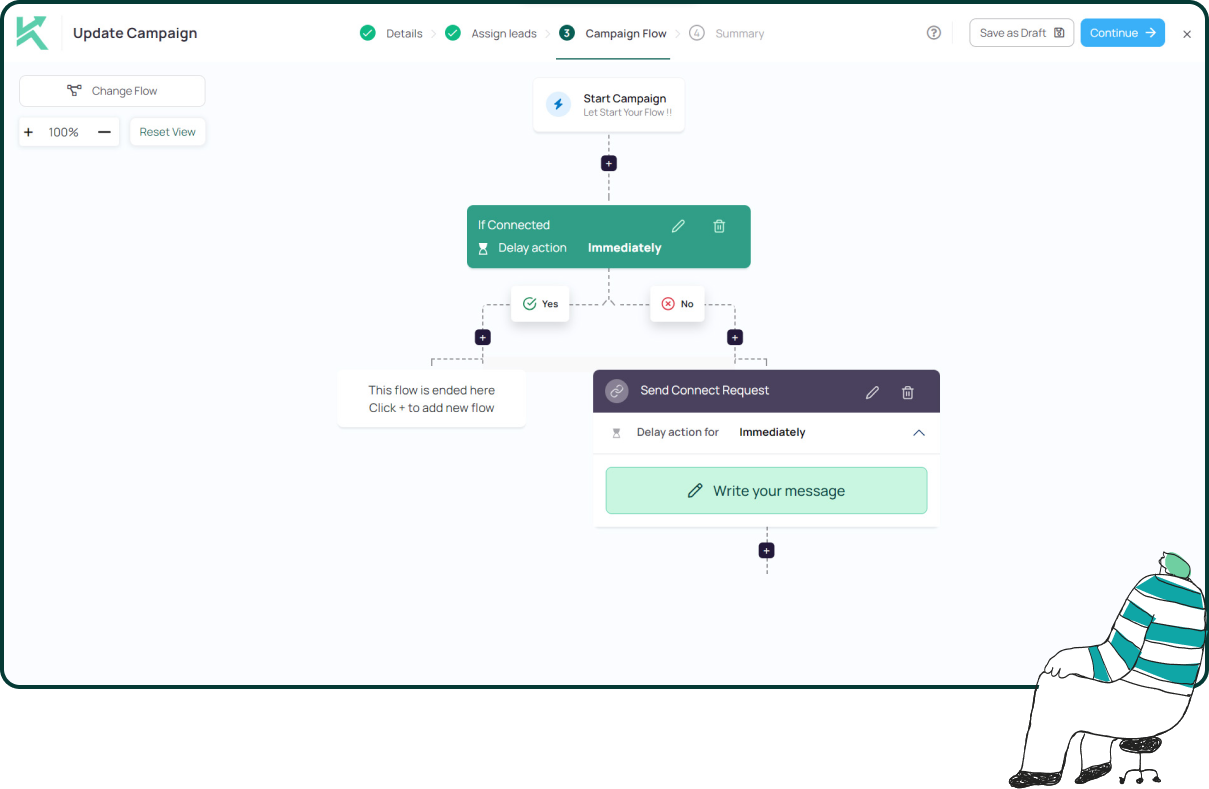
Konnector automates every step of this workflow — signal detection, profile views, post engagement, AI-drafted comments, connection requests — with human approval at the touchpoints that carry the most brand weight. Book a demo to see how it maps to your ICP and current outreach setup. Or sign up and run your first warm automation campaign today.
Further reading
- The LinkedIn® Warm-Up Protocol: How to Automate Safely in 2026
- How to Use Social Signals to Warm Up LinkedIn® Leads
- LinkedIn® Automation: Ideal Connection Request Acceptance Rate
- Safe LinkedIn® Automation in 2026: Compliance Guide
- Smart Sequences: LinkedIn® Automation with If/Then Logic
11x Your LinkedIn® Outreach With
Automation and Gen AI
Harness the power of LinkedIn® Automation and Gen AI to amplify your reach like never before. Engage thousands of leads weekly with AI-driven comments and targeted campaigns—all from one lead-gen powerhouse platform.
Frequently Asked Questions
Warm automation is a LinkedIn® outreach strategy that builds familiarity with prospects before sending connection requests. It combines profile views, post engagement, follows, and contextual comments to create recognition before direct outreach begins.
Cold automation sends connection requests without prior interaction. Warm automation creates multiple touchpoints first, helping prospects recognise your name before the invite arrives. This typically leads to significantly higher acceptance and reply rates.
Yes. Warm automation campaigns can achieve acceptance rates between 50% and 70%, compared to 20% to 30% for traditional cold outreach campaigns.
LinkedIn® uses acceptance rates as part of its Trust Score system. Low acceptance rates may reduce outreach visibility, shrink daily limits, and increase account restriction risks over time.
A typical workflow includes:
Profile views
Post likes
Following prospects
Contextual comments
Personalised connection requests
These interactions create familiarity before direct outreach begins.
They can be safe when used responsibly. Tools like Konnector.AI use AI to draft contextual comments while keeping human approval in the workflow before publishing.
Yes. Warm automation distributes activity across multiple engagement types instead of relying heavily on connection requests alone. This creates a more natural activity pattern that aligns better with LinkedIn® compliance expectations.
An acceptance rate above 50% is generally considered strong for LinkedIn® outreach campaigns. Lower rates over long periods may negatively affect account health and outreach visibility.
Most effective warm automation campaigns use a three-to-five-day warm-up period involving profile engagement and meaningful interactions before sending a connection request.
Yes. Because prospects already recognise your name and engagement history, warm automation often improves first-message reply rates compared to cold outreach workflows.