Most LinkedIn® lead generation guides tell you to optimise your profile, post consistently, and personalise your outreach. That is not advanced. That is the baseline — and everyone doing LinkedIn® lead generation in 2026 already knows it.
This guide is for teams that have the basics locked in and are asking a harder question: what separates the pipelines that compound from the pipelines that plateau?
The answer is not one tactic. It is a system — one that combines intent signals, Sales Navigator’s most underused features, account-based marketing precision, content that generates inbound, and automation that protects your account health rather than burning it. LinkedIn® drives 75–85% of all B2B leads from social media. The teams capturing the most of that are not working harder. They are operating at a different level of sophistication entirely.
The gap between average LinkedIn® lead generation and exceptional LinkedIn® lead generation is not effort. It is system design. The platform rewards teams who understand how it actually works — not teams who simply show up more often.
Why LinkedIn® Lead Generation Is More Competitive — and More Rewarding — Than Ever
Before the advanced strategies, a few numbers worth understanding. 89% of B2B marketers use LinkedIn® for lead generation, and 62% say it actively produces qualified leads. LinkedIn®’s cost per lead is 28% lower than Google Ads while delivering conversion rates twice as high as other social platforms. 41% of all B2B ad budgets now flow through LinkedIn®, with a 121% average ROAS — outperforming Google Search at 67% and Meta at 51%.
The platform is crowded. But it rewards precision in a way that no other B2B channel does. The teams losing on LinkedIn® are the ones treating it as a volume game. The teams winning are treating it as an intelligence game.
One finding from a 7,793-engagement dataset across 50+ B2B founders tells the whole story: a single niche expert with 176 total engagers produced more qualified leads than 16 other profiles combined — despite those 16 having a collective audience 14 times larger.
Reach is not the variable. Relevance is.
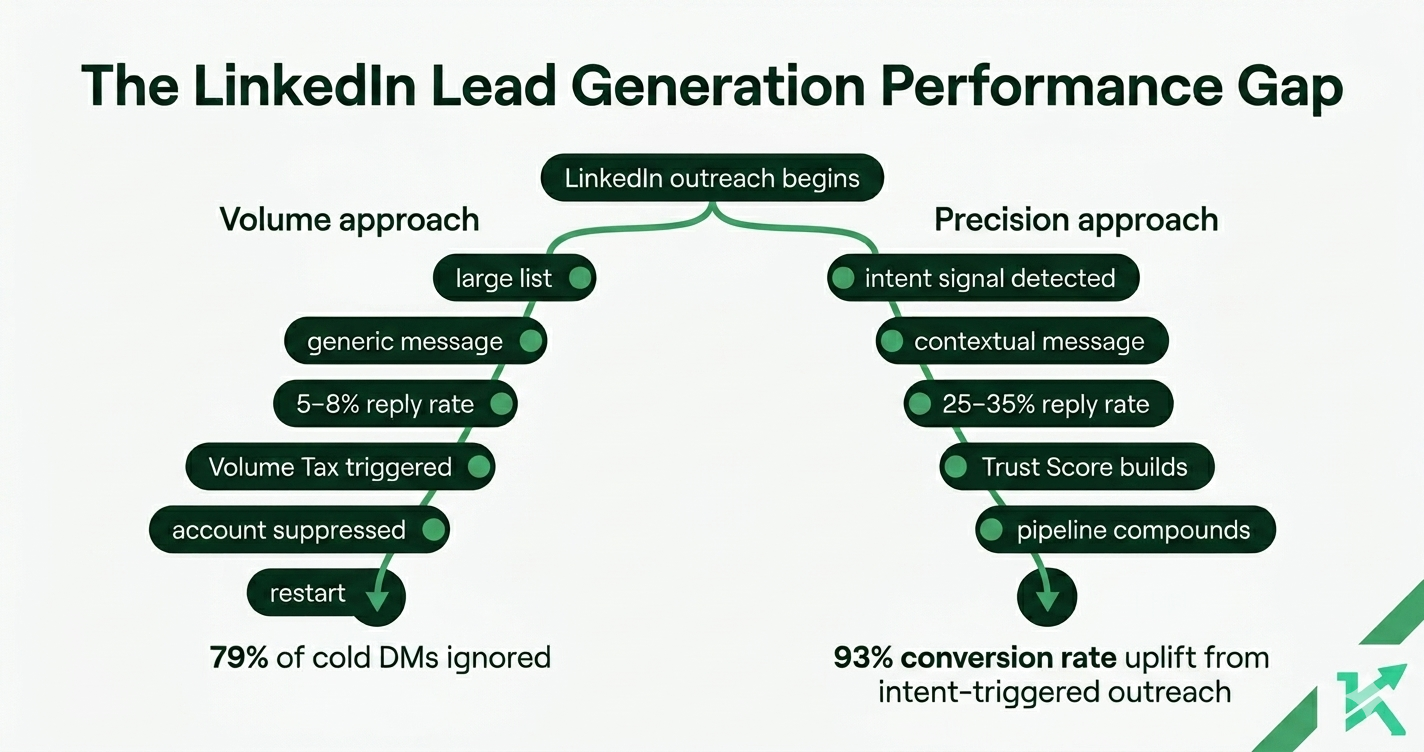
Start With Intent Signals — Not Lists
What Intent Signals Actually Are
Most LinkedIn® lead generation starts with a list. Sales Navigator search, ICP criteria applied, export, outreach sequence. The problem is that a list tells you who fits your profile. It does not tell you who is ready to have a conversation right now.
Intent signals are the behaviours that tell you a prospect is in-market — actively thinking about, researching, or experiencing the problem your product solves. On LinkedIn®, the richest intent signals are:
| Intent Signal | What It Tells You | Outreach Priority |
|---|---|---|
| Role change in last 90 days | New mandate, new budget, new vendor stack to build. People in new roles are 3x more likely to engage with outreach. | Highest |
| Posted on LinkedIn® in last 30 days | Active platform user — far higher response rate than dormant profiles | High |
| Viewed your profile | Inbound interest already demonstrated. They found you. | High |
| Engaged with competitor content | Actively in the category; evaluating options | High |
| Company funding announcement | Budget exists; growth is underway; new initiatives likely | High |
| Follows your company page | Already aware of your brand; warm context for outreach | Medium-High |
| Attended or registered for a relevant event | Declared interest in the topic; shared context available | Medium-High |
| Keyword activity in posts or comments | Currently thinking about the problem you solve | Medium |
Intent-driven outreach based on real-time engagement signals can lift conversion rates by up to 93% compared to cold, signal-free targeting. That is the gap between a list and an intelligence layer.

How to Build an Intent-Triggered Outreach System
The practical approach: stop building static lead lists and start building dynamic signal feeds.
In Sales Navigator, spotlight filters surface prospects actively engaging on LinkedIn® — “Posted on LinkedIn® in last 30 days” and “Changed jobs in last 90 days” are the two highest-converting. Save these as searches with weekly alerts so new prospects matching your ICP automatically surface in your feed.
Layer keyword monitoring on top. When a prospect posts or comments using language that maps to your category — “outreach automation,” “LinkedIn® compliance,” “sales pipeline” — that is a natural, timely reason to reach out. The message becomes obvious: reference what they said. That is not outreach. That is a conversation continuation.
Konnector.ai’s Social Signals Intelligence does this at scale — monitoring keyword activity and post engagement across your target audience in real time, surfacing the moments when your ICP is already in the conversation you want to have.
Book a demo to see which signals are already live in your ICP today.
Sales Navigator: The Features Most Teams Never Touch
Boolean Search Is More Powerful Than Most People Realise
The majority of Sales Navigator users apply basic filters — job title, company size, geography — and stop there. Sales Navigator has 50+ filters, AI-powered lead intelligence, real-time buyer signals, and intent data built in. Most people use maybe 10% of that.
Boolean search in the keyword and title fields is where precision really starts. You can exclude titles you do not want (NOT “intern” OR “student”), combine multiple target functions (VP AND “revenue operations”), and surface profiles matching very specific criteria that a dropdown filter will never find.
A practical example: targeting “Head of Growth” OR “VP of Growth” OR “Director of Demand Generation” at SaaS companies with 50–200 employees in North America, who posted on LinkedIn® in the last 30 days, and who changed jobs in the last 90 days. That single search returns a list of high-intent, active prospects who are far more likely to respond than a broad “Director+” filter ever will.
TeamLink: The Warm Introduction Engine Nobody Uses
TeamLink (available on Sales Navigator Advanced) surfaces how any prospect connects to anyone on your team — not just you. A warm introduction through a colleague consistently outperforms cold InMail by a significant margin. Before sending any cold outreach to a high-priority account, check TeamLink first. If someone on your team has a first-degree connection to your target, a warm introduction is always the better move.
4x higher engagement when a colleague makes an introduction versus cold InMail. That is not a marginal improvement — it is a different conversation entirely.
Smart Links: Turning Content Into a Live Buying Signal
Sales Navigator Smart Links let you share presentations, case studies, and proposals while tracking exactly who engaged, how long they spent on each section, and whether they forwarded it to colleagues.
When a prospect spends 40 seconds on your pricing slide or opens your proposal three times in two days, that is a buying signal. Follow up within 24 hours while the content is fresh. Without Smart Links, that moment is invisible. With it, it becomes the most perfectly timed outreach message you will ever send.
Account-Based Marketing on LinkedIn®: The Precision Play
Why ABM Changes the Lead Generation Equation
Traditional LinkedIn® lead generation is contact-level. You identify individuals, reach out, and hope the timing aligns with their buying cycle. Account-Based Marketing flips this entirely — you select a defined set of high-value target accounts and build a coordinated presence around every decision-maker inside them before you send a single message.
Most B2B purchases involve 6–10 decision-makers. If you are only reaching one of them, you are only influencing one vote in a committee. ABM on LinkedIn® means mapping the full buying committee at each target account and ensuring your content, your outreach, and your ads are visible to all of them simultaneously.
One contact at a target account is one vote. ABM means showing up for the whole committee — so by the time your sales conversation happens, you are already a familiar name across the room.
How to Execute LinkedIn® ABM
The three-layer approach that consistently works:
| Layer | What You Do | What It Achieves |
|---|---|---|
| Content layer | Publish content addressing the specific challenges of your target accounts. Reference their industry dynamics, relevant regulatory changes, or category trends. | Builds familiarity and authority before any outreach occurs |
| Engagement layer | Comment thoughtfully on posts from decision-makers at target accounts. Like and share their content. Be visible in conversations they are already having. | Creates recognition — your name appears multiple times before you message |
| Outreach layer | Personalised connection requests and DMs that reference the specific account context, a shared topic of interest, or a trigger event at the company. | Warm, contextually relevant contact rather than cold approach |
Warm audiences — people who have engaged with your content, visited your company page, or watched your videos — typically convert at 2–3x the rate of cold prospects. ABM systematically builds that warmth before the outreach ever starts.
LinkedIn® Content That Generates Inbound Pipeline
The Niche Expert Effect
The data is unambiguous: one expert profile engaging thoughtfully with 176 ICP-fit prospects outperformed 16 generic profiles working an audience 14 times larger. This is the Niche Expert Effect. Specificity of expertise, not breadth of reach, is what drives qualified inbound on LinkedIn® in 2026.
The implication for content: stop posting for reach. Post for your ICP. A post that generates 20 comments from people who match your exact buyer profile is worth more than a post that gets 500 reactions from a broad, unfocused audience.
73% of decision-makers trust thought leadership on LinkedIn® more than traditional marketing materials, and 95% of hidden decision-makers say strong thought leadership makes them more receptive to outreach. Content is not a brand-building exercise — it is the trust infrastructure that makes every subsequent outreach message land better.
The Content Mix That Converts
| Content Type | Primary Goal | Performance Signal | ICP Targeting Approach |
|---|---|---|---|
| Specific case studies with real numbers | Credibility and trust at bottom of funnel | Saves and DM shares — strongest quality signals | Reference the exact role and challenge your ICP faces |
| Contrarian takes on industry assumptions | Thought leadership and profile visits | Comment threads — especially from ICP-fit profiles | Position against the conventional wisdom your ICP is questioning |
| Data-led posts with proprietary insight | Authority building and inbound connection requests | Saves and shares to other decision-makers | Frame data around the specific metrics your ICP cares about |
| Short native video (30–90 seconds) | Dwell time and reach expansion | Watch-through rate and comments | Speak directly to a specific problem. Not a general tip. |
| Pain-point polls | Lead qualification and audience research | Vote count and comment engagement | Each answer option maps to a specific buyer segment |
Only 3% of LinkedIn® members post more than once per week. If you are consistent, you already have a visibility advantage over 97% of the platform. The only question is whether the content you are putting out is specific enough to matter to the people who need to see it.
LinkedIn® Lead Gen Forms: The Most Underutilised Paid Channel
Most teams either do not use LinkedIn® ads at all, or they run standard sponsored content and wonder why the CPL is high. LinkedIn® Lead Gen Forms are a different conversation entirely.
Lead Gen Forms pre-populate with a user’s LinkedIn® profile data, dramatically reducing friction. They achieve 10–15% submit rates on average, and 90% of B2B marketers report reduced cost per lead when using them. For comparison, the average landing page conversion rate sits at 4.02%. That is a 2–3x improvement from removing the friction of a form-fill on an external page.
The nuance: Lead Gen Forms attract convenience-driven form fills. Not all of them are high-intent. Use them for mid-funnel offers — a guide, a benchmark report, a checklist — where the value exchange justifies a quick fill. For high-value, high-consideration offers where you want additional qualification, a landing page with a longer form still serves a purpose.
The advanced play: combine Sales Navigator prospect lists with LinkedIn® Ads matched audiences. Export your refined ICP list, upload it as a matched audience, and run Lead Gen Form campaigns specifically to people already in your outreach sequence. They see your content in their feed and receive your outreach message. The dual exposure drives significantly higher conversion than either channel alone.
Automating LinkedIn® Lead Generation Without Burning Your Account
This is where most teams either leave significant pipeline on the table (by doing everything manually) or destroy their account health (by automating without understanding LinkedIn®’s detection systems).
The 2026 reality: automation is not dangerous. Bad automation is dangerous. LinkedIn®’s algorithm monitors behavioural patterns — timing precision, action intervals, session geography, engagement ratios — not just volume. A well-configured automation platform with consistent infrastructure and human-like timing is, paradoxically, more compliant than a disorganised manual approach.
The principles of safe, effective automation at scale:
| Principle | What It Means in Practice | Why It Matters |
|---|---|---|
| Signal before sequence | Only trigger automated outreach when a prospect has demonstrated a signal — a post, a visit, a role change, an event registration | Higher reply rates; lower spam report risk; protects Trust Score |
| Human approval on every message | Automation drafts; you approve before anything sends | Brand voice consistency; catches mismatches before they damage relationships |
| Non-linear timing | Variable delays that mimic purposeful human behaviour, not fixed 30-second intervals | Avoids detection as a Coordinated Activity pattern |
| Acceptance rate monitoring | Auto-reduce volume if acceptance rate drops below 20% | Prevents Trust Score damage that silently reduces future reach |
| Organic engagement alongside outreach | Posting, liking, commenting in parallel with outreach sequences | Engagement ratio monitoring — pure outreach accounts look mechanical |
Konnector.ai is built around every one of these principles by default — not as settings you need to configure, but as the architecture the platform runs on. Social Signals Intelligence identifies warm prospects. AI personalisation drafts contextual messages. Human approval gates every send. Real-time acceptance rate monitoring adjusts volume before LinkedIn® acts.
For a full breakdown of safe automation limits and compliance in 2026, see our guide on LinkedIn® automation in 2026 and our breakdown of LinkedIn® lead generation hacks that feel illegal but aren’t.
⚡ Sign Up Free → Start building a signal-based, compliance-first LinkedIn® lead generation system today.
Measuring LinkedIn® Lead Generation Like a Senior Team
Most teams track vanity metrics. Advanced teams track the metrics that predict pipeline.
| Metric | What It Measures | What to Watch |
|---|---|---|
| Connection acceptance rate | Targeting precision and profile credibility | Below 20% = fix targeting before scaling. Above 40% = expand. |
| Reply rate by channel | Message relevance and sequence quality | Below 10% = targeting or personalisation problem. 25%+ = system is working. |
| ICP-fit rate of engagements | Whether content is attracting the right audience | Only 2.9% of all LinkedIn® engagements come from ICP-fit prospects on average. Track yours separately. |
| Reply-to-meeting conversion | Quality of conversations generated | Below 10% suggests offer framing or ICP precision needs work |
| Profile visits from target accounts | Inbound interest from ABM content and engagement activity | Rising number indicates content and engagement strategy is working |
| Content saves and DM shares | Quality of content (not just quantity of engagement) | Under 360Brew, saves carry 5–10x the algorithmic weight of a like |
The teams that compound on LinkedIn® are the ones who track ICP-fit engagement, not total engagement. A hundred irrelevant likes tells you nothing. Three saves from VP-level buyers tells you everything.
The Full-Funnel LinkedIn® Lead Generation System
Pulling it all together: the advanced approach is not a collection of separate tactics. It is a system where every element reinforces the others.
Content builds the trust infrastructure and surfaces inbound signals. Signal monitoring identifies which prospects in your ICP are ready for a conversation. Sales Navigator precision ensures outreach goes to the right people at the right moment. ABM ensures that across high-value target accounts, your name is familiar before a message ever lands. Automated sequences — with human approval — run the operational layer without burning account health. And measurement tracks the metrics that actually predict revenue, not the ones that look good in a dashboard.
None of these elements work in isolation as well as they work together.
Konnector.ai is built to run this entire system from one platform — surfacing signals, drafting personalised outreach, managing sequences, monitoring account health, and keeping every public-facing action under human review. The intelligence scales. The judgment stays yours.
📅 Book a Free Demo → See how Konnector.ai’s full-stack LinkedIn® lead generation system works for your team’s ICP and outreach volume.
⚡ Sign Up Free → Start running advanced, signal-based LinkedIn® lead generation today.

Further Reading
- Best LinkedIn® Lead Generation Europe: Tools and Tactics for Cross-Border Campaigns
- 10 Proven LinkedIn® Lead Generation Strategies for Your B2B Pipeline
- AI Lead Generation: How to Build Pipeline Faster in 2026
- LinkedIn® Automation in 2026: Safe Tools, Limits and Expert Strategies
- LinkedIn® Lead Generation Hacks That Feel Illegal (But Aren’t)
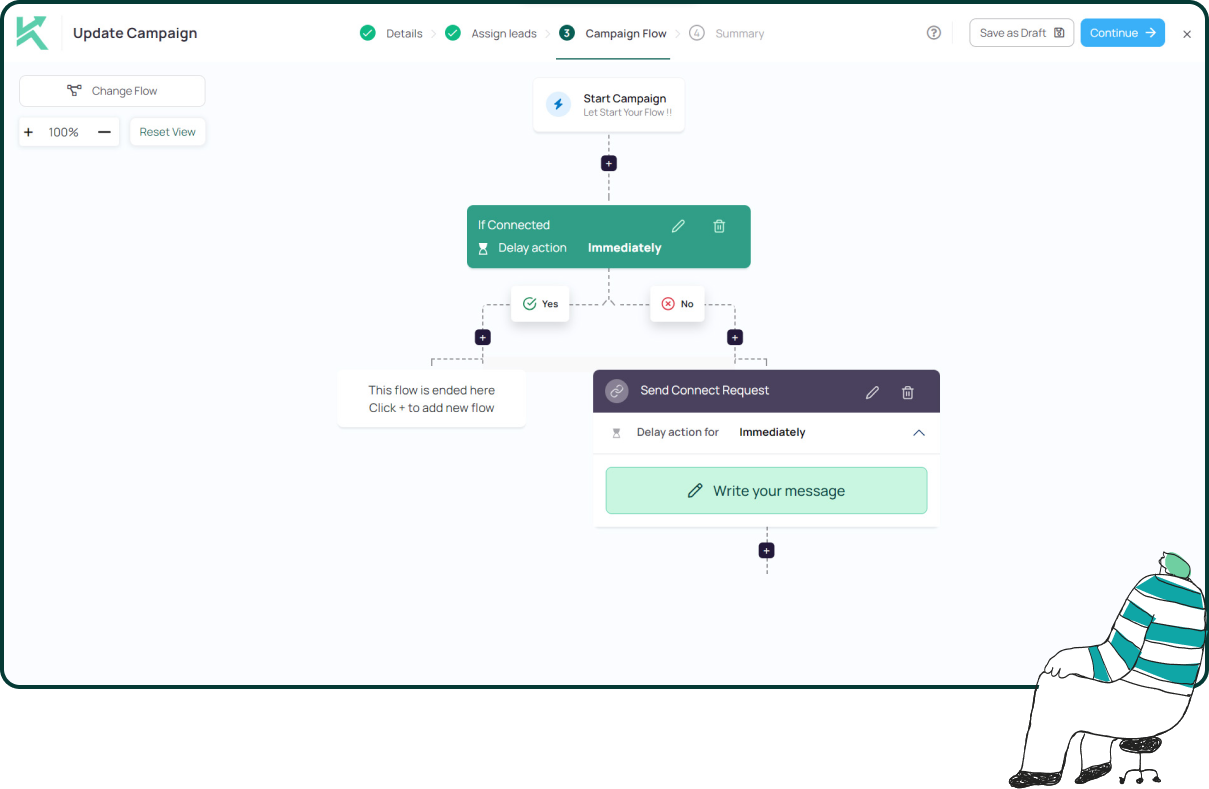
11x Your LinkedIn® Outreach With
Automation and Gen AI
Harness the power of LinkedIn® Automation and Gen AI to amplify your reach like never before. Engage thousands of leads weekly with AI-driven comments and targeted campaigns—all from one lead-gen powerhouse platform.
Frequently Asked Questions
Lead generation on LinkedIn® is the process of identifying, engaging, and converting professionals into potential customers using a combination of intent signals, targeted outreach, content, and advertising. Unlike traditional channels, LinkedIn® lead generation focuses on professional context and real-time buyer signals rather than broad demographic targeting.
LinkedIn® lead generation is more effective for B2B because it provides direct access to decision-makers, real-time intent signals, and precise targeting through tools like Sales Navigator. It also delivers higher conversion rates and lower cost per lead compared to other social platforms.
Intent signals in lead generation are behavioural indicators that show a prospect is actively considering a solution. On LinkedIn®, these include role changes, posting activity, profile visits, engagement with competitor content, and event participation.
To improve LinkedIn® lead generation, shift from list-based targeting to signal-based targeting, use advanced Sales Navigator filters, implement account-based marketing, and combine content with outreach. Tracking metrics like reply rate, acceptance rate, and ICP-fit engagement is critical.
A good connection acceptance rate for LinkedIn® lead generation is between 30–45%. If your acceptance rate drops below 20%, it usually indicates poor targeting or weak profile positioning.
A strong reply rate for LinkedIn® lead generation is 20–30%. Rates below 10% typically indicate issues with targeting, timing, or message relevance.
Account-based marketing improves lead generation by targeting entire buying committees instead of individual contacts. This increases familiarity, trust, and conversion rates across high-value accounts.
Yes, LinkedIn® Lead Gen Forms are effective because they reduce friction by auto-filling user data. They typically achieve 10–15% conversion rates, significantly higher than standard landing pages.
LinkedIn® automation is safe when implemented correctly using signal-based triggers, human approval, non-linear timing, and engagement alongside outreach. Poorly configured automation that mimics spam behaviour can damage account health.
The most important lead generation metrics are connection acceptance rate, reply rate, ICP-fit engagement, reply-to-meeting conversion, and content saves. These metrics indicate pipeline quality rather than vanity engagement.