There is a persistent myth in B2B sales that you have to choose between LinkedIn® and cold email. LinkedIn® teams swear by the targeting precision and relationship context the platform offers. Email teams point to scalability, deliverability controls, and the ability to reach inboxes directly. Both camps are right about their channel. Both are wrong about the choice.
The outbound teams consistently generating the strongest pipeline in 2026 are not choosing between channels. They are running them in deliberate coordination — using LinkedIn® automation to build familiarity and context before cold email enters the sequence, and using cold email to reach prospects at a different point in their day, through a different medium, with a different persuasion dynamic. The combination does not just add the two channels together. It multiplies their effectiveness, because each touchpoint builds on the one before it.
This guide breaks down exactly how to structure that combination — the sequencing logic, the channel-specific roles, the data architecture that keeps it coordinated, and how Konnector’s platform supports the whole workflow end to end.

Why single-channel outreach has a structural ceiling?
Every outreach channel has its own friction points, and understanding them is the starting point for understanding why multichannel sequences outperform single-channel ones.
Cold email is one of the most scalable B2B outreach channels available — but it carries significant technical overhead. Domain authentication (SPF, DKIM, DMARC), warm-up periods for new sending domains, inbox rotation to protect deliverability, and the ongoing management of bounce rates and spam complaint ratios are all prerequisites for email outreach that actually lands. Even well-executed cold email campaigns, with strong personalisation and clean lists, typically produce response rates between 1 and 5%. The channel works, but it works within constraints that require consistent investment to maintain.
LinkedIn® has the opposite problem. The platform has unmatched targeting precision — you can reach a specific seniority, in a specific industry, at a specific company stage, with a specific set of signals attached — but its outreach limits are tight. LinkedIn®’s weekly connection request limit sits at around 100 per account for standard users, and inboxes for senior professionals are increasingly crowded with outreach that never established any prior context. A connection request that arrives without prior engagement is easy to ignore.
Put those two channels in a deliberate sequence and the constraints dissolve. LinkedIn® builds the relationship context that makes the cold email feel less cold. Cold email scales the outreach past LinkedIn®’s limits and reaches prospects in a different environment. The channels cover each other’s weaknesses in a way that neither can achieve alone.
What LinkedIn® automation actually does in a multichannel sequence?
Before building the sequence, it helps to be precise about what role LinkedIn® automation plays and what it does not do. LinkedIn® automation at its best is not a replacement for human judgment or authentic engagement. It is the infrastructure that makes human judgment and authentic engagement scalable — handling the discovery, the scheduling, the drafting, and the activity management that would otherwise consume hours of manual work per day.
In a multichannel outreach sequence, LinkedIn® automation serves three distinct functions:
Signal detection and prospect prioritisation
The most valuable thing LinkedIn® automation does before any outreach begins is surface the right prospects at the right moment. A static contact list tells you who your prospects are. Real-time LinkedIn® social signals — posts about relevant challenges, comments on competitor content, new role announcements, shifts in engagement patterns — tell you which of those prospects are showing active intent right now.
Reaching out to a prospect who posted three days ago about the exact problem your product solves is structurally different from reaching out to the same prospect based on their job title alone. The signal changes the entire dynamic: your message is a relevant response to something they have expressed, not a cold interruption to their day. Konnector tracks these signals automatically across your defined ICP, surfacing high-intent prospects so your team is always working the most receptive accounts first.

Warm-up engagement before direct outreach
Once a high-intent prospect is identified, LinkedIn® automation supports the warm-up phase — the period of engagement that precedes any direct outreach and establishes name recognition before a connection request arrives. This means leaving contextual comments on the prospect’s posts, engaging with their content, and building a presence in their feed before you appear in their inbox.
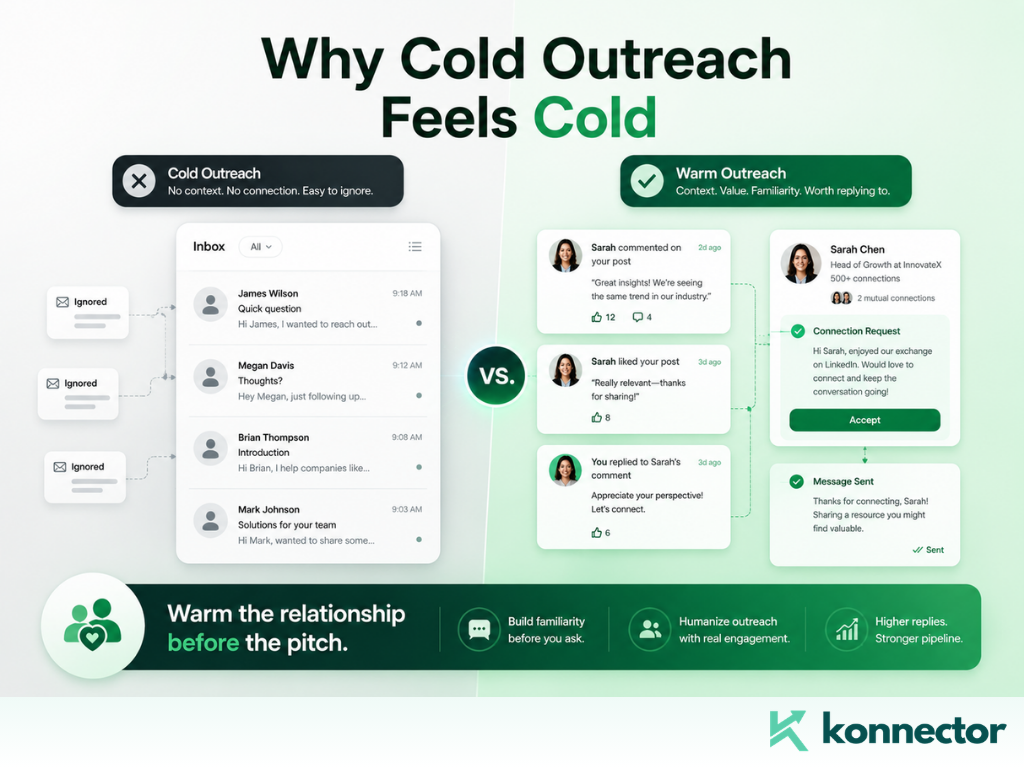
Konnector’s AI-assisted comment workflow handles this at scale. The platform drafts contextual comments based on the actual content of each post — not generic responses, but specific engagements that add perspective or extend the conversation. Every draft is held for human review and approval before posting. Nothing goes live without your sign-off, which keeps the engagement authentic and your account compliant with LinkedIn®’s guidelines.
Direct outreach sequence management
After the warm-up, LinkedIn® automation manages the direct outreach sequence: connection requests with personalised notes, first messages built around the signal context, follow-ups timed to the prospect’s activity, and re-engagement messages triggered by new signals if the initial sequence does not produce a reply. All of this runs within LinkedIn®’s safe daily and weekly limits, with activity staggered and randomised to maintain a natural-looking behaviour pattern on the account.
The sequencing architecture: step by step
A well-structured LinkedIn® and cold email sequence has a clear logic to it. Each stage has a specific job, and the transition between LinkedIn® and email is determined by what has happened in the sequence, not by an arbitrary calendar schedule.
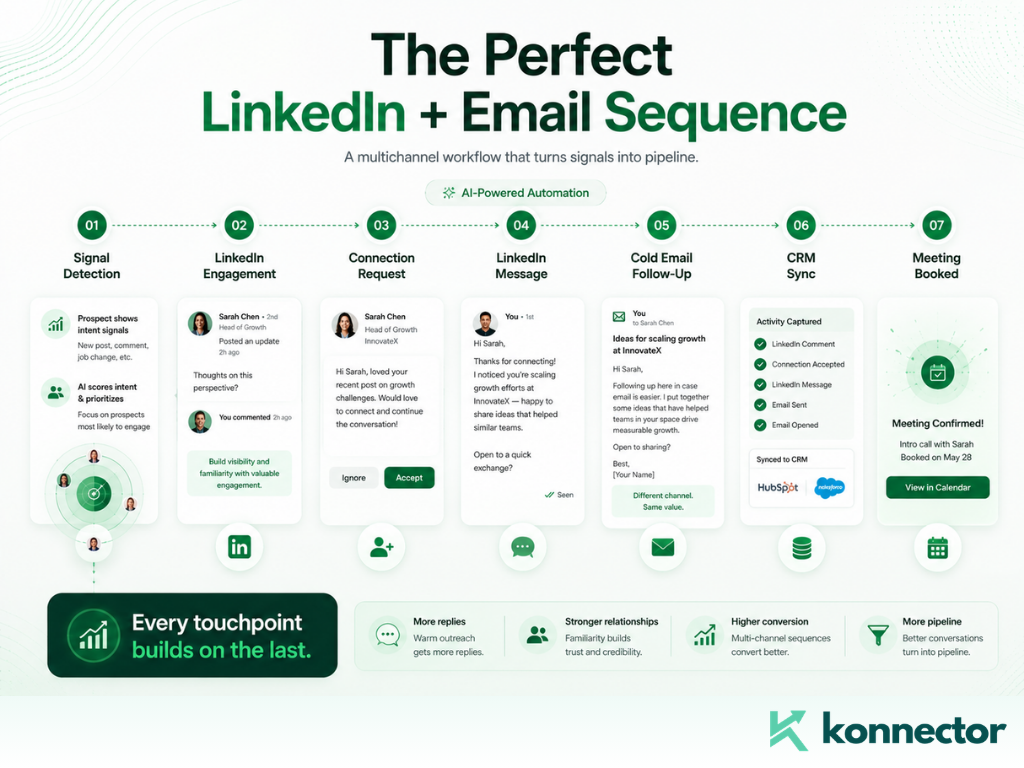
Stage 1: Signal detection (Days 1 to 3)
Identify which prospects in your ICP are showing active intent signals on LinkedIn®. Prioritise accounts where multiple signals overlap — a new role plus recent posts about a relevant challenge plus engagement with category content. These are your highest-intent targets and the ones worth investing in multichannel treatment.
Stage 2: LinkedIn® warm-up (Days 3 to 10)
Engage with the prospect’s content before any direct outreach. A thoughtful, specific comment on a post they have published puts your name in their awareness without any ask attached. Two or three comments over a week, on posts where you have something genuine to contribute, is enough to establish recognition. This step is the one most teams skip — and skipping it is the reason their connection requests feel cold even when the message is personalised.
Stage 3: LinkedIn® connection request (Days 10 to 12)
Send the connection request with a short note that references something specific — their recent post, a topic they have been exploring, a challenge they raised publicly. The note should be two sentences at most. Because the prospect has already seen your name in their comments, this does not arrive as a cold approach. It arrives as a natural next step from someone they have already encountered in their professional feed.
Stage 4: First LinkedIn® message (Days 13 to 15, post-acceptance)
Once connected, send a first message built around the signal that triggered the outreach. Reference what they posted or expressed. Ask one specific, relevant question. No pitch, no attachments, no request for a meeting at this stage. The goal is a reply, not a conversion. A prospect who replies to a first message is many times more likely to eventually take a meeting than one who receives a pitch before they have engaged at all.
Stage 5: Cold email follow-up (Days 18 to 21, if no LinkedIn® reply)
If the LinkedIn® message has gone unanswered after five to seven days, cold email enters the sequence. But this is not a cold introduction — it is a continuation of a conversation that has already started on LinkedIn®. The email acknowledges the prior connection, references the same signal or challenge that opened the LinkedIn® message, and takes a slightly different angle or offers a specific piece of value.
The prospect has seen your name in their comments, accepted your connection, and received your LinkedIn® message. The email arrives in a completely different environment — their work inbox rather than their LinkedIn® notifications — but with all that context already established. That context changes the open rate, the read rate, and the reply rate in ways that no cold email sent in isolation can match.
Stage 6: LinkedIn® and email alternation (Days 21 to 35)
From here, LinkedIn® and email alternate as touchpoints — each arriving through a different channel, each adding a new angle rather than repeating the same message in a different format. A LinkedIn® share of a relevant piece of content. An email with a specific case study. A LinkedIn® check-in triggered by a new signal from the prospect’s activity. Each touchpoint reinforces the last and keeps the sequence progressing without feeling persistent or pressured.
Stage 7: Final touchpoint and close (Day 35 to 40)
The final message — typically via email — acknowledges the full arc of the outreach, asks a clear and easy-to-answer question, and leaves the door open without applying pressure. If there is no reply after this point, the prospect moves to a monitoring list. When the next signal appears — a new post, a role change, a return to category content — the sequence restarts with fresh context.
The full multichannel sequence at a glance
| Stage | Channel | Days | Objective | Key input |
|---|---|---|---|---|
| Signal detection | LinkedIn® (automated) | 1 to 3 | Identify high-intent prospects | ICP filters plus live engagement signals |
| Content warm-up | LinkedIn® (AI-assisted comments) | 3 to 10 | Establish name recognition | Contextual comment on prospect’s post |
| Connection request | LinkedIn® | 10 to 12 | Earn the acceptance | Short personalised note, signal-referenced |
| First message | LinkedIn® | 13 to 15 | Open a conversation | Signal-based opener, one question, no pitch |
| Cold email follow-up | 18 to 21 | Re-engage via different channel | Prior LinkedIn® context, new angle or value | |
| LinkedIn® touchpoint | LinkedIn® | 23 to 26 | Keep top of mind | Relevant content share or signal-triggered nudge |
| Email deepening | 28 to 32 | Add specific value or case study | Role-specific or challenge-specific resource | |
| Final touchpoint | 35 to 40 | Soft close or pivot to monitoring | Acknowledge the arc, one clear and easy ask |
The data problem that breaks most multichannel sequences
The most common failure mode in combined LinkedIn® and email outreach is not the strategy. It is the data. LinkedIn® activity and email activity run in separate systems, and when those systems do not talk to each other, the sequence loses its coordination.
A prospect who accepted a LinkedIn® connection request yesterday should not be receiving a cold email introduction today that makes no mention of that connection. A prospect who opened an email three times without replying should be treated differently in the next LinkedIn® message than one who did not open it at all. These distinctions are only possible when both channels are feeding into the same data layer.
Konnector’s native integration with HubSpot and Salesforce solves this directly. Every LinkedIn® touchpoint — connection requests sent, messages delivered, comments posted, replies received, signal activity detected — is written automatically into the corresponding CRM record alongside email activity. Your team has a single, accurate view of every prospect’s interaction history across both channels, in real time, without manual logging.
This is what makes the sequence feel coherent from the prospect’s perspective rather than fragmented. And it is what makes attribution accurate from the revenue team’s perspective — LinkedIn®-sourced pipeline is visible, measurable, and comparable to other channels in the same reporting framework.
How intent signals improve performance across both channels?
Running a multichannel sequence without intent signals is like running it with the lights off. You are reaching out to the right type of prospect but with no information about whether this is the right moment for them. Adding LinkedIn® social signals as the trigger for the entire sequence — rather than a scheduled calendar pull from a static list — changes the performance of every stage that follows.
When the LinkedIn® warm-up comment references a topic the prospect actually posted about, the acceptance rate on the connection request rises. When the first message opens with a question tied to something they expressed publicly, the reply rate rises. When the cold email arrives with that same contextual thread running through it, the open and reply rates rise. The signal does not just improve the LinkedIn® opener — it improves every downstream touchpoint in the sequence.
Intent-based outreach applied across channels produces compounding returns because the relevance compounds. Each touchpoint that arrives in a relevant, contextual moment raises the prospect’s perception of you as someone worth engaging with — which raises the probability that the next touchpoint produces a reply.
What a compliant, scalable version of this looks like
Combining LinkedIn® automation with cold email sequences at scale raises two compliance considerations: LinkedIn®’s platform guidelines and, for teams operating in Europe or targeting European prospects, GDPR.
On the LinkedIn® side, the key principles are safe daily sending limits, human oversight at every outreach touchpoint, and activity patterns that look like a genuine professional rather than an automated system. Konnector operates within these constraints by design — cloud-based infrastructure with per-account IP isolation, randomised activity timing, human approval queues for all messages and comments, and safe sending thresholds built into the default settings.
On the email side, the technical prerequisites — domain authentication, warm-up, bounce rate management — need to be in place before any cold email sequence begins. Running email from your primary domain without authentication is the fastest way to damage your sender reputation in ways that take months to recover. You can read more about getting this right in Konnector’s cold email setup guide.
GDPR compliance for email outreach to EU prospects requires a legitimate interest basis for processing contact data, a clear opt-out mechanism in every email, and honest identification of the sender. These are not obstacles to cold email — they are the professional standard that keeps your domain reputation and your legal position clean.
How Konnector supports the full multichannel workflow?
Konnector was designed around the assumption that the most effective outreach is signal-driven, multichannel, and human-reviewed — not volume-led and fully automated. The platform connects every stage of the sequence described in this article:
- Social signal tracking surfaces high-intent prospects from your ICP in real time, so your sequence starts from a position of relevance rather than assumption.
- AI-assisted LinkedIn® automation handles warm-up comments, connection request drafts, and message sequences — each reviewed and approved by a human before posting.
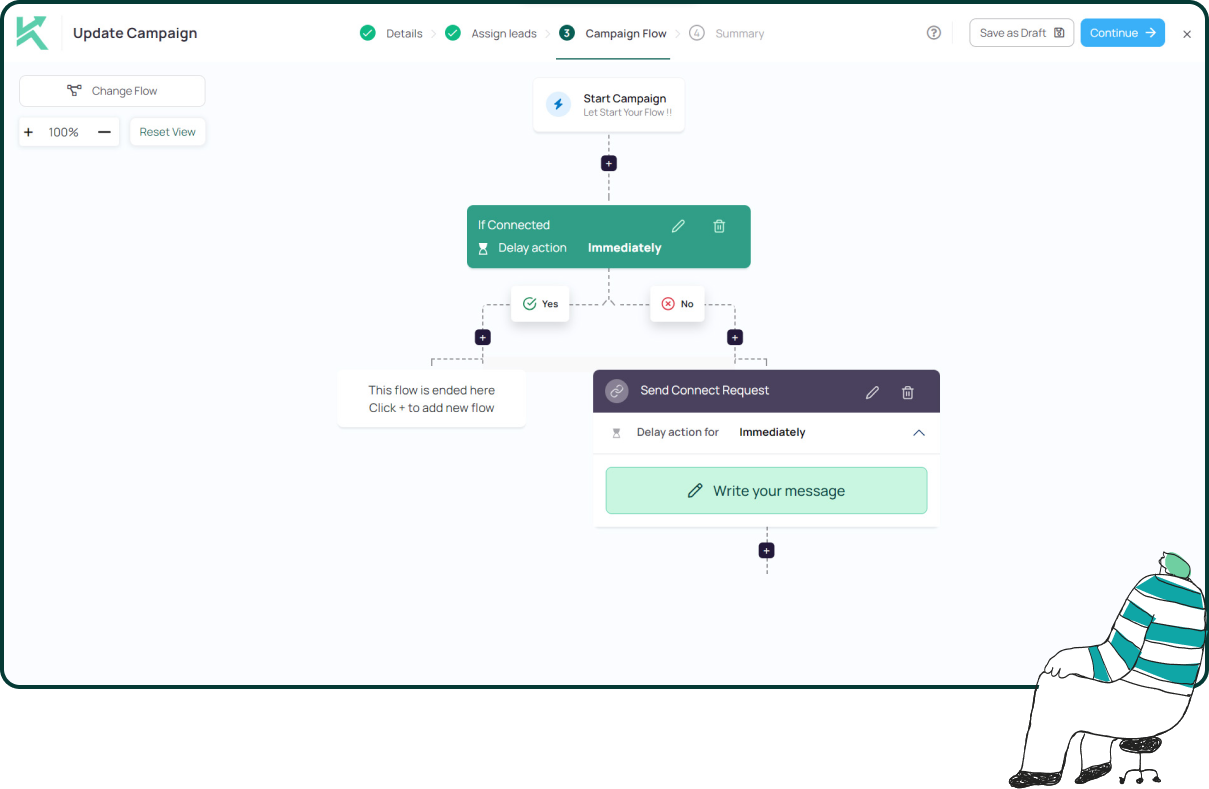
- Smart sequence logic adapts based on prospect behaviour: if connected, advance to message; if not replied within five days, trigger email; if a new signal appears, re-engage with fresh context.
- Native CRM integration with HubSpot and Salesforce keeps LinkedIn® and email activity visible in the same record, in real time, across your full pipeline.
- Campaign analytics track performance at every stage — acceptance rates, reply rates, email open and response rates — so you can identify exactly where the sequence needs refinement and act on it quickly.
The result is a multichannel outreach operation where LinkedIn® and cold email are genuinely coordinated — not two separate campaigns running in parallel, but a single coherent sequence that uses each channel at the moment it is most effective.
If you want to see how this maps to your team’s ICP and outreach motion, book a demo and we will walk through the full workflow. Or sign up and run your first coordinated LinkedIn® and email campaign today.
Further reading
- Cold Email vs Cold Calling: Which Strategy Works Best?
- Scalable Cold Email Setup: The Technical Foundation
- LinkedIn® Outreach at Scale: Automate Without Losing Engagement
- Understanding LinkedIn® Social Signals with Konnector
- Best Outbound Automation Tools for Multi-Channel Outreach
- LinkedIn® Outreach Strategy for B2B: What Works in 2026
11x Your LinkedIn® Outreach With
Automation and Gen AI
Harness the power of LinkedIn® Automation and Gen AI to amplify your reach like never before. Engage thousands of leads weekly with AI-driven comments and targeted campaigns—all from one lead-gen powerhouse platform.
Frequently Asked Questions
LinkedIn® should come first. Using LinkedIn® to establish name recognition — through content engagement, a connection request, and an initial message — means the cold email that follows is not truly cold. The prospect already has context for who you are and why you are reaching out, which changes how the email lands and improves open and reply rates compared to a cold email sent with no prior exposure.
Five to seven days after a LinkedIn® message goes unanswered is the right window before moving to email. This gives the prospect enough time to see the LinkedIn® message without the sequence going cold. When the email does arrive, it should acknowledge the prior LinkedIn® connection rather than treating the two channels as separate campaigns — because from the prospect's perspective, they are receiving outreach from the same person through different channels.
The strongest signals to trigger a full multichannel sequence are a new role announcement in a buying position, a post directly describing a challenge your product addresses, and a pattern of engagement with content in your category over a short period. These indicate active intent rather than passive ICP match. Signal stacking — acting on prospects showing multiple signals simultaneously — produces the strongest outcomes across both channels.
Use a platform that syncs LinkedIn® activity natively into your CRM rather than relying on manual logging or third-party connectors. Konnector's native HubSpot and Salesforce integration writes every LinkedIn® touchpoint — connection requests, messages, comments, replies — directly into the corresponding CRM record alongside your email activity. This gives your team full cross-channel visibility on every prospect without any manual data entry.
Consistently, yes. A multichannel sequence where LinkedIn® establishes context before cold email arrives outperforms single-channel outreach across every key metric — acceptance rates, email open rates, reply rates, and conversion to meeting. The improvement is compounding rather than additive: each touchpoint that arrives in a relevant, contextual moment raises the prospect's perception of you and increases the probability that the next touchpoint produces a reply.
Cold email to EU prospects requires a legitimate interest basis for processing contact data, a clear opt-out mechanism in every email, and honest sender identification. These are the professional standards that protect your domain reputation and your legal position. LinkedIn® outreach under GDPR follows similar principles — your outreach should be relevant, proportionate, and targeted rather than mass and indiscriminate. Konnector's platform supports compliant outreach by keeping activity human-reviewed and signal-based rather than volume-led and automated.
Most effective multichannel sequences run for 35 to 40 days and contain six to eight touchpoints across both channels. Sequences shorter than this often do not give the prospect enough time to engage at their own pace. Sequences longer than this without a response typically produce diminishing returns and risk damaging the sender's reputation on both channels. If a prospect has not engaged after the final touchpoint, move them to a monitoring list and re-engage when the next intent signal appears.