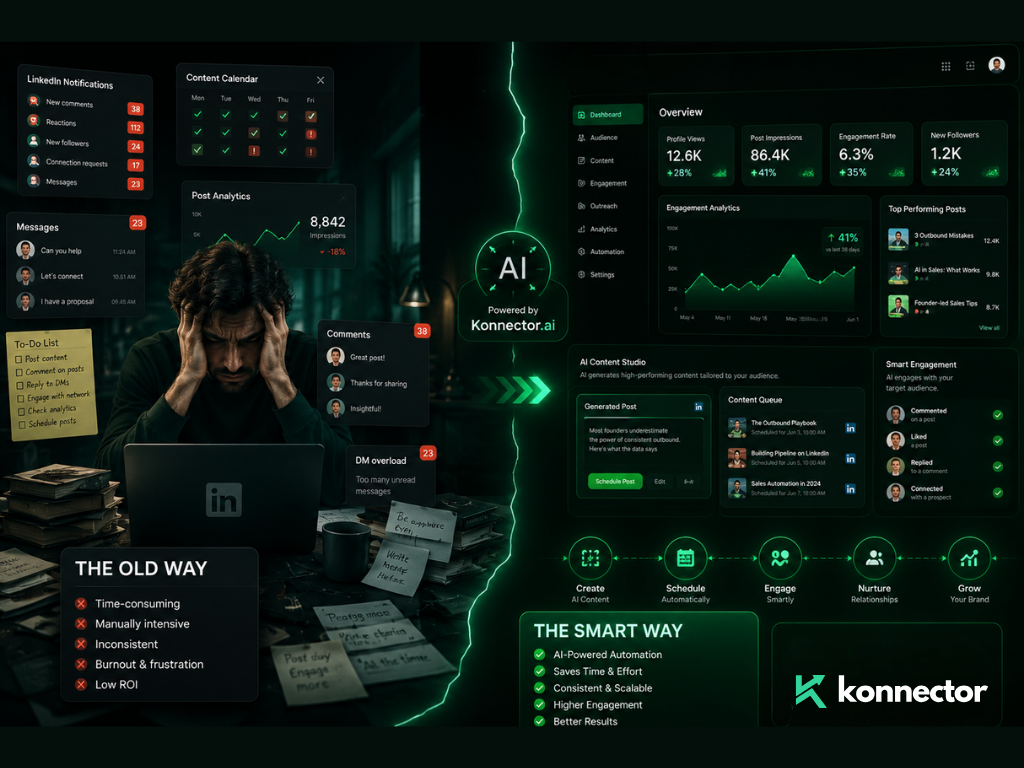
Building a personal brand on LinkedIn® sounds like a full-time job. Post every day. Comment on everything. Engage with your network. Reply to every message. Obsess over your analytics. Rinse and repeat.
No wonder most people try it for two weeks, burn out, and quietly go back to lurking.
Here is the reality: you do not need five hours a day to build a credible, visible LinkedIn® presence. You need a clear system, the right content habits, and tools that handle the repetitive work — so you show up consistently without it consuming your calendar.
This guide covers exactly how to do that.
What does “personal brand on LinkedIn®” actually mean?
Before the tactics, it is worth being precise about what you are building — because most people are optimising for the wrong thing.
A personal brand on LinkedIn® is not follower count. It is not likes per post. It is not even reach.
It is the answer to one question: when a relevant professional lands on your profile, do they immediately understand who you are, what you do, and why that matters to them?
A strong personal brand means the right people — your ICP, your potential hires, your future collaborators, your next employer — can answer yes to that question within thirty seconds. Everything else is in service of that outcome.
With that framing, a lot of what gets sold as “personal branding advice” — posting every day for the algorithm, chasing trending formats, accumulating generic followers — becomes obviously misaligned. You are not building an audience. You are building a professional reputation with a specific set of people.
Why most LinkedIn® personal brand strategies fail?
How long does it take to build a personal brand on LinkedIn®? Most people give up before they find out — not because the strategy is wrong, but because the system is unsustainable.
The failure modes are predictable.
| Mistake | What it looks like | Why it fails |
|---|---|---|
| Posting without a point of view | Sharing industry news with no original perspective | Invisible in a feed full of the same content |
| Inconsistency | Posting five times one week, disappearing for three | Algorithm suppresses dormant accounts; audience loses thread |
| Optimising for likes over relevance | Chasing trending formats regardless of fit | Attracts the wrong audience; builds vanity metrics not trust |
| Treating posting as the whole strategy | No engagement, no outreach, no commenting | Content alone does not build relationships |
| Manual everything | Writing, scheduling, engaging, tracking all done by hand | Unsustainable; quality drops when time is scarce |
The fix for most of these is not more effort. It is a better-designed system that makes consistency the path of least resistance.
Step 1: Get your profile right before anything else
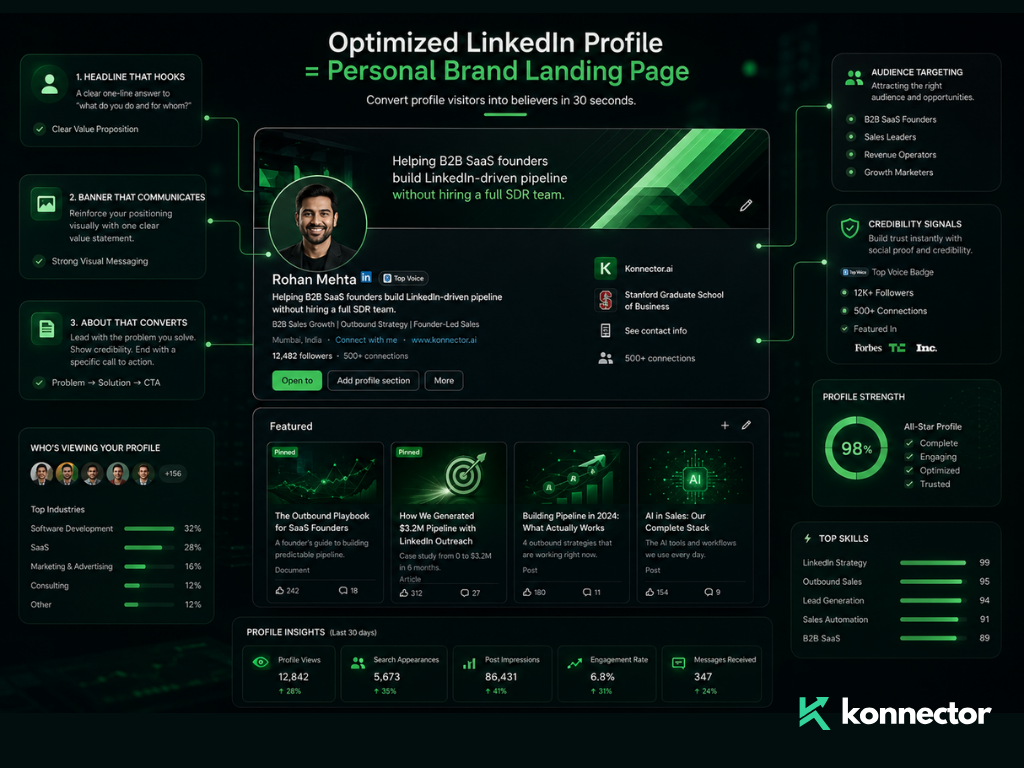
Your profile is the landing page for your personal brand. Every piece of content you publish, every comment you leave, every connection you make — it all routes people back here. If the profile does not convert a visitor into a believer within thirty seconds, everything else is working harder than it needs to.
The five elements that matter most:
- Headline: Not your job title. A one-line answer to “what do you do and for whom?” Example: “Helping B2B SaaS founders build LinkedIn®-driven pipeline without hiring a full SDR team.”
- Banner image: Reinforce your positioning visually. One clear statement. No clutter.
- About section: Two to three paragraphs. Lead with the problem you solve. End with a specific call to action. Write in first person.
- Featured section: Your three best proof points — a case study, a post that performed well, a piece of content that shows your thinking.
- Experience: Outcomes, not duties. Every role should answer “so what did you actually achieve?”
This takes two to three hours to do properly. Do it once. Review it quarterly. Everything you build after this point amplifies what the profile says about you — so make sure the profile says the right thing.
Step 2: Define your content pillars — and stick to three
Content pillars are the three to four themes your LinkedIn® presence consistently speaks to. They are the topics you are known for. The intersection of what you know deeply, what your audience cares about, and what differentiates you from everyone else posting in your space.
How do you choose your LinkedIn® content pillars? Answer these three questions:
- What could you talk about for an hour without preparation?
- What do the people you want to reach actually need to know?
- What perspective do you hold that most people in your space would push back on?
The answers become your pillars. For a B2B founder running a sales tool, that might be: outbound strategy, founder-led sales, and AI in sales development. Every post you write sits inside one of those three buckets.
This constraint is what makes content sustainable. You are not starting from scratch every time you sit down to write. You are drawing from a defined well of topics that already have depth attached to them.
Step 3: Build a content system that runs on 45 minutes a week
Most LinkedIn® advice assumes you are writing content from scratch every time you post. You should not be. The professionals building strong personal brands on LinkedIn® are running content systems — not sprinting to write something new every morning.
Here is what a sustainable weekly content system looks like.
| Activity | Time required | Frequency | Output |
|---|---|---|---|
| Weekly content batch (write 2 to 3 posts) | 30 to 40 minutes | Once a week | 2 to 3 scheduled posts |
| Comment engagement on target accounts | 10 to 15 minutes daily | 3 to 4 days a week | Visibility in relevant feeds |
| Reply to comments on your own posts | 5 minutes | Same day as posting | Algorithm boost and relationship building |
| Review analytics | 10 minutes | Weekly | Insight on what to write more of |
Total: under an hour a day on active days. Less than five hours a week, and much of that can be batched.
Batch writing is the single highest-leverage habit in LinkedIn® personal branding. Sit down once a week, write two or three posts, schedule them, and you have covered your posting cadence for the whole week without opening LinkedIn® again until your content is live.
Tools like LinkedIn® post schedulers handle the timing so you are not manually logging in to post at 8am on Tuesday. Set it, and the system runs without you.

Step 4: Write posts that people actually want to read
LinkedIn® is a professional network. But it is also a content feed. And content that gets ignored in a content feed is content that does not build a personal brand — no matter how insightful it is.
What types of LinkedIn® posts perform best for personal branding? Based on consistent patterns across high-performing accounts, these five formats work reliably.
| Post format | What it does well | Best for |
|---|---|---|
| Contrarian take | Stops the scroll, signals a point of view | Building credibility with people who think |
| Numbered list with a specific angle | Easy to scan, high share value | Reach and saves |
| Short story with a lesson | Emotionally engaging, memorable | Trust and connection |
| Behind-the-scenes or process post | Authenticity signal, differentiates from polished content | Audience warmth and DM conversations |
| Question post | Drives comments, extends algorithm reach | Community building and signal gathering |
The hook — the first one to two lines — determines whether anyone reads past it. Write the hook last, after you know what the post is actually saying. Make it specific, not clever. “Three things I got wrong about LinkedIn® outreach in my first year of running a sales team” will outperform “Thoughts on LinkedIn® outreach” every single time.
You do not need to be a professional writer to do this well. You need a point of view and the willingness to express it plainly. AI post prompts can help you structure your thinking and draft faster — but the perspective needs to come from you. That is the part that cannot be automated.
Step 5: Comment strategically — this is where the leverage is
Most people underestimate commenting and overestimate posting. Posting builds your archive. Commenting builds your visibility.
When you leave a thoughtful comment on a post by someone your target audience follows, your name appears in their feed alongside a post they were already reading. That is earned visibility — no algorithm spend, no promotion, no outreach. Just a well-timed, well-written contribution to a conversation that was already happening.
How does commenting help build a personal brand on LinkedIn®? In three ways.
- Surface you to new audiences. High-engagement posts reach people outside your network. Your comment rides that reach.
- Establish expertise before the follow. A prospect who has read three of your comments knows what you think before they visit your profile. They arrive pre-qualified.
- Warm up outreach targets. Leaving thoughtful comments on a prospect’s posts before sending a connection request consistently improves acceptance rates. You are not a stranger anymore.
The challenge is doing this consistently across twenty or thirty target accounts without it consuming your morning. Konnector’s AI-assisted comment workflow solves this directly. The platform surfaces relevant posts from your target accounts, drafts a contextual comment based on the actual post content, and holds it for your review before anything posts. You read it, adjust if needed, approve it. Nothing goes live without your sign-off.
This is the difference between personal brand building that scales and personal brand building that burns you out. The AI handles the discovery and the first draft. Your voice and your judgment remain in every comment that goes out.
Step 6: Use your content to support outreach — not replace it
A strong LinkedIn® personal brand is not just a visibility asset. It is an outreach asset.
When a prospect accepts your connection request and visits your profile, they are not meeting you cold. They are reading three months of your thinking, your takes, and your professional perspective. The posts you have been publishing are doing the work of a first conversation before the first conversation happens.
This is the flywheel that most personal brand strategies miss. Content builds context. Context reduces friction. Reduced friction improves reply rates.
Founders and sales leaders who maintain consistent LinkedIn® presence consistently report higher connection acceptance rates and better-quality first conversations than those operating without one. Content-first automation improves connection acceptance rates by 40 to 60% because it builds familiarity before the request arrives.
Your content is not separate from your outreach strategy. It is the warmest part of it.
Step 7: Track what works — and do more of it
Personal brand building without analytics is guesswork. You are producing content, but you have no idea which posts are driving profile visits, which are generating inbound messages, and which are being saved and shared by the exact people you want to reach.
The four metrics worth tracking for LinkedIn® personal branding are:
- Profile views: Are the right people finding you? Check who is viewing and whether they match your ICP.
- Post impressions per follower: A rough proxy for how well your content is resonating relative to your audience size.
- Saves and reposts: The strongest signal of content value. Saves mean someone thought it was worth returning to.
- Inbound connection requests and DMs: The downstream metric that actually matters. Are people reaching out to you because of what you are publishing?
Review these weekly. Not to obsess — to orient. One post format that generates three times the profile views of your average post is a signal worth acting on. A drop in impressions over two weeks is a signal worth investigating.

This review should take ten minutes. What you learn in those ten minutes shapes the next week’s content batch — and the compound effect of consistently improving your content quality is what separates LinkedIn® accounts that plateau from ones that keep growing.
How long does it take to build a personal brand on LinkedIn®?
Honestly? Longer than most people expect — and shorter than most people fear.
With a consistent system and two to three posts per week, most professionals start seeing meaningful traction — inbound messages, increased profile views from their target audience, recognition in their comments — within three to six months. Building to a point where the brand is doing serious commercial work, generating inbound pipeline or career opportunities without active outreach, typically takes twelve to eighteen months of sustained effort.
The variable is not talent. It is consistency. And consistency is a systems problem, not a motivation problem. The professionals who build strong LinkedIn® brands are not more disciplined than everyone else. They have better systems — which means they do not have to rely on discipline when motivation is low.
That is the whole point of the approach in this guide. Batch your writing. Automate your scheduling. Use AI assistance for commenting without losing your voice. Track the numbers that matter, not the ones that feel good. Show up consistently in the feeds of the right people — and let the compound interest of regular, relevant presence do its work.
Build your brand — without building it manually
Konnector supports the engagement and outreach side of LinkedIn® personal branding — AI-assisted comments, signal-based targeting, automated connection sequences, and campaign analytics — all with human approval at every touchpoint. Your voice stays yours. The system handles the volume.
Book a demo to see how it fits into your current LinkedIn® workflow. Or sign up and start building a presence that works while you are focused on everything else.
Further reading
- LinkedIn® AI Tools for Generating Posts and Automating Engagement
- How to Become a LinkedIn® Top Voice in 2026
- How to Automate Your LinkedIn® Posts
- LinkedIn® Post Prompt Templates for ChatGPT
- 30 LinkedIn® Hacks You Should Be Using in 2026
- How the 2026 LinkedIn® Algorithm Affects Automation
11x Your LinkedIn® Outreach With
Automation and Gen AI
Harness the power of LinkedIn® Automation and Gen AI to amplify your reach like never before. Engage thousands of leads weekly with AI-driven comments and targeted campaigns—all from one lead-gen powerhouse platform.
Frequently Asked Questions
A personal brand on LinkedIn® is your professional reputation online — how clearly people understand who you are, what you do, and why your expertise matters when they visit your profile.
Most professionals begin seeing meaningful traction within three to six months of consistent posting and engagement. Building a strong reputation that generates inbound opportunities usually takes twelve to eighteen months.
For most professionals, posting two to three times per week consistently performs better than posting daily for short periods and disappearing afterward. Consistency matters more than volume.
High-performing LinkedIn® post formats include:
Contrarian takes
Short personal stories
Numbered lists
Behind-the-scenes insights
Question-driven posts
The strongest posts combine expertise with a clear point of view.
No. A structured system with batch writing, scheduled posts, strategic commenting, and analytics reviews can keep your LinkedIn® presence active in under five hours per week.
Most LinkedIn® strategies fail because they are inconsistent, overly focused on vanity metrics, or completely manual. Posting without a clear positioning strategy or engagement system usually leads to burnout and low visibility.
Strategic commenting is one of the highest-leverage activities on LinkedIn®. Thoughtful comments increase visibility, warm up prospects, and help establish expertise before someone even visits your profile.
Yes. A strong LinkedIn® presence improves connection acceptance rates, builds familiarity before outreach, and creates warmer first conversations with prospects, collaborators, or recruiters.
The most useful metrics include:
Profile views
Post impressions
Saves and reposts
Inbound DMs
Connection requests from relevant professionals
These metrics reveal whether your content is attracting the right audience.
Yes — especially with content ideation, scheduling, engagement workflows, and comment drafting. However, the perspective, positioning, and final judgment should still come from you to maintain authenticity.