Most B2B outreach is built on a simple premise: find the right person and send them a message. The targeting is ICP-based. The timing is calendar-based. The personalisation is name-and-company-based.
It works — just not very well. And in an environment where decision-makers are receiving more outreach than ever, “not very well” is trending toward “not at all.”
Social Signals Intelligence is what replaces that premise. It is not a better version of the same approach. It is a fundamentally different starting point — one that asks not just who to reach out to, but what that person is thinking about right now, and whether this is actually a good moment to start a conversation.
What is Social Signals Intelligence?
Social Signals Intelligence is the practice of using real-time behavioural data from LinkedIn® to identify, qualify, and time B2B outreach with precision. Rather than relying on static profile data to build a list and blast a sequence, it uses live activity signals — what your ICP is posting, commenting on, engaging with, and broadcasting publicly — to surface the prospects worth prioritising right now.

The signals are not hidden. They are published daily on LinkedIn® by the professionals you are trying to reach. A VP of Sales posting about outreach quality problems. A Head of RevOps commenting on pipeline attribution content. A founder announcing a new hire in a role that suggests budget has been unlocked. Each of these is a data point that tells you something no static filter can: that this prospect is actively thinking about a problem you can solve.
Social Signals Intelligence is the infrastructure that captures those data points, interprets them, and routes the right prospects to your outreach workflow at exactly the right moment.
Why static ICP targeting is no longer enough
Static targeting has a core flaw that volume cannot fix. It tells you who to reach out to. It tells you nothing about when.

The same person who is your ideal buyer in January may have just renewed a two-year contract in December. The same company that perfectly matches your firmographic criteria may be mid-restructure and in a buying freeze. Static filters are a snapshot. Buying intent is dynamic. Treating the two as equivalent is why well-targeted outreach still produces reply rates that hover between 3 and 7%.
| Targeting approach | What it tells you | What it misses | Typical reply rate |
|---|---|---|---|
| Static ICP filters | Who matches your buyer profile | Whether now is the right time | 3 to 7% |
| Static filters + personalisation | Who matches + a name and company reference | Whether the prospect is actively engaged | 5 to 10% |
| Social Signals Intelligence | Who matches + what they are thinking about right now | Very little — outreach is triggered by evidence | 15 to 30%+ |
The difference between the first row and the third is not better copy. It is better timing — and timing is entirely a function of signal quality.
The six signals that indicate real B2B buying intent
Not all LinkedIn® activity carries equal weight as a buying signal. Some signals are loud and explicit. Others are subtle and contextual. The most effective Social Signals Intelligence frameworks distinguish between them — and act on the strongest ones first.

Explicit intent signals
- Publishing a post about a specific challenge — the prospect has named a problem publicly. Your outreach responds to something they have already put on the record.
- Asking their network for tool or vendor recommendations — active evaluation is happening right now. This signal has a shelf life of 48 to 72 hours before the conversation moves on.
- Commenting on competitor content — curiosity, dissatisfaction, or active comparison. All indicate engagement with your category.
Contextual intent signals
- New role announcement in a buying position — a new VP, Head of, or Director brings a mandate to evaluate tools and processes. The window is 30 to 90 days.
- Shift in content engagement patterns — a prospect suddenly engaging with category-specific content after months of silence is a behavioural shift worth noting.
- Company-level signals — funding announcements, new senior hires, headcount growth — all indicate organisational change that often precedes procurement activity.
The highest-confidence signal scenarios are stacked signals — when a prospect is showing multiple indicators simultaneously. A new role announcement from someone who is also posting about a relevant challenge and engaging with competitor content is not a lukewarm lead. It is your highest-priority outreach target of the week.
You can read a detailed breakdown of how to identify and act on these in Konnector’s guide to LinkedIn® social signals for high-intent B2B buyers.
Watch: Social Signals Intelligence with Konnector
How Social Signals Intelligence changes the outreach workflow
The practical impact of Social Signals Intelligence is not just better targeting. It changes the entire sequence of how outreach happens — from the first warm-up touch through to the first message and every follow-up that follows.

Before the connection request: the signal-led warm-up
When a prospect posts about a challenge your product addresses, that post is also an opportunity to warm up before any direct outreach begins. A contextual comment — one that engages with the actual substance of what they wrote, not a generic acknowledgment — puts your name in their awareness before you have asked for anything.
By the time your connection request arrives two or three days later, you are not a stranger. You are the person who said something worth reading about the problem they publicly raised. That context changes the acceptance rate in ways no personalisation token can replicate.
Konnector’s AI-assisted comment workflow surfaces these posts automatically and drafts a contextual comment based on the content — not a template. Every draft sits in a human approval queue. Nothing posts without your sign-off.
The connection request: reference the signal specifically
A connection request note written around a social signal is categorically different from a generic introduction. Compare:
“Hi Sarah — I work with VP Sales teams on outreach quality and thought it would be worth connecting.”
versus:
“Hi Sarah — your post about SDR reply rates dropping to 4% resonated. We have been working through the same problem with a few teams. Would be good to connect.”
The second message references something real. It arrives with context already attached. The prospect recognises the reference and the acceptance rate reflects it.
The first message: build on what they said, not what you sell
The first message after a connection is accepted is not the place for a pitch. It is the place to continue the conversation the signal started. Ask one specific question that builds on the challenge they raised. Make it easy to answer. Make it about them.
Konnector drafts these first messages based on the live signal data — the specific post content, the role context, the engagement behaviour — producing a message that reads as genuinely written for that individual rather than drawn from a template library. AI personalisation at this level of specificity is what closes the gap between automation and authenticity at scale.
Social Signals Intelligence and AI personalisation: how they work together
Social Signals Intelligence provides the raw material — what the prospect is doing and thinking about right now. AI personalisation converts that raw material into outreach that is specific enough to feel genuinely human.

Neither works as well without the other.
AI personalisation without signal context produces messages that are well-written but generic — varied enough not to look templated, but not grounded in anything the prospect has actually expressed. Signal intelligence without AI assistance produces a research bottleneck — the signals are there, but writing a bespoke message for each one at scale is not operationally possible.
Together, they produce what the best human SDRs produce — contextual, timely, specific messages — but at a volume no human team can sustain manually.
| Approach | Personalisation quality | Scalability | Signal-awareness |
|---|---|---|---|
| Manual outreach | High — fully human | Low — 15 to 20 prospects per day ceiling | High — if the SDR researches each prospect |
| Standard automation | Low — template-based | High — hundreds per day | None — static list, no live signals |
| Social Signals Intelligence + AI personalisation | High — signal-grounded, context-specific | High — scales without quality loss | High — live signals feed every message |
The bottom row is what Konnector is built to deliver. It is also what the outreach landscape is moving toward as the tools to make it practical become more accessible.
Measuring the impact: what Social Signals Intelligence changes in your metrics
The effect of signal-based outreach shows up across every stage of the funnel — not just reply rate.
- Connection acceptance rate: Warm-up engagement plus signal-referenced notes consistently push acceptance above 50%. Cold requests average 20 to 30%.
- First message reply rate: Signal-based openers that reference what the prospect expressed produce 15 to 30%+ reply rates. Generic first messages average 3 to 7%.
- Conversation quality: Prospects who replied to a signal-triggered message are already engaged with the problem being discussed. The quality of the conversation — and the speed of progression to a meeting — reflects it.
- Pipeline velocity: A prospect who arrived at the conversation already thinking about the problem closes faster than one who was cold-interrupted at an arbitrary moment.
- Account health: Higher acceptance rates improve LinkedIn®’s Trust Score over time — which means sustained signal-based outreach actually strengthens your account’s future sending capacity rather than eroding it.
Every metric improves because the underlying logic is better. Outreach that lands in the right moment produces better outcomes at every stage that follows.
How Konnector’s Social Signals Intelligence works in practice
Konnector monitors keyword activity, post engagement, and profile behaviour across your defined ICP continuously. When a prospect shows a qualifying signal — a post about a relevant challenge, a comment on competitor content, a new role announcement, a profile view — they are surfaced in the platform’s signal feed, prioritised by intent strength.
From there, the outreach workflow runs with the signal as its foundation.
- AI-assisted warm-up comments engage with the specific post that triggered the signal — drafted from the post content, approved by a human before posting
- Signal-referenced connection notes are generated based on what the prospect said and what they are currently engaging with
- First messages and follow-ups are personalised to the live signal context — not to static profile fields
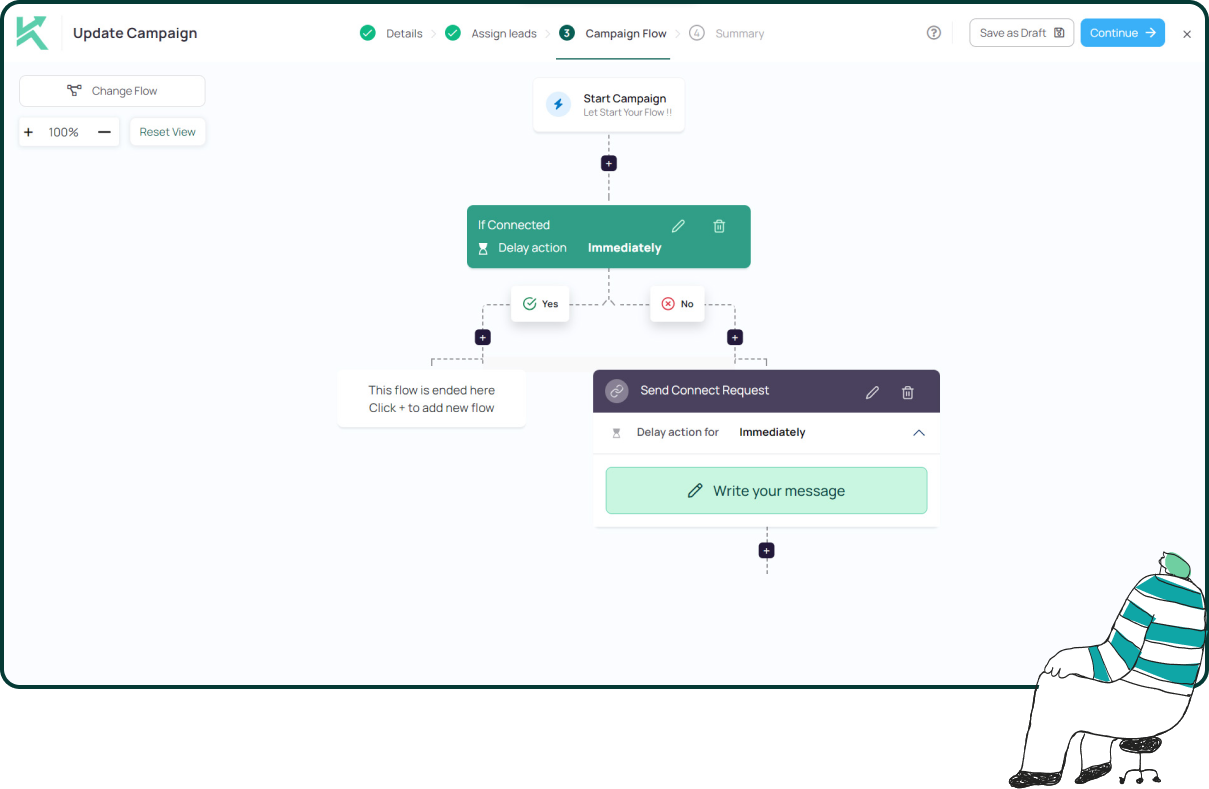
- Smart Sequences with if/then logic route each prospect based on their behaviour — so the sequence adapts as the prospect engages, ignores, or signals again
The full workflow — from signal detection to CRM sync — is covered in detail in Konnector’s guide to LinkedIn® outreach with social signals.
The teams that will win on LinkedIn® outreach going forward
As LinkedIn® inboxes continue to fill with generic outreach, the signal-to-noise ratio for anyone still running static list sequences will keep falling. The floor on cold automation performance is not stable — it is declining.
The teams that will pull away from the pack are the ones running outreach that is grounded in evidence. Prospects who have already signalled interest. Messages that respond to something real. Sequences that adapt to behaviour rather than running on a calendar. Outreach that arrives in a moment when it is relevant — not in a moment that was convenient for the sender.
That is Social Signals Intelligence in practice. And it is the architecture Konnector is built to deliver — at the scale, speed, and compliance level that B2B outreach teams actually need.
Book a demo to see how Konnector’s Social Signals Intelligence maps to your ICP and outreach workflow. Or sign up and run your first signal-triggered campaign today.
Further reading
- LinkedIn® Social Signals for High-Intent B2B Buyers
- LinkedIn® Outreach with Social Signals: The Konnector Approach
- AI Personalisation in LinkedIn® Outreach: How Konnector Does It
- Smart Sequences: LinkedIn® Automation with If/Then Logic
- LinkedIn® Outreach Strategy for B2B: What Works Now
- Tracking Social Signals: LinkedIn® Outreach for Sales Teams
11x Your LinkedIn® Outreach With
Automation and Gen AI
Harness the power of LinkedIn® Automation and Gen AI to amplify your reach like never before. Engage thousands of leads weekly with AI-driven comments and targeted campaigns—all from one lead-gen powerhouse platform.
Frequently Asked Questions
Social signals on LinkedIn® are actions professionals take on the platform, such as posting, commenting, liking, sharing content, announcing new roles, or engaging with industry discussions. These activities provide insights into what prospects are actively thinking about and can indicate buying intent.
Social Signals Intelligence is the process of tracking and analyzing LinkedIn® activity to identify high-intent prospects, understand their current priorities, and trigger outreach based on real-time engagement rather than static profile information.
Traditional ICP targeting identifies who matches your ideal customer profile, but it doesn't reveal whether they're actively interested in solving a relevant problem. Social Signals Intelligence adds timing and context, helping teams engage prospects when they are most likely to respond.
Common buying intent signals include posting about business challenges, asking for software recommendations, commenting on competitor content, announcing a new role, engaging with industry-specific discussions, and company growth events such as funding rounds or hiring initiatives.
Sales teams can use social signals to identify engaged prospects, interact with their content, personalize connection requests, and craft outreach messages that reference real challenges or topics the prospect has recently discussed.
Signal-based LinkedIn® outreach is an approach where communication is triggered by specific prospect behaviors or activities, such as posts, comments, profile views, or engagement patterns, rather than sending messages to a static list on a predetermined schedule.
AI helps analyze large volumes of LinkedIn® activity, identify meaningful signals, draft contextual comments, generate personalized outreach messages, and automate workflows while maintaining relevance and authenticity.
Social Signals Intelligence identifies what prospects are interested in or concerned about right now, while AI personalization uses those insights to create relevant, context-aware outreach messages. Together, they enable more effective and scalable engagement.
Yes. Outreach that references real-time prospect activity tends to generate higher engagement because it is timely, relevant, and connected to topics the prospect is already discussing or researching.