Direct answer: LinkedIn® no longer detects automation by counting your actions. It detects automation by analysing the pattern of your actions — timing precision, session duration, dwell time, device fingerprints, and IP consistency, evaluated together. Staying under a published numerical limit does not guarantee safety. The only outreach that scales safely is outreach built to behave like a real, varied, human session — not a faster version of one.
Here is exactly how LinkedIn®’s detection systems work, what triggers them, and how to build outreach that scales past hundreds of weekly touches without tripping a single filter.

How does LinkedIn® actually detect automation?
LinkedIn®’s detection layer evaluates several signal categories simultaneously. No single signal triggers a flag on its own — it is the combination that gets read as automated.
| Detection layer | What it monitors | What gets flagged |
|---|---|---|
| Behavioural timing analysis | Action timing precision, session duration, dwell time before clicking | Near-identical intervals between actions — mathematical consistency no human produces |
| Device and browser fingerprinting | TLS handshake signatures, JavaScript environment properties, installed plugins, hardware signals | Headless browser signatures, missing browser attributes, DOM injection from extensions |
| IP and geolocation tracking | Login location consistency, IP reputation, geographic matching to stated profile location | “Impossible travel” — logins from different countries within short timeframes |
| Engagement ratio (Trust Score) | Reply rate, acceptance rate, spam reports relative to outreach volume | High send volume paired with low engagement — read as broadcast spam, not networking |
| Activity density | How much happens in how little time — profile visits, scroll behaviour, page dwell time | Visiting 50 profiles in 5 minutes — technically possible for software, physically implausible for a person |
This is why a tool that respects numerical limits can still get flagged. Sending exactly 30 connection requests every day at precisely 9:00 AM is more statistically suspicious than sending 45 requests with natural variation spread across the day — even though the second account sent more.

What is the Volume Tax — and why does it matter more than your daily limit?

The Volume Tax is an algorithmic penalty that silently suppresses an account’s outreach visibility when reply rate falls too far below send volume — without ever restricting the login itself. Send 500 messages in a week and receive 8 replies, and LinkedIn®’s systems treat the account as a spam risk. The penalty does not announce itself. Messages still send. They simply stop landing.
This is the mechanism that makes “just stay under the limit” outdated advice. There is no published numerical ceiling that guarantees safety anymore. The system runs on a dynamic Trust Score — a reputation metric built from your engagement-to-outreach ratio over time, not a fixed daily cap you can calculate once and forget.
What are the safe LinkedIn® automation limits right now?
While there is no single published number, the following ranges represent the current safe operating bands for most accounts.
| Activity | Safe daily range | Notes |
|---|---|---|
| Connection requests | 10 to 20 per day | New accounts should stay at the lower end for the first 30 days |
| Direct messages | 50 to 100 per day | Free accounts cap lower; Premium and Sales Navigator allow more headroom |
| Profile views | 40 to 100 per day | Fewer than 80 recommended on free accounts |
| Pending connection requests | Under 500 total | A large unanswered backlog signals poor targeting, regardless of message quality |
These are operating benchmarks, not targets to hit. A study analysing 12,000 automation users across 47 different tools found that timing pattern mattered more than raw volume — accounts sending 200 requests daily with natural variation had lower restriction rates than accounts sending 50 requests with robotic, fixed 30-second intervals between actions.
Why do random delays alone no longer work?
Because LinkedIn® evaluates the distribution of the randomisation itself, not just whether delays vary. A headless tool executing every action at a mathematically generated random interval still produces a statistical signature that looks algorithmic on close inspection.
What actually passes detection is non-linear delay variation combined with natural navigation behaviour — for example, 42 seconds, then 115 seconds, then 58 seconds between actions, paired with real dwell time on pages and natural scroll patterns. The randomness has to be purpose-driven, not just mathematically random.
Watch: how Konnector builds outreach that passes detection
Does switching to cloud-based automation eliminate detection risk?
No — not on its own. This is one of the most common misconceptions in LinkedIn® automation. Moving from a browser extension to a cloud-based tool does not eliminate detection risk if that cloud tool runs headless Chrome on shared data-centre servers. It simply replaces DOM injection risk with TLS fingerprint risk, IP reputation risk, and session geography risk.
Cloud automation is genuinely safer only when it combines all of the following simultaneously:
- Dedicated residential or ISP-based IPs, geographically matched to the account holder’s actual location
- Authentic browser fingerprinting — real device configuration, not a stripped-down headless signature
- Human-like behavioural execution — non-linear timing, natural dwell time, organic session structure
- Activity confined to the account’s normal geographic pattern — no rotating IPs that trigger “impossible travel” flags
A tool that only solves the browser extension problem while running on cheap, shared, data-centre IPs has not actually reduced risk. It has relocated it.
What is the warm-up protocol for a new or automation-ready account?

Automation should never start on day one of an account, or on day one of introducing automation to an existing account. A 30-day warm-up period is the standard baseline before scaling outreach volume.
- Days 1 to 30: Manual activity only. 5 to 10 connection requests per day, genuine profile engagement, content posting and commenting. No automation tools active yet.
- Days 31 to 45: Introduce automation at the lower end of safe limits — 10 to 15 connection requests per day with randomised, non-linear delays.
- Days 46 onward: Scale gradually, increasing by roughly 10 messages per week, monitoring acceptance rate and reply rate at every step.
This builds an account history that reads as consistently human before any meaningful automation volume begins. Skipping the warm-up is the single most common reason new accounts get flagged within their first few weeks of automated outreach.
How does engagement-before-outreach reduce detection risk?
The most effective LinkedIn® automation does not start with a message. It starts with visibility. Profile views, post likes, and contextual comments 48 hours to 4 days before a connection request builds recognition without triggering resistance — and it also produces an activity pattern that looks fundamentally different from a connection-request-only sequence.
This matters for detection specifically because layered, varied action types are harder to flag than a single repeated action type at volume. An account that only ever sends connection requests, over and over, is a much simpler pattern to detect than an account that views, likes, comments, and occasionally connects — the way a real, active LinkedIn® user actually behaves.
| Action sequence | Detection risk | Why |
|---|---|---|
| Connection requests only, high volume | High | Single repeated action type is the simplest pattern to flag |
| Connection requests + generic follow-ups | Medium-high | Template repetition is detectable even with varied timing |
| Profile views + likes + comments + connection requests, layered | Low | Mixed action types mirror genuine professional browsing behaviour |
Can personalisation alone reduce detection risk?
Personalisation reduces spam-report risk and improves engagement, but it does not by itself address behavioural detection. A message personalised with a first name and company field, sent in a fixed interval pattern to 50 people, can still be detected — LinkedIn®’s systems can identify templated structure even when surface-level variables change.
Real personalisation that improves both engagement and detection resistance pulls in specific, current context — a recent post, a shared connection, a relevant signal — rather than just swapping {FirstName} into the same sentence structure repeated at scale.
How does multi-account management change the detection equation?

For agencies and teams running outreach across several LinkedIn® accounts, detection risk compounds if those accounts share infrastructure. LinkedIn®’s systems interpret multiple accounts operating from the same IP address or browser session as coordinated, inauthentic behaviour — even if each account belongs to a different real person.
The fix is per-account isolation: each account needs its own dedicated IP, its own session environment, and its own independent activity cadence. An issue on one account should never be able to affect another. This is infrastructure, not a setting — it has to be built into the platform’s architecture rather than configured manually per campaign.
What does a fully compliant automated outreach system look like end to end?
Pulling every layer above together, here is the complete picture of what scalable, detection-resistant LinkedIn® outreach requires.
- Infrastructure: Dedicated, geography-matched residential IPs per account. No shared data-centre proxies. No rotating IPs.
- Account warm-up: 30 days of manual activity before automation begins on any new account.
- Action layering: Profile views, likes, and comments mixed with connection requests — not a single repeated action type.
- Timing: Non-linear, purpose-built delay variation across an 8 to 10 hour window — not simple random number generation.
- Personalisation: Specific, current context per message — not template fields with variables swapped.
- Engagement monitoring: Continuous tracking of acceptance and reply rate, with automatic volume reduction if either drops below healthy thresholds.
- Pending request hygiene: Regular cleanup of unanswered connection requests to avoid the spam-classification trigger of a large pending backlog.
- Human approval: A review layer for AI-drafted comments and messages before they post — protecting both brand voice and account safety simultaneously.
Konnector’s architecture is built around every layer of this list — social signal intelligence to drive relevance, non-linear behavioural execution to avoid timing detection, dedicated per-account IPs to prevent multi-account linkage, and a human approval queue that keeps quality high as volume scales.
The bottom line
LinkedIn® stopped counting actions years ago. It now reads behaviour. Scaling outreach safely means building a system that behaves like a genuinely engaged professional — warmed up, varied, layered, and responsive to engagement signals — rather than a faster version of a templated send. Volume was never the variable that mattered most. Pattern always was.
Want to see this architecture running on your own ICP? Book a demo with Konnector. Or sign up and start your first compliant, scaled campaign today.
Further reading
- Safe LinkedIn® Automation: Trust Scores, Volume Tax, and Detection Layers
- Can LinkedIn® Detect Human-Like Randomized Delays?
- LinkedIn® Automation: Setup, Tools, and Detection Explained
- LinkedIn® Automation Limits: The Complete Guide
- Managing Multiple LinkedIn® Accounts at Scale
- Understanding LinkedIn® Social Signals with Konnector
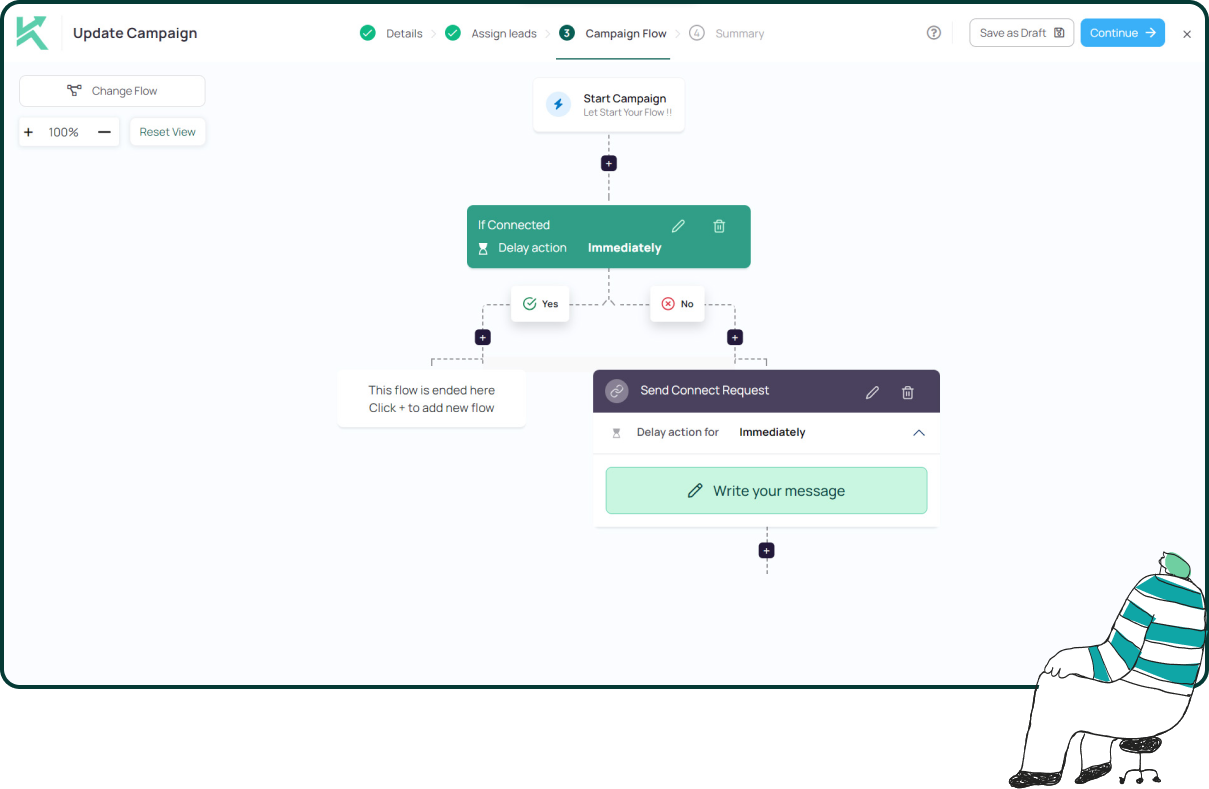
11x Your LinkedIn® Outreach With
Automation and Gen AI
Harness the power of LinkedIn® Automation and Gen AI to amplify your reach like never before. Engage thousands of leads weekly with AI-driven comments and targeted campaigns—all from one lead-gen powerhouse platform.
Frequently Asked Questions
Yes. LinkedIn® can detect automation through behavioral patterns, browser fingerprints, IP activity, session consistency, and engagement signals. Detection is based on how actions are performed rather than simply how many actions are taken.
The safest LinkedIn® automation tools focus on human-like activity patterns, dedicated IP infrastructure, natural timing variation, account warm-up, and engagement-based scaling rather than maximizing activity volume.
Most accounts operate safely within 10–20 connection requests per day, though the ideal number depends on account age, engagement rates, and overall account trust.
LinkedIn® automation is generally legal, but some automation methods may violate LinkedIn®'s Terms of Service. Users should review LinkedIn®'s policies and choose tools that prioritize compliance and account safety.
Yes. LinkedIn® can evaluate the pattern behind delays, not just whether delays exist. Simple random intervals may still appear automated, while natural, varied user behavior is harder to distinguish from genuine activity.
Not necessarily. Cloud-based automation reduces some risks but can still be detected if it relies on shared IPs, headless browsers, or unrealistic activity patterns.
Trust Score is an informal term used to describe the reputation signals LinkedIn® may associate with an account based on engagement rates, reply rates, connection acceptance rates, and overall account behavior. Higher engagement generally indicates healthier account activity.
Yes. A gradual warm-up period that includes profile activity, networking, posting, and engagement can help establish normal account behavior before introducing automated outreach.
Personalization can improve acceptance and reply rates, which supports account health. However, personalization alone does not eliminate detection risk if activity patterns remain obviously automated.
The safest approach is to isolate each account with dedicated infrastructure, separate sessions, unique activity patterns, and location-consistent access to avoid account linkage risks.