Direct answer: connection requests win on every measurable conversion metric. A real-world analysis of over 500,000 LinkedIn® outreach attempts found a 39% positive reply rate for personalised connection-based sequences, compared to 18 to 25% for InMails. Connection requests also cost nothing and grow your network permanently. InMails are a paid, finite resource — best used as a fallback, not a first move.
That is the short answer. Here is the full breakdown, including when InMails genuinely outperform connection requests, and how to sequence both for maximum B2B conversion.

Connection requests vs. InMails: the numbers side by side
| Metric | Connection requests | InMails |
|---|---|---|
| Positive reply rate | 39% (personalised sequences) | 18 to 25% |
| Cost | Free | Paid credits — finite monthly allowance |
| Network effect | Builds permanent first-degree connections | No network growth — message only |
| Acceptance lift with personalisation | 55% higher acceptance vs. generic notes | Shorter InMails (under 400 characters) outperform longer ones |
| Best use case | First touch — primary outreach channel | Fallback after unaccepted requests, or senior titles with low cold acceptance |
| Comparison to cold email | Far outperforms cold email (1 to 5% reply rate) | Also outperforms cold email — but weaker than connection requests within LinkedIn® |
The conclusion the data supports: automate connection requests first, and use InMails as your second-line strategy — not your opening move.

Why do connection requests outperform InMails in B2B outreach?

Three structural reasons explain the gap.
First, connection requests build a relationship, not just deliver a message. An accepted connection request creates a first-degree network tie. That prospect now sees your future posts, comments, and activity in their feed — extending your visibility well beyond a single message. An InMail is a one-time interruption with no lasting connection if it is ignored.
Second, connection requests carry a built-in cost signal. Accepting a connection is a small but real commitment — the prospect is letting you into their network. That commitment correlates with higher engagement on what follows. An InMail requires no such commitment, so the reply threshold is lower in both directions: easier to ignore, easier to delete.
Third, InMail fatigue is real. Senior LinkedIn® users — the exact profile most B2B sales teams target — receive a high volume of InMails from recruiters and sales reps. The channel is more saturated than the connection request inbox, which depresses average reply rates regardless of message quality.
When should you use InMails instead of connection requests?

InMails are not obsolete. They have a specific, valuable role — just not as your first move.
| Scenario | Why InMail makes sense here |
|---|---|
| Connection request unaccepted after 5 to 7 days | The prospect has not engaged — InMail offers a second channel to reach them directly |
| Senior executive or C-suite target | Cold acceptance rates on connection requests are typically lower at this seniority — InMail bypasses the acceptance gate entirely |
| Open Profile prospects | Free Open InMails can be sent without using paid credits — high-value, zero-cost opportunity |
| Time-sensitive outreach | InMail delivers immediately without waiting on connection acceptance |
The smartest B2B teams treat InMails as a precision tool — reserved for the prospects who matter most and have not responded through the primary channel.
Watch: InMails vs. connection requests explained
What does a high-converting connection-to-InMail sequence look like?

The data points to a clear sequencing logic. Here is how it plays out step by step.
- Warm up before connecting. Engage with the prospect’s content 24 to 48 hours before sending a request — a specific comment, a profile view, a like. Comment-first outreach lifts connection acceptance rates from roughly 20% to 45 to 60%.
- Send a personalised, pitch-free connection request. Reference something specific — a post, a company milestone, a shared group. Keep it under 300 characters. Personalised requests achieve a 55% higher acceptance rate than generic ones.
- Wait 5 to 7 days. If accepted, move to a value-first first message — no pitch, one specific question tied to what prompted the connection. This is where the 39% reply rate is generated.
- If unaccepted after 5 to 7 days, withdraw the request. This protects your pending invite ratio, which matters for long-term account health.
- Deploy an InMail as the fallback. Keep it under 400 characters — shorter InMails consistently produce higher response rates. Use your monthly InMail credits here, not at step one.
This sequencing conserves InMail credits for where they are genuinely needed, maximises network growth from accepted requests, and ensures no high-value prospect falls through without a second attempt.
How many follow-ups should a high-converting sequence include?
Single-touch outreach leaves significant results on the table. 80% of positive replies happen after the first message — not on it. Two to three follow-ups spaced four to five business days apart can push reply rates to 20 to 30%+ on campaigns that would otherwise stagnate at 6 to 8% with a single send.
The rule that makes follow-ups work: each message needs a new reason to exist. Repeating the same ask in different words does not move the reply rate. Referencing a new signal, sharing a different angle, or acknowledging the silence directly all perform better than a repeated nudge.
What is a good LinkedIn® connection request acceptance rate for B2B?
30 to 45% is a healthy acceptance rate for B2B connection requests. Below 20% typically signals a targeting or profile problem that needs addressing before scaling outreach volume further. Personalised, contextual notes are the single biggest lever for improving this number — contextual requests outperform generic ones by 55%.
How many LinkedIn® connection requests and InMails can you safely send per day?
Most stable accounts can safely send 20 to 40 connection requests per day and 50 to 100 direct messages to existing connections per day. Exceeding these thresholds increases the risk of triggering LinkedIn®’s spam detection systems. InMail credits are capped monthly based on your subscription tier — Sales Navigator and Premium accounts receive a fuller allowance, while Recruiter accounts have higher thresholds again, up to 500 messages per week.
| Activity | Safe daily volume | Notes |
|---|---|---|
| Connection requests | 20 to 40 per day | Personalised notes improve both acceptance and account safety |
| Direct messages to existing connections | 50 to 100 per day | Higher ceiling — no acceptance gate required |
| InMail credits | Capped monthly by subscription tier | Open Profile targeting unlocks free InMails outside this cap |
Can connection requests and InMails be automated together?

Manually managing this sequence — tracking pending requests, monitoring acceptance rates, spacing follow-ups, switching between connection requests and InMail fallbacks — across hundreds of prospects is operationally impossible without a platform built for it.
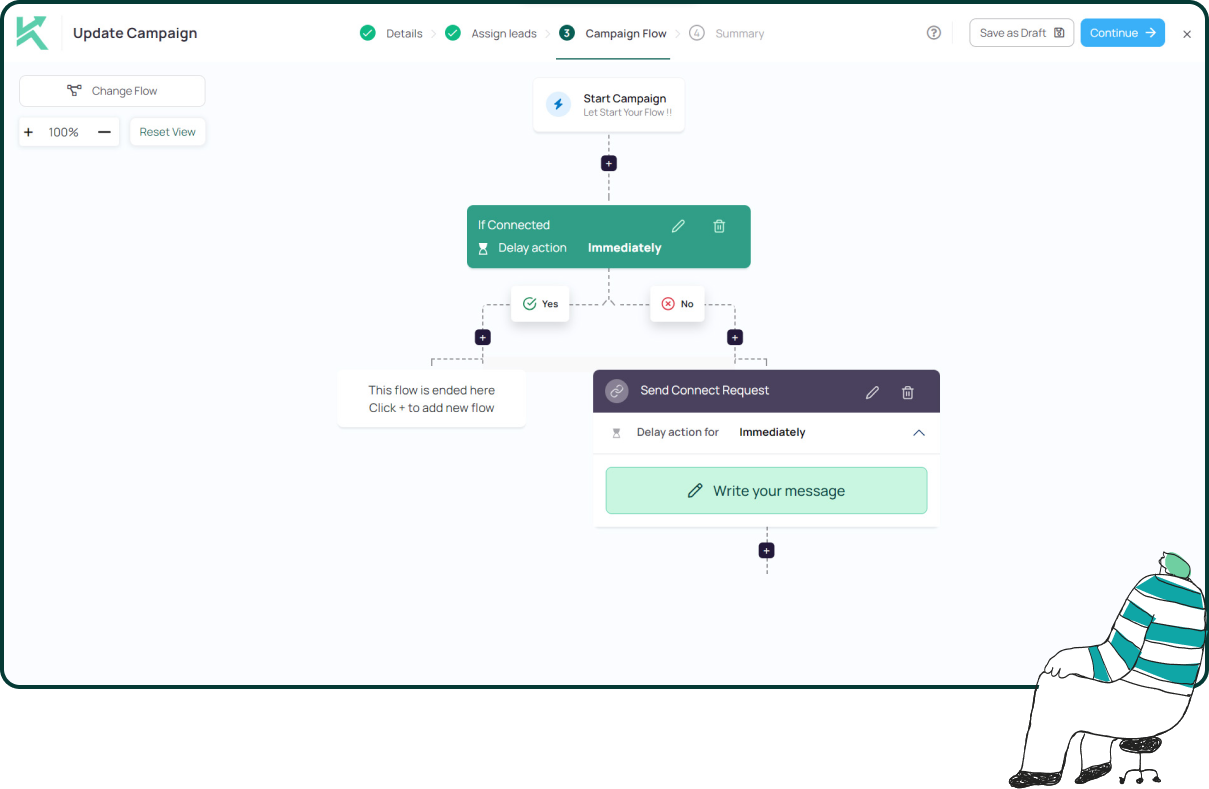
Konnector automates the full sequence: request, follow-up, and InMail fallback, all from one dashboard. The platform auto-detects Open Profiles to send free InMails without spending credits, paces connection requests to match your account’s safe threshold, withdraws stale pending invites before they hurt your reputation, and blends LinkedIn® outreach with email in coordinated multichannel sequences.
This is also where LinkedIn® social signals change the equation further — surfacing which prospects are actively engaged right now, so the connection-or-InMail decision is made on evidence rather than a blanket rule applied to every contact equally.
The bottom line
Connection requests should be your default first move. They convert better, cost nothing, and build a lasting professional network. InMails are not a weaker tool — they are the right tool for a specific job: senior prospects with low cold-acceptance rates, time-sensitive outreach, and unaccepted requests that need a second channel.
The strategy that wins is not “connection requests or InMails.” It is connection requests first, InMails as a precision fallback — sequenced automatically, so no prospect and no credit goes to waste.
Want to see this sequence running on your own ICP? Book a demo with Konnector. Or sign up and automate your first connection-to-InMail campaign today.
Further reading
- LinkedIn® Automation: InMails vs Connection Requests — Full Guide
- What Is a Good LinkedIn® Reply Rate?
- What Is the Best LinkedIn® Outreach Strategy for B2B Leads?
- LinkedIn® Weekly Connection Request Limit: Complete Guide
- Email vs. LinkedIn® Message: Which Is More Effective for Outreach?
- Automate Intent-Based Outreach: Profile Views into Pipeline
11x Your LinkedIn® Outreach With
Automation and Gen AI
Harness the power of LinkedIn® Automation and Gen AI to amplify your reach like never before. Engage thousands of leads weekly with AI-driven comments and targeted campaigns—all from one lead-gen powerhouse platform.
Frequently Asked Questions
In most B2B outreach scenarios, yes. Connection requests typically generate higher positive reply rates, cost nothing to send, and create a lasting first-degree network connection. InMails are generally most effective as a secondary outreach channel rather than a first touch.
Most studies place LinkedIn® InMail response rates between 18% and 25%, although results vary based on targeting, message quality, industry, and seniority level.
A healthy B2B connection request acceptance rate is typically between 30% and 45%. Highly targeted, personalised outreach campaigns can achieve acceptance rates above 50%.
Yes. If a connection request remains pending for 5 to 7 days, an InMail can serve as an effective second touchpoint, particularly for high-value prospects or decision-makers.
No. Standard LinkedIn® connection requests are free, making them one of the most cost-effective outreach methods available. InMails, on the other hand, require Premium, Sales Navigator, or Recruiter subscriptions and consume monthly credits.
InMails often perform better when targeting senior executives, reaching Open Profile users, handling time-sensitive opportunities, or contacting prospects who have not accepted a connection request.
Shorter InMails generally perform best. Messages under 400 characters tend to achieve higher response rates than lengthy, sales-heavy outreach.
Yes. Modern LinkedIn® outreach platforms can automate connection requests, follow-ups, pending invitation management, and InMail fallback sequences while maintaining safe activity limits.
A proven sequence is: engage with a prospect's content, send a personalised connection request, follow up after acceptance, and use an InMail only if the request remains unaccepted or the prospect is strategically important
For many B2B audiences, LinkedIn® outreach delivers higher engagement rates than cold email. While cold email campaigns often achieve reply rates in the low single digits, personalised LinkedIn® outreach frequently generates substantially higher response and conversation rates.
Most accounts can safely send 20 to 40 targeted connection requests per day. Focusing on relevance and personalisation is generally more effective than maximising volume.
Yes. LinkedIn® Open Profiles allow users to receive messages from anyone on LinkedIn®, often without consuming InMail credits, making them valuable targets for outreach campaigns.