
Most outreach sequences are built backwards. The structure gets decided first — five touchpoints, three days apart, standard follow-up cadence — and the content gets poured into that structure afterward. The reply rate reflects the order of operations.
A high-reply sequence is built the other way around. Every step earns its place because it serves a specific purpose at a specific moment in the prospect’s attention. Nothing is there because “that’s how sequences work.” Here is how to build one properly.

What actually makes a sequence get replies?
A high-reply sequence is relevant before it is persistent. Relevance comes from two things working together: timing and specificity. Timing means reaching out when the prospect is already thinking about the problem you solve. Specificity means the message responds to something real about them — not a templated field swap.
Persistence without relevance is just noise repeated on a schedule. The sequences that consistently pull 15 to 30%+ reply rates are not the ones that follow up the most. They are the ones that earn a reply at every single touchpoint — not just the last one.
Step 1: Start from a signal, not a list
The first decision in building a high-reply sequence happens before you write a single message. Who you are reaching out to, and why now, matters more than what you say.
A static ICP list tells you who matches your buyer profile. It tells you nothing about whether this is a good moment to reach out. A prospect who posted yesterday about the exact problem you solve is in a completely different position than the same prospect six months from now, with no recent activity.
Social intent signals — new role announcements, posts about relevant challenges, comments on competitor content — are what tell you which prospects are worth sequencing right now. A sequence built on signal-triggered timing starts with an advantage no amount of clever copywriting can replicate.
Step 2: Warm up before the first direct touch
The single biggest lever in a high-reply sequence is not in the sequence itself. It is what happens before the sequence starts.
A connection request sent to someone who has never seen your name converts at 20 to 30%, even with a personalised note. The same request sent after your name has already appeared in their notifications — through a profile view, a post like, or a genuinely thoughtful comment — regularly exceeds 50%.
The warm-up sequence does not need to be elaborate. Three light touches over three to five days is enough:
- View the profile — a soft, zero-friction first impression
- Like one or two recent posts — builds a visibility trail
- Leave one specific, contextual comment — engages with the substance of what they actually said
By the time your connection request lands, you are a familiar name, not a stranger. That recognition is doing work no opening line can do on its own.

Step 3: Build the connection note around the signal
The connection note is not the place for an introduction. It is the place to reference the specific thing that brought you to this prospect’s profile.
Compare these two notes:
“Hi Daniel — I help RevOps leaders streamline their outreach stack. Would love to connect.”
versus:
“Hi Daniel — your post on attribution gaps between LinkedIn® and email outreach was sharp. We’ve been seeing the same pattern with a few teams. Would be good to connect.”
The second note references something real. It does not ask for anything — it simply proves you read what they wrote. That is the entire job of a connection note in a high-reply sequence.
Step 4: Make the first message earn a reply, not a meeting
This is where most sequences fail. The first message after a connection is accepted pivots straight into a pitch — and the reply rate collapses immediately.
The goal of the first message is a reply. Nothing more. Reference the signal that triggered the outreach. Ask one specific question that builds on what the prospect already expressed. No product mention. No deck. No request for fifteen minutes.
A prospect who replies once — even with a short, low-commitment answer — is in a fundamentally different pipeline position than one who has been silently sequenced through three identical touchpoints. One genuine reply is worth more than five ignored sends.
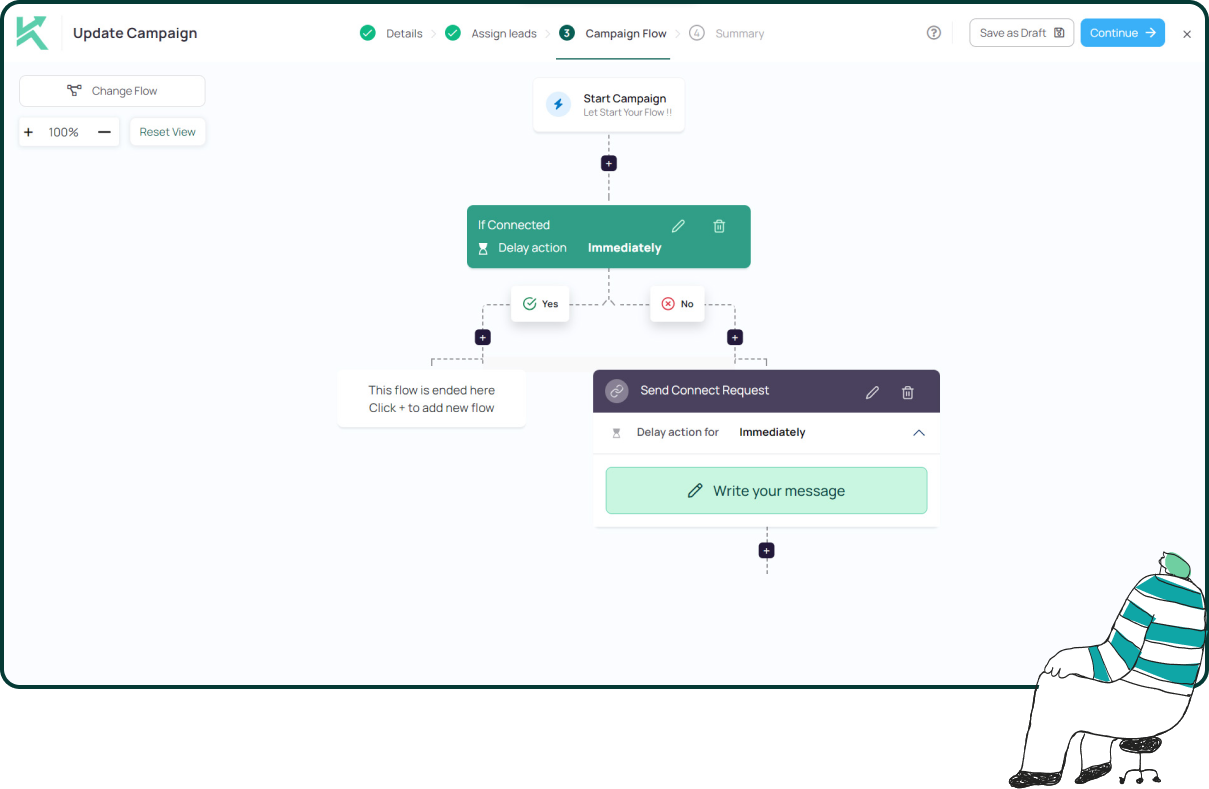
Watch: building outreach sequences with Konnector
Step 5: Let follow-ups respond to behaviour, not the calendar
A static follow-up sequence sends the same message on the same schedule regardless of what the prospect actually did. A high-reply sequence adapts.
| What the prospect did | What the sequence should do | Timing |
|---|---|---|
| Accepted connection, no reply to first message | Follow-up with a new angle — reference the acceptance | Day 5 to 7 |
| Viewed your profile after receiving a message | Timely follow-up while interest is live | Within 24 hours |
| Replied to any message | Pause automation — human takes the conversation | Immediate |
| Posted a new signal during the sequence | Re-engage with fresh context, not a stale thread | Within 48 hours of the post |
| No engagement after the full sequence | Move to a monitoring list — re-enter on the next signal | After final touchpoint |
This is what behaviour-triggered automation actually buys you. Not less effort — better-timed effort. The sequence does the tracking. You respond to the conversations that are actually moving.

Step 6: Write every message like a human read the last one
The single biggest tell that a sequence is automated is when each message ignores what happened in the one before it. A high-reply sequence reads like a continuous thread, not five disconnected sends.
Every message should reference, build on, or acknowledge what came before — the connection, the first question, the silence, the new signal. Continuity is what makes five touchpoints feel like one conversation instead of five separate interruptions.
This is where well-structured AI prompts make the difference between a sequence that sounds templated and one that reads like a person paying attention. The prompt needs the full context — what stage the prospect is at, what they have already been told, what they have or have not responded to — not just a name and a company field.
The high-reply sequence at a glance
| Stage | Purpose | What makes it high-reply |
|---|---|---|
| Signal detection | Identify the right prospect at the right time | Timing precedes targeting |
| Warm-up | Build familiarity before the ask | Name recognition before the connection request |
| Connection note | Earn the acceptance | References the specific signal — no pitch |
| First message | Open a real conversation | One question, no product mention, goal is a reply |
| Follow-ups | Stay relevant as the prospect’s behaviour changes | Adapts to action, not a fixed calendar |
| Tone and continuity | Feel like one conversation, not five sends | Each message builds on the last |

Why this approach compounds over time
A high-reply sequence is not just a better version of the same outreach. It changes your account’s trajectory. Higher acceptance rates and reply rates improve LinkedIn®’s read on your account — which protects your sending capacity for every future campaign rather than eroding it.
This is the foundation of what intent-based selling looks like in practice — outreach that responds to evidence instead of running on a schedule. And it is the same logic behind every effective LinkedIn® outreach strategy that consistently outperforms volume-based sending.
Build your next sequence the right way
Konnector handles every layer of this — signal detection, AI-assisted warm-up with human approval, signal-referenced connection notes and first messages, and Smart Sequences that adapt to behaviour instead of a fixed calendar.
Book a demo to see how a high-reply sequence maps to your ICP. Or sign up and build your first one today.
Further reading
- LinkedIn® Outreach Strategies for Sales Teams
- LinkedIn® Automation and Cold Email: Building the Right Sequence
- Prompt Engineering for LinkedIn® Outreach
- Intent-Based Selling on LinkedIn®: The Konnector Approach
- Understanding Social Intent Signals with Konnector
11x Your LinkedIn® Outreach With
Automation and Gen AI
Harness the power of LinkedIn® Automation and Gen AI to amplify your reach like never before. Engage thousands of leads weekly with AI-driven comments and targeted campaigns—all from one lead-gen powerhouse platform.
Frequently Asked Questions
A high-reply LinkedIn® outreach sequence is a series of personalised touchpoints designed to start meaningful conversations rather than push immediate sales pitches. It focuses on relevance, timing, and engagement to generate consistent replies from prospects.
Most outreach sequences fail because they prioritise persistence over relevance. Sending multiple follow-ups without context or personalisation often results in prospects ignoring the messages altogether.
You can increase response rates by personalising messages, engaging with prospect content before reaching out, referencing relevant signals, and focusing on starting conversations rather than immediately pitching your product or service.
Social intent signals are prospect activities that indicate potential buying interest or relevance. Examples include job changes, posts discussing business challenges, company announcements, content engagement, or interactions with competitor content.
No. The most successful LinkedIn® Outreach Strategies focus on relationship-building first. Engaging prospects before introducing a sales conversation typically leads to higher reply and conversion rates.
Timing is often more important than messaging. Reaching out when a prospect is actively discussing or experiencing a problem you solve significantly increases the chances of receiving a reply.
Social intent signals are prospect activities that indicate interest, change, or opportunity. Examples include job changes, company growth announcements, posts about business challenges, content engagement, or interactions with competitor content.
Yes. Viewing a prospect's profile, engaging with their content, and leaving thoughtful comments can increase familiarity and improve connection acceptance rates before direct outreach begins.
Yes. LinkedIn® automation tools can help manage connection requests, follow-ups, prospect tracking, and campaign execution. However, successful automation still relies on personalised messaging and human oversight.
A strong connection request note should reference a specific signal, such as a recent post, comment, achievement, or industry insight. The goal is to demonstrate relevance, not to pitch a product or book a meeting.
The goal of the first message should be to earn a reply, not schedule a meeting. Asking a thoughtful question related to the prospect's interests or recent activity often generates better engagement than a direct sales pitch.
Most successful LinkedIn® outreach sequences contain four to six touchpoints. However, the effectiveness of the sequence depends more on relevance and timing than the number of messages sent.